Back to deals
Marketing & SEOLifetime Deal

AI Mentions Lifetime Deal: buy or skip?

A potentially economical research tool for teams prepared to inspect the underlying answers and act on accurate findings. It measures selected responses, not all customer conversations, and it cannot promise rankings, recommendations or sales.

Product overview

What AI Mentions does

AI Mentions organizes repeated brand-related questions, answer history and follow-up ideas. Its strongest use is a consistent research routine that reveals inaccurate product descriptions or missing information worth investigating.

This assessment uses public product pages and primary provider documentation checked October 24, 2026. No private account, paid prompt run or marketing experiment was operated. The $59 discounted listing and $99 direct offer are distinct purchase routes, with external usage costs to consider.

Read the full AI Mentions review

Best for

  • Marketers with a defined buyer-question set and time to review evidence
  • Small teams comparing repeated model responses without enterprise reporting requirements
  • Agencies able to explain sample scope and separate visibility observations from commercial results

Why we picked it

  • Organizes repeated questions and changes in saved answers
  • Connects citation research with proposed editorial follow-up
  • Separates the software purchase from provider usage spending

Check before buying

  • Inspect raw answers for a small stable prompt set and verify brand matches, citations, model identity and market settings manually.
  • Estimate monthly model and search usage, confirm license limits, and test what happens when a provider allowance is exhausted.
  • Record one useful content correction and evaluate later observations without treating a changed score as proof of causation.

Buy if

You have specific buyer questions and can keep a stable, relevant monitoring sample over time.

Verify first

Inspect raw answers for a small stable prompt set and verify brand matches, citations, model identity and market settings manually.

Skip if

You expect the tool to reveal every private customer conversation with an AI assistant.

SoftScout sends you to the source after the risk checks, so you can verify live terms before buying instead of trusting stale coupon text.

Check Source Offer

Source transparency

Source
Source marketplace
Link type
Source page
Last checked
Oct 24, 2026

Buyer checklist

  • Inspect raw answers for a small stable prompt set and verify brand matches, citations, model identity and market settings manually.
  • Estimate monthly model and search usage, confirm license limits, and test what happens when a provider allowance is exhausted.
  • Record one useful content correction and evaluate later observations without treating a changed score as proof of causation.

AI Mentions: the buying decision

AI Mentions combines repeatable brand-answer sampling, answer history and proposed follow-up work under a bring-your-own-key model. Its practical distinction is turning a scattered collection of manual AI searches into a reviewable research process, provided users understand exactly which responses and markets are being measured.

Research-based review, not a hands-on test. Sources checked on 2026-10-24. The assessment below is our editorial judgment, not a customer rating. Editorial assessment: 74/100.

Consider it if

  • You have specific buyer questions and can keep a stable, relevant monitoring sample over time.
  • A demonstration shows usable raw answers, configuration details and exports rather than only a headline score.
  • The reports lead to factual corrections or useful content work at a lower complete cost than your existing process.

Skip it if

  • You expect the tool to reveal every private customer conversation with an AI assistant.
  • You need guaranteed recommendations, rankings or revenue improvement from buying a monitoring license.
  • You cannot confirm brand limits, account permissions, data handling or the recurring cost of your required sampling plan.
Problem fit: 18/20
Repeatedly inspecting how models describe a brand is a concrete research task, especially when inaccurate information or missing buyer explanations can be corrected.
Capabilities: 16/20
The public feature set covers answer history, source analysis and follow-up work, but detection accuracy and complete account-level access remain unverified.
Workflow fit: 16/20
Stored answers and a task-oriented process can reduce scattered manual research, provided prompt changes, market settings and evidence review remain disciplined.
Evidence confidence: 12/20
Public documentation identifies important mechanisms, yet no private-account benchmark or controlled commercial experiment supports a stronger claim about effectiveness.
Value: 12/20
The one-time offer may be economical for focused monitoring, while separate provider bills and the time needed to act on findings determine actual value.

The useful question is what you will do with the answers

A brand can spend an impressive amount of time asking AI whether it is impressive. The result is often a folder of screenshots, several conflicting answers and no clear decision. AI Mentions is most interesting when it replaces that scattered ritual with an organized research process. The point is not to obtain a flattering score. It is to notice a specific information problem or opportunity and decide whether there is worthwhile work to do about it.

The current product presents repeated monitoring, answer history, source analysis and suggested follow-up work under a bring-your-own-key model. That combination could help a small marketing team keep evidence in one place. It could also become another dashboard that looks busy while nobody improves the underlying offer. Before buying, name the decisions the tool should support: correcting an obsolete feature description, identifying a missing comparison or checking how a defined category is represented.

Our preferred buyer already knows the audience and has a product worth explaining. Such a team can judge whether the observed answers reveal something useful. A business with no clear positioning may discover that models are confused, but the confusion is not necessarily an analytics problem. Sometimes the website itself has spent three paragraphs saying it is revolutionary without explaining what it sells. Monitoring can reveal that gap; it cannot repair the proposition on its own.

This review is based on public product and provider documentation, not a live customer account or a measured growth experiment. We have not benchmarked mention detection or verified a return on investment. The assessment focuses on what the documented workflow could reasonably help with, which assumptions need checking and how to run a useful evaluation. A responsible purchase begins with those distinctions rather than treating the existence of an AI visibility category as proof that every business needs another subscription or license.

Sources: Current product overview, pricing and bring-your-own-key model

A monitored prompt set is a sample, not access to customer conversations

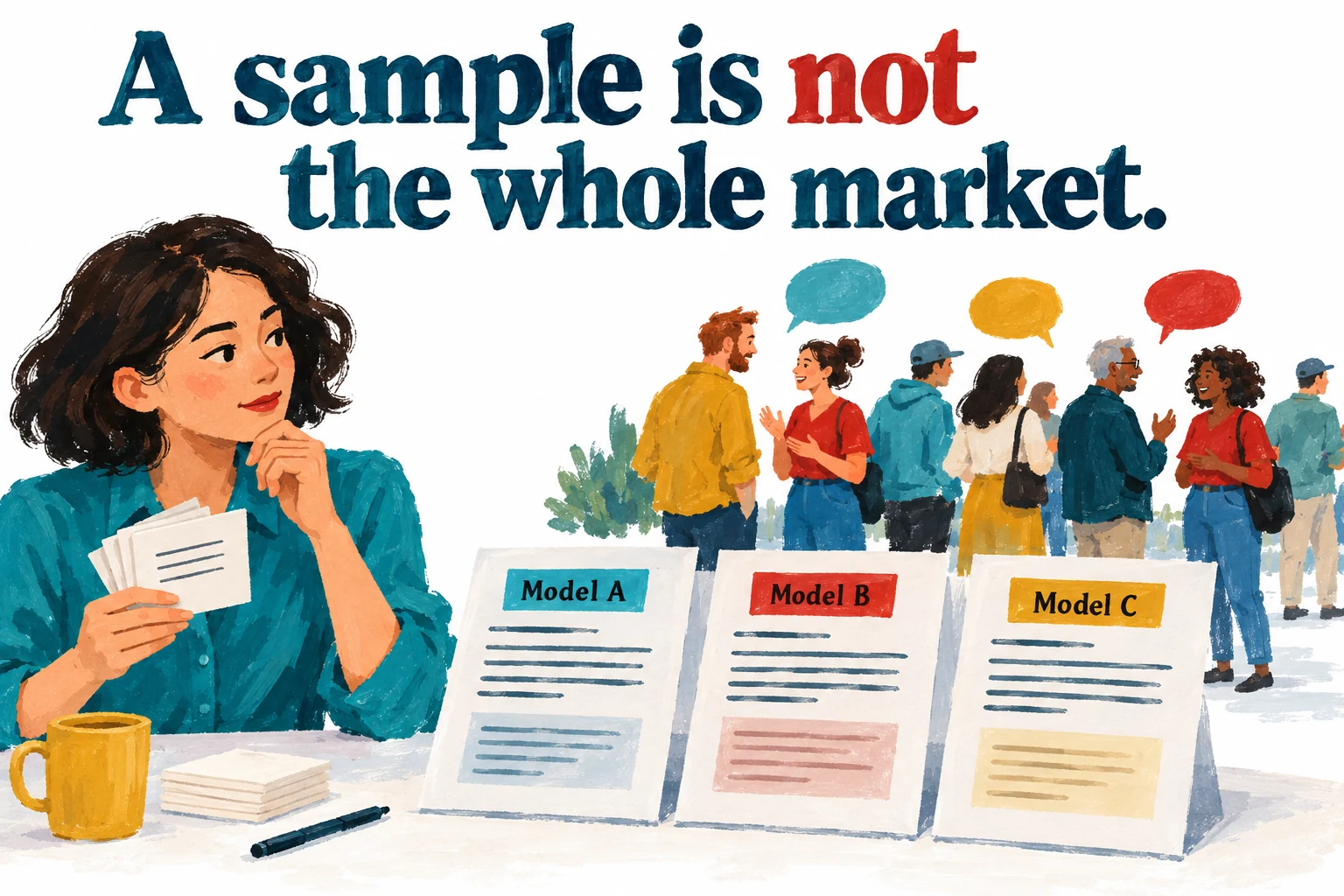
The vendor describes prompt tracking as repeating a fixed set of buyer questions and recording the resulting answers over time. That is a sampling method. It does not mean the product is reading the private conversations that every potential customer has with an assistant. The distinction is fundamental: the team chooses the questions and configuration, so the results describe that chosen experiment rather than the complete market.

Imagine a fictional scheduling service that tracks questions about appointment reminders for small clinics. The sample may be useful for that narrow buying situation. It says much less about enterprise procurement, restaurant reservations or users who already know the brand. Calling the result overall AI visibility can be convenient shorthand, but the report should preserve the scope underneath it. A broad label should not make a narrow experiment look like a census.

Start with questions taken from actual sales conversations, support inquiries and search research, after removing private details. Separate discovery questions from comparisons and branded fact checks. Keep a record of why each question belongs in the sample. This makes it possible to explain what the monitoring covers and, just as importantly, what it leaves out. The most entertaining prompt is not automatically the one a likely buyer would ask.

Use the tool as a structured observation system rather than a substitute for customer research. Continue talking to customers and examining real acquisition data. If the model answers and customer conversations point in different directions, investigate instead of forcing them into one story. A sample can be valuable without being universal. In fact, acknowledging its boundaries is what makes the findings useful enough to act on without turning a dashboard into an oracle with a billing page.

Sources: Vendor explanation of repeated prompt tracking

Model API responses and consumer assistant experiences are not interchangeable

The vendor's ChatGPT-specific page says tracking runs through OpenRouter using the customer's key and selected GPT model, with grounded and ungrounded options. That identifies an API-based measurement route. We would not treat it as proof that the result reproduces every detail of a consumer assistant session. The model name alone does not establish the same instructions, tools, context, search behavior or personalized history as a particular person's conversation.

OpenRouter's own web-search documentation describes several grounding mechanisms, including native search where supported and other search engines in different configurations. That reinforces the need to record how the answer was obtained. Two outputs bearing a familiar model family name can have meaningfully different retrieval conditions. A report that hides this distinction can make a change in configuration look like a change in brand reputation.

Ask the vendor to show the model identifier, grounding setting and relevant run metadata for a saved answer. Confirm how model changes are handled and whether historical comparisons clearly identify them. This is not a demand for every internal implementation detail. It is a request for enough context to interpret the measurement. If the measuring instrument changes, the chart needs an annotation rather than a confident explanation that the marketing campaign suddenly worked.

Use occasional manual spot checks in the actual experiences important to your audience, within their normal permitted use. Treat differences as information, not evidence that one result must be wrong. The API sample may still be useful for consistent trend observation while the consumer experience answers a different practical question. Buy the tool for the measurement it actually performs, not for an assumed equivalence between every product that happens to use a related underlying model.

Sources: Vendor explanation of model selection and API-based tracking; OpenRouter web-search behavior and additional usage costs

A researcher compares a small set of model answers while separate customer conversations remain outside the measured sample
The chosen prompts define the sample. This conceptual illustration does not represent observed customer conversations or a measured market share.

Choose prompts that a buyer could ask without already knowing your name

A branded prompt and an unbranded discovery prompt test different things. Asking whether a named product supports a feature can reveal inaccurate information. Asking which tools solve a defined problem can reveal whether the product appears in a shortlist. Both are useful, but combining them into one undifferentiated score can make a brand look more discoverable simply because the question itself supplied its name.

Build a small prompt map around the buying journey. Include a problem description, a constraint such as team size or budget, a comparison question and a factual check where appropriate. Keep the wording natural. A prompt containing every phrase from your homepage may measure how well you have coached the model rather than how likely an ordinary buyer is to encounter the brand. It is very easy to win a contest when you wrote the question and inserted the answer.

Avoid changing the sample every time the results disappoint. Keep a stable core set for comparison and a separate exploratory set for new ideas. If you replace a broad question with a much narrower one that favors your product, annotate the change. The new question may be a better representation of the audience, but an improved score across different questions is not necessarily evidence of improved visibility.

Review the map with someone who speaks to customers. Ask which prompts are plausible, which are missing and which sound like a marketer interviewing themselves. This human check can improve the research more than adding dozens of models. The quality of the question set determines whether the output leads toward useful work or merely generates a detailed report on a conversation your buyers were never going to have.

Sources: Vendor explanation of repeated prompt tracking

A share-of-voice percentage needs its denominator

The product's glossary defines share of voice around how often a brand is named in tracked answers, compared with competitors over repeated runs. That is a useful starting definition, but any percentage needs a clear denominator. Ask whether the calculation uses all attempted runs, only successful answers, only answers containing recommendations or another subset. Also ask how multiple brands in one response are counted.

A simple hypothetical example shows why this matters. If a brand appears in three of ten valid sampled answers, that is thirty percent of those ten answers under that particular counting rule. It is not thirty percent of the market, thirty percent of customers or thirty percent of future sales. The arithmetic is easy; the interpretation is where an attractive dashboard can get carried away.

Keep the sample size visible beside the percentage. A movement caused by one answer in a tiny sample deserves a different level of confidence from a persistent pattern across a larger stable set. Do not hide failed runs or model outages, because missing observations can distort comparisons. An empty chart cell should remain an unknown observation when that is what it is, not quietly become proof that the brand was absent.

For agency reporting, define the metric in ordinary language and retain access to the underlying answers. Explain changes in prompts, markets and model versions before discussing trends. A client should be able to understand what was counted without taking a course in dashboard interpretation. The strongest report is not the one with the largest green percentage; it is the one that can survive a calm question about where the number came from.

Sources: Vendor definition of share of voice in tracked answers

Mentions, recommendations and citations answer different questions

A named brand, a positive recommendation and a cited page are different observations. The vendor's citation glossary recognizes that a brand can be used as a source without being recommended, or named without receiving a link. Keep that distinction in your own review. An answer saying that a product is unsuitable for a particular task still contains the product's name, but it is not the same marketing outcome as a clear recommendation.

Read the surrounding sentence before celebrating a match. Is the model describing the right company? Is the mention current and accurate? Is it a comparison, a warning, a historical reference or a genuine option for the buyer's stated need? Ambiguous brand names and acronyms deserve special attention. A detector that finds the correct sequence of letters has not necessarily identified the correct business, and a false positive can make a weak sample look reassuring.

Follow citations to the actual page and check what the source supports. A link beside a claim does not automatically prove the claim is accurate, nor does it mean the publisher endorses the brand. The page might discuss a different product version or provide only background context. Treat the citation as a research lead that deserves inspection before it becomes a recommendation for your next marketing action.

During a pilot, manually label a modest set of answers and compare those labels with the product's classifications. Include clear positives, negatives and ambiguous cases. The point is not to invent a universal accuracy percentage from a tiny sample. It is to discover the errors that matter for your brand and whether the workflow makes them visible. A useful monitoring system should make questionable matches easier to inspect, not merely easier to count.

Sources: Distinction between named brands and cited sources

A researcher follows a citation from an answer to its source and checks a separate factual product record
Follow a citation and verify what it supports before treating it as a useful marketing finding or endorsement.

Answer history is most useful when the experiment stays identifiable

The published changelog announces stored-answer comparisons, prompt editing without losing history, CSV exports and visibility into where a brand appears in an answer. These can be useful research features because they preserve more than a headline score. However, retaining old records is not enough by itself. The reader still needs to know whether two answers came from comparable prompts, settings and conditions.

When editing a prompt, record the reason and the date. A small wording change can alter the task substantially: adding a country, price ceiling or industry can change which products are relevant. Preserve the original baseline rather than presenting the entire history as one unchanged experiment. The convenience of editing in place should not erase the conceptual boundary between the old question and the new one.

Use answer differences to generate hypotheses. If a product disappears, inspect whether the answer became shorter, shifted categories, used different sources or changed its interpretation of the task. A disappearance does not automatically mean a competitor displaced you through better marketing. Likewise, an appearance does not prove a recent page update caused it. The history is evidence of a changed response; the explanation requires additional reasoning.

Export a sample early in the evaluation and see whether it contains enough information to remain useful outside the application. Can a colleague identify the prompt, time, model, market and source links? Are long answers preserved intelligibly? This matters for client reporting and for continuity if you later stop using the service. A research archive should remain understandable after the person who configured the dashboard has moved on to another project.

Sources: Published product changes: history, exports and action workflow

Google AI Overviews need their own market and coverage checks

AI Mentions describes Google AI Overview tracking through SerpApi with market-specific searches and saved results. It also acknowledges that not every query produces an overview. That is a different collection route from asking a model API to generate an answer. Keep the two result types separate in interpretation, even if the product displays them together for convenience.

Choose the market that corresponds to the business you actually serve. A United States software audience and a local service operating in another country may encounter different information needs and result conditions. Record the country, language and other relevant settings the tool supports. Ask what the product does when an overview is absent: does it record no overview, a collection failure or a zero brand score? Those states should not be treated as synonyms.

Inspect a few saved results against the source context rather than assuming one captured search represents every user. Search experiences can differ, and a result collected under a specified configuration is evidence about that configuration. The vendor's language about seeing what customers see should be read with that boundary in mind. A useful sample can guide investigation without claiming perfect replication of every individual search session.

For local or region-sensitive work, create distinct groups instead of averaging unlike markets into one score. A gain in a market you do not serve should not hide a decline where your customers are. Similarly, a product unavailable in a region may reasonably be omitted from recommendations there. Good monitoring helps reveal those contextual differences; it should not encourage you to demand universal inclusion in questions for which the business is not a suitable answer.

Sources: Vendor explanation of Google AI Overview sampling

The license is one purchase; the observation schedule has its own bill

The checked discounted listing shows $59 with thirty-day money-back protection, while the direct site shows $99 once. The product's ongoing model usage is bring-your-own-key rather than an unlimited allowance bundled with the license. Keep the exact purchase-channel conditions and confirm account limits before paying. A lifetime software price does not establish unlimited brands, team seats, historical retention or every future third-party service at no additional cost.

Estimate usage from the actual monitoring design. As a hypothetical example, ten prompts across three models on each of thirty days create nine hundred scheduled model calls before retries or extra analysis. That is not a cost quote and does not describe a tested AI Mentions configuration. It is a way to make the scale of a proposed schedule visible before attaching a billing account.

Grounding can add another cost layer. OpenRouter explicitly states that web search can incur charges even when the underlying model is free. Therefore, a claim that free models enable zero ongoing cost should not be generalized to every configuration. Check the selected model, search mechanism and any additional operations. A free label attached to one component does not cancel the bill generated by the components beside it.

Compare complete operating cost with the manual process you would otherwise use. Include reviewing the results, investigating citations and implementing useful changes. An inexpensive tool can be good value even when it does not save every minute, but only if it supports decisions worth making. If nobody has time to act on the findings, the cheapest monitoring schedule may simply be a very efficient way to accumulate unread reports.

Sources: Discounted lifetime offer and advertised refund protection; Current product overview, pricing and bring-your-own-key model; OpenRouter web-search behavior and additional usage costs

A free search allowance is a capacity limit, not an infinite plan

SerpApi's current pricing page lists a free allowance of 250 searches per month. It also explains how successful searches are counted and offers paid plans for larger volumes. That provider allowance belongs in the monitoring budget when Google search-based tracking is part of the workflow. It is separate from the AI Mentions license and from model-token spending through another service.

Use a simple capacity estimate before scheduling. Ten daily search checks over thirty days would already imply three hundred scheduled checks under a one-search-per-check assumption. The real integration may involve different request behavior, so verify it in the usage record rather than treating that illustration as a billing guarantee. Markets, additional engines and retries can complicate the calculation. The important point is that a small free allowance can be exceeded by an ordinary-looking schedule.

Ask what happens when a key runs out of credit or reaches a limit. Will the interface clearly show incomplete monitoring? Can alerts distinguish a failed collection from a genuine missing mention? Does the schedule resume without silently changing the sample? These are acceptance questions for the application, not features we have verified in a private account. A gap in data should be visible enough that nobody mistakes it for a business trend.

Review any provider auto-renewal or spending behavior before connecting the account. Use a dedicated budget and inspect actual usage after the first few runs. Expand only when the monitoring plan is both useful and affordable. There is no analytical virtue in checking every available combination simply because the interface allows it. A smaller relevant sample with understood coverage is usually easier to interpret than an expensive collection of loosely related observations.

Sources: Current SerpApi search allowances and billing behavior

Citation gaps are research opportunities, not a license to spray outreach

The product defines a citation gap as third-party sources appearing for competitors while the brand is absent. This can produce a concrete list of pages to inspect. It does not establish that every source is relevant, trustworthy or open to adding your product. Nor does a citation prove that obtaining a mention on that page will cause future model recommendations. Treat the list as a starting point for editorial judgment.

Read the page and identify why the competitor belongs there. It may serve a different audience, offer a required integration or have evidence your product does not yet possess. Sometimes the honest conclusion is that the page should not include you. That finding can still be useful because it clarifies a product or positioning gap. Marketing research becomes less expensive when it is allowed to say that an opportunity is not actually an opportunity.

When outreach is appropriate, make it specific and factual. Point out an outdated detail, offer a relevant demonstration or explain a genuinely missing option with supporting evidence. Respect the publisher's editorial process and any contact preferences. Do not turn a generated email draft into automatic bulk contact simply because the tool has identified a domain. The person receiving the message is not an API endpoint with feelings added as an optional integration.

Track the outcome separately from the act of sending. A corrected factual page, a useful conversation and an ignored email are different results. Avoid buying low-quality placements merely to move a citation score. The strongest external mention is one that helps a real reader evaluate the product accurately. If the proposed action would look embarrassing when described plainly to a customer, it probably needs more thought before becoming part of the growth plan.

Sources: Vendor definition of citation gaps

Suggested fixes should become reviewed hypotheses

The current product and changelog describe drafted outreach, content suggestions and a board for moving proposed work through stages. That can help connect observation with action. It does not make the suggestion correct by default. A recommendation may be grounded in a real answer while still proposing work that is irrelevant, redundant or unsupported by the product's actual capabilities.

For each proposed fix, write a short explanation of the observed problem, the evidence and the intended benefit for a reader. A useful task might clarify a confusing pricing condition or add an accurate implementation example. A weak task might produce another generic comparison page because a competitor happens to have one. The fact that a model cited a page does not mean its structure should become a universal content template.

Keep a person responsible for approving factual claims and external communications. Review generated comparisons for fair criteria, current information and omissions that would mislead a buyer. Never invent a customer result, testimonial or product capability to make the page look more authoritative. A well-written explanation of a real limitation can be more useful than an unsupported claim of superiority, even when the latter seems more likely to please a marketing dashboard.

Use the board to preserve reasoning, not only to count completed tasks. A task marked done should link to the actual correction and explain what changed. Later, you can assess whether the work improved reader understanding or produced a useful observable pattern. This turns suggestions into an accountable editorial process. Otherwise, the board risks becoming a tidy display of activity that nobody can connect to a better customer decision.

Sources: Current product overview, pricing and bring-your-own-key model; Published product changes: history, exports and action workflow

Do not replace ordinary SEO with a special-file scavenger hunt

Google's guidance says its AI search features do not require a special AI text file or additional schema format. Supporting pages still need to meet ordinary search requirements, including indexing and snippet eligibility, and inclusion is not guaranteed. This is important when an optimization checklist presents a technical artifact as though creating it were a direct route into AI answers. A file can exist without changing the evidence that makes a page useful.

Prioritize accessible, accurate information that answers the buyer's question. Make important details available as readable text, preserve sensible internal navigation and keep visible content aligned with structured data. If a product's pricing, compatibility or limitations are unclear, fix those explanations before pursuing a new acronym. The best improvement may help both a human reader and a retrieval system because it makes the underlying information less ambiguous.

Treat automated readiness checks as diagnostics with a defined scope. Passing a technical check can show that a particular condition is satisfied; it does not establish authority, demand or a guaranteed recommendation. Similarly, a missing optional file should not automatically become the highest-priority marketing problem. Ask what each check proves and whether the proposed change helps the actual audience, not merely whether it turns an indicator green.

Maintain the fundamentals that already support discovery: useful pages, clear product facts, working links and reliable site delivery. Use AI-answer research to identify questions those pages fail to answer, then improve the content on its merits. This is a more defensible strategy than repeatedly rebuilding the site around whichever optimization term appeared most recently. New search experiences create new observations to study; they do not repeal the need to publish something worth finding.

Sources: Google's requirements and measurement guidance for AI search features

Keys, stored answers and client data need separate checks

OpenRouter's privacy documentation distinguishes its own logging choices from the behavior of downstream providers and describes metadata collection. Those controls do not establish how AI Mentions stores its own account data, prompts, answer history or credentials. Each part of the workflow needs its own review. A bring-your-own-key arrangement gives useful billing control, but it is not a general security certification for every service involved.

Before using confidential client material, request the application's current privacy and retention details, account-access controls and deletion process. We did not verify a private security configuration or a contractual data-processing arrangement for this review. Use public brand information and non-sensitive sample prompts during initial evaluation. There is rarely a reason to include a customer's private sales history merely to ask a general category-discovery question.

Create a dedicated provider key with appropriate spending limits and permissions where supported. Keep it out of reports, screenshots and shared messages. Decide who owns the account and who can change the monitoring schedule, especially in an agency setting. A client's budget should not depend on a former contractor's personal login or an undocumented key copied into several unrelated tools.

Check the lifecycle as well as setup. Can the relevant data be exported, removed or transferred when a client relationship ends? What happens to scheduled requests after access is revoked? Ask for clear answers before making the service part of an important reporting workflow. These are purchasing questions, not accusations about the product. They help establish whether a convenient research tool can fit responsibly into the way the business already handles information and access.

Sources: OpenRouter data collection and logging controls

A changed answer is not yet a measured business result

A visibility report measures an observation about answers. A business outcome requires another layer of evidence: relevant visits, qualified inquiries, purchases or another defined objective. The two may be related, but they are not interchangeable. A brand can appear more often in sampled responses while receiving no measurable increase in useful traffic, and it can receive valuable inquiries that the chosen prompt set never anticipated.

Keep reporting layers separate. Record the monitoring result with its scope, then examine site and customer evidence independently. Google says traffic from its AI search features is included in the Web reporting context in Search Console. That does not turn a third-party mention score into a direct attribution system. Avoid claiming that a particular sale came from a sampled answer unless the available customer journey actually supports that conclusion.

For a small business, a useful early result may be a factual correction rather than immediate revenue. Discovering that an answer describes an obsolete plan can justify improving public documentation. Report that honestly as a corrected information problem. Do not inflate it into a percentage growth story simply because the purchase needs defending. A practical tool can earn its place through better decisions without becoming the sole explanation for every favorable change.

Agree on success before running the experiment. Perhaps the goal is fewer recurring factual errors, faster research preparation or a better-supported content plan. Later commercial outcomes can be tracked with suitable caution. If traffic is too small to distinguish a real effect, say so. A measurement tool should help a team become more comfortable with uncertainty, not provide enough decimal places to make uncertainty temporarily difficult to see.

Sources: Google's requirements and measurement guidance for AI search features; Vendor definition of share of voice in tracked answers

Run a modest experiment with a stable baseline

Our suggested pilot begins with one brand, a small defensible question set and the models or search experiences most relevant to its buyers. Preserve the settings and inspect the initial raw answers manually. Record missing observations, incorrect brand matches and unsupported claims. These are proposed evaluation steps, not results from a campaign we operated. The first objective is to learn whether the data is interpretable enough to support useful work.

Choose one improvement that would benefit a reader even if the monitoring score never moved. Clarify a limitation, update a factual comparison or explain an implementation requirement with real evidence. Record the publication date and the exact change. Keep the main monitoring sample stable afterward. This does not create a perfect causal experiment, but it is more informative than changing the website, prompts and model settings simultaneously and then crediting the nicest graph.

Observe repeated runs and inspect the actual answers, not just the aggregate. Note competing explanations such as source changes, model updates or a different interpretation of the question. If an answer becomes more accurate, preserve the evidence. If nothing changes, that is also useful information about the limits of the intervention. A sensible research process can produce an inconclusive result without being a failed process.

At the end of the pilot, review the complete cost and decisions produced. Did the tool reveal something you would otherwise have missed? Was the evidence easy to inspect and export? Did the team act responsibly on it? Continue only when the answers justify the ongoing attention and provider usage. The purpose of a pilot is to make a purchase decision easier, not to create a new recurring task that survives merely because someone already configured it.

Sources: Vendor explanation of repeated prompt tracking; Published product changes: history, exports and action workflow

Two colleagues preserve a baseline improve a factual page and record a later observation without claiming guaranteed growth
A proposed experiment: document a useful change and compare later observations while keeping alternative explanations visible.

For agencies, explain the method before selling the score

An agency can use structured answer monitoring as part of research and reporting, but it should not sell the score as a certified measure of total market influence. The client deserves to know which questions, models, markets and time window are included. Keep methodology visible in the report and preserve examples that illustrate both favorable and unfavorable findings. Selective screenshots can make almost any brand appear to be winning something.

Confirm the commercial and operational limits needed for client work. The public materials describe multiple-brand use, but a buyer should still verify the exact number of workspaces, collaborators and reporting rights included in the purchased offer. Do not assume unlimited agency use from a broad marketing sentence. A one-time license can be attractive while still requiring clear boundaries around who may access the application and how client data is separated.

Define a service that produces useful deliverables: a reviewed question set, evidence-backed findings, prioritized factual improvements and a clear account of what remains uncertain. Avoid charging for an automatic report whose interpretation is left entirely to the client. The agency's value is the judgment applied to the observations, especially when the right recommendation is to improve the product explanation rather than chase another superficial mention.

Keep provider spending and research effort visible in the engagement. Agree who approves outreach and publication, and never imply that a generated suggestion authorizes contacting a third party on the client's behalf. A responsible service can be commercially valuable without promising guaranteed inclusion in AI answers. In a young measurement category, a clear explanation of limitations is not a weakness in the sales process; it is part of the expertise the client is paying for.

Sources: Discounted lifetime offer and advertised refund protection; Published product changes: history, exports and action workflow

Our verdict: useful research infrastructure when the scope stays honest

We score AI Mentions 74 out of 100 as a source-researched buying assessment. The product addresses a real organizational problem and offers a potentially economical way to preserve repeated observations. Its appeal is the connected workflow from question to answer history to reviewed follow-up. The score does not represent tested detection accuracy, a prediction of revenue or an endorsement of every optimization claim on the sales page.

The best fit is a marketer who can define a relevant sample, inspect evidence and make useful factual improvements. Such a buyer may save time compared with scattered manual checking while gaining a better record of changes. The weakest fit is someone looking for a shortcut to recommendations or a universal market-share number. Monitoring can show what happened in selected responses; it cannot purchase relevance on behalf of an unclear offer.

Before paying, ask for a demonstration of raw answers, configuration metadata, export completeness and the handling of failed runs. Confirm license limits and estimate external usage under the actual schedule. Review the application's data practices separately from provider policies. Those questions are more important than the headline number of available models, because a small reliable set can support better decisions than broad coverage whose meaning is difficult to explain.

Buy when the pilot produces actionable, reviewable findings at an acceptable complete cost. Pass when the required controls are unclear or the reports would simply add another obligation without changing the work. The most valuable result is not hearing that an AI likes your brand. It is understanding a real information gap, improving it honestly and keeping enough evidence to distinguish what you observed from what you merely hoped would happen next.

Sources: Current product overview, pricing and bring-your-own-key model; Discounted lifetime offer and advertised refund protection; Vendor explanation of model selection and API-based tracking

Frequently asked questions

Does AI Mentions read real customers' private AI conversations?

The documented workflow runs selected prompts and records resulting answers. Treat those results as a configured sample, not access to every customer's private conversation or a census of market demand.

Is the lifetime license the only cost?

No. The product uses your own provider accounts for ongoing monitoring. Model requests, web grounding and search-based tracking can have separate costs or limited free allowances.

Does an API-based ChatGPT result reproduce every consumer session?

Do not assume that equivalence. Model choice, grounding, context and product behavior can differ. Record the collection method and use the sample for the question it actually measures.

Will a higher visibility score prove more sales?

No. The score describes selected observations under its counting rules. Qualified traffic and commercial outcomes require separate evidence, and a changed answer does not by itself establish causation.

Are the illustrations screenshots of measured results?

They are original explanatory artwork about sampling, citation verification and careful experimentation. They contain no customer results, actual application interface captures or claimed performance improvement.

More marketing & seo deals

Marketing & SEO

Inrō

A strong candidate for businesses already receiving relevant Instagram conversations. Start with a narrow, supervised flow and verify the plan's limits. It can improve response handling, but it does not create an audience or make every stored contact reachable.

$59 · checked Nov 14, 2026

Marketing & SEO

Nuwtonic SEO

Nuwtonic SEO monitors rankings, optimizes pages, and generates GEO-ready content for AI search, helping teams improve visibility in both traditional and AI-generated answer ecosystems. The product is designed for teams that need a repeatable marketing & seo process and want clearer control over the core task. It fits best when the buyer has a defined use case, realistic input data, and a way to judge output quality before rolling it out across a wider workflow.

$69 · checked Nov 14, 2026

Marketing & SEO

Skillplate

Skillplate uses an AI agent, Overmind, to help users build products, websites, checkouts, and marketing campaigns from a single platform. This aims to streamline the process of launching and growing an online business. The product is designed for teams that need a repeatable marketing & seo process and want clearer control over the core task. It fits best when the buyer has a defined use case, realistic input data, and a way to judge output quality before rolling it out across a wider workflow.

$79 · checked Nov 5, 2026

Marketing & SEO

SheetXAI

SheetXAI automates spreadsheet tasks using AI and natural language, eliminating the need for formulas or coding. It integrates directly with Excel and Google Sheets, streamlining data cleaning, content generation, and bulk operations. This tool is suitable for teams seeking to automate repetitive spreadsheet workflows, allowing them to focus on strategic tasks rather than manual data management.

$49 · checked Nov 6, 2026

Deal alerts

Get marketing & seo deal alerts by email.

SoftScout will send short buying notes when offers like AI Mentions look worth checking or worth skipping.

Short buyer verdicts

Useful offers before checkout

Editorial note

Our 74/100 assessment rewards the practical research workflow while discounting unverified detection quality and claims that a visibility score represents the entire market. Evaluate the evidence trail, limits and real operating cost before committing.

For vendors

Have a better deal for AI Mentions?

Send current partner terms, coupon limits, refund rules, and the best buyer fit. We review offers before adding them to SoftScout pages or Telegram alerts.

Submit terms