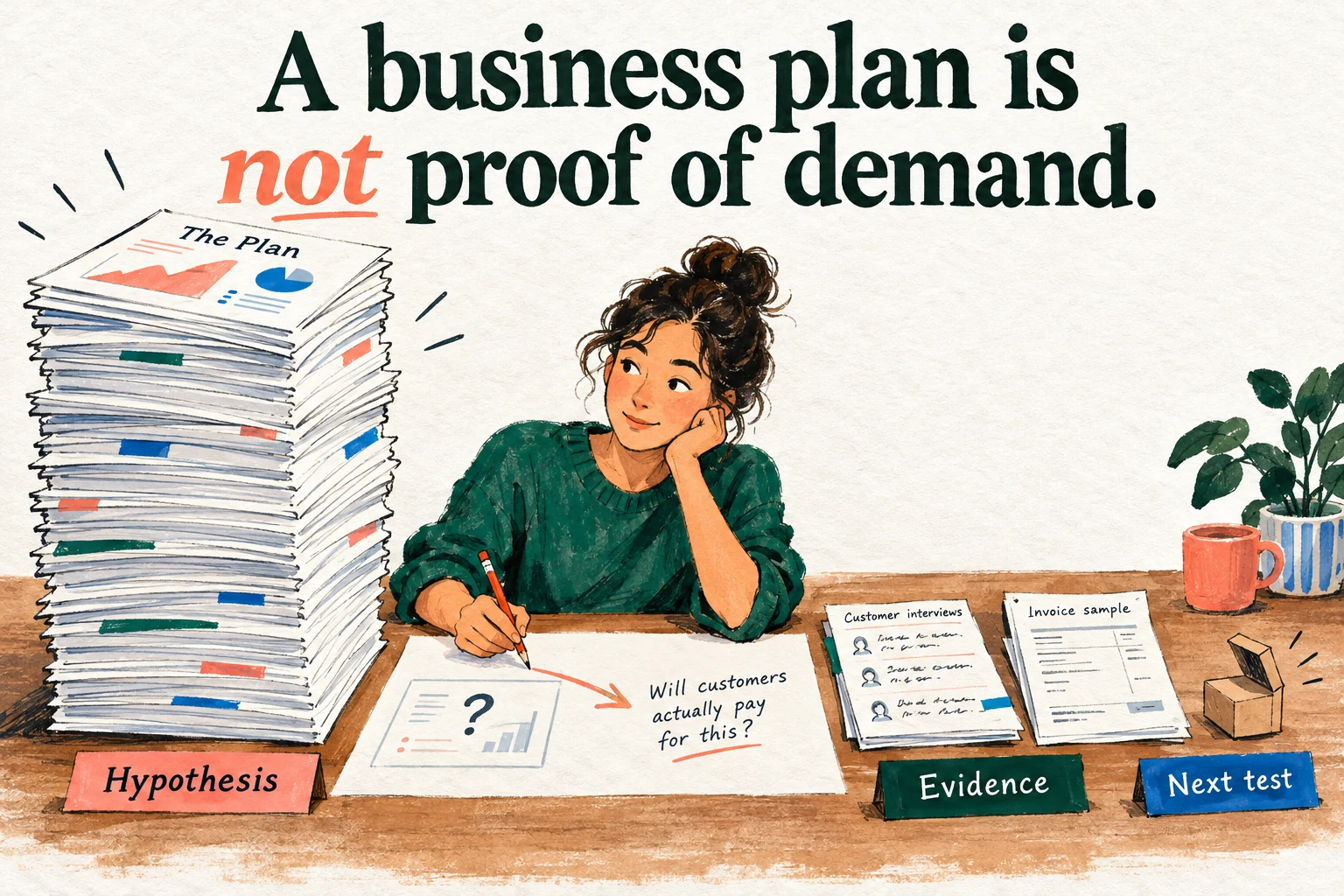
Financial planning appears in the published toolset, but a generated narrative is not a substitute for a transparent model. Every consequential number should connect to an assumption you can inspect. For a small service business, start with price, expected usage, direct delivery cost, fixed operating cost and available capacity. A forecast that skips those relationships can become optimistic fiction with a currency symbol.
Here is an illustrative calculation, not a Vizologi result or a recommended business forecast. Suppose a service charges $40 per member each month and expects $15 in variable delivery cost per member. The assumed contribution is $25. With $1,000 in monthly fixed costs, the simplified operating break-even point is 40 members. Change variable cost to $25 and the contribution falls to $15, requiring about 67 members. The assumptions matter more than the attractive first total.
That simplified example excludes many real considerations, including taxes, financing, timing of cash receipts, owner compensation and unexpected work. It also says nothing about whether the team can acquire or serve those members. Use it to understand sensitivity, then build an appropriate model with qualified accounting or financial support when the decision warrants it. Do not present an illustrative calculation as a forecast backed by customer data.
Ask the planning tool to help identify missing assumptions and alternative scenarios, then independently check the formulas. Include a slow-sales case and a higher-service-cost case, not just the path where every customer behaves exactly as the presentation hoped. The useful outcome is a clearer view of what must be true for the business to work. Confidence should come from evidence and arithmetic, not from how smoothly the software explains the optimistic scenario.