Back to deals
Marketing & SEOLifetime Deal

AkioSurvey Lifetime Deal: buy or skip?

Worth considering for recurring customer feedback when you need conditional questions and usable exports. Start with a modest pilot, confirm the exact license and privacy settings, and buy for the workflow you will actually run rather than the largest response allowance.

Product overview

What AkioSurvey does

The useful outcome is a decision you can make after reading the answers. AkioSurvey's documented tools can support that process, but they do not supply a representative audience, neutral questions or a person responsible for fixing the problems respondents describe.

This is an independently reasoned review of public product documentation and offer terms checked October 24, 2026. It does not claim a logged-in test, accessibility certification, security audit or measured response-rate improvement. The example surveys and pilot exercises are our proposed evaluation methods.

Read the full AkioSurvey review

Best for

  • Small businesses running a repeatable customer or service-feedback process
  • Product teams that need targeted follow-up questions and can analyze an exported response set
  • Operators who value a focused survey tool more than a large connected research suite

Why we picked it

  • Conditional paths can keep questions relevant to each respondent
  • Documented question formats cover both structured answers and explanatory comments
  • Individual-response and summary exports support analysis beyond a dashboard screenshot

Check before buying

  • Build one short representative questionnaire, traverse every conditional path and verify the exported values against known dummy answers.
  • Open both the survey and any report link outside your account and confirm that only the intended information is visible.
  • Ask a few suitable pilot participants to explain the questions in their own words, then revise ambiguity before collecting real responses.

Buy if

A real pilot demonstrates that the branching, reporting and export behavior match your recurring feedback process.

Verify first

Build one short representative questionnaire, traverse every conditional path and verify the exported values against known dummy answers.

Skip if

Your existing form already handles the entire job and no specific missing feature is costing you meaningful time.

SoftScout sends you to the source after the risk checks, so you can verify live terms before buying instead of trusting stale coupon text.

Check Source Offer

Source transparency

Source
Source marketplace
Link type
Source page
Last checked
Oct 24, 2026

Buyer checklist

  • Build one short representative questionnaire, traverse every conditional path and verify the exported values against known dummy answers.
  • Open both the survey and any report link outside your account and confirm that only the intended information is visible.
  • Ask a few suitable pilot participants to explain the questions in their own words, then revise ambiguity before collecting real responses.

AkioSurvey: the buying decision

AkioSurvey combines conditional survey paths with accessible response reporting and portable exports, making it a practical candidate for small teams that need recurring feedback without building a full research operation. Its usefulness depends on asking a focused question, reaching the relevant people and assigning someone to act on the findings.

Research-based review, not a hands-on test. Sources checked on 2026-10-24. The assessment below is our editorial judgment, not a customer rating. Editorial assessment: 76/100.

Consider it if

  • A real pilot demonstrates that the branching, reporting and export behavior match your recurring feedback process.
  • Your expected response volume and required branding or identification features fit the exact purchased license.
  • You have an appropriate audience, a clear privacy explanation and someone responsible for acting on the results.

Skip it if

  • Your existing form already handles the entire job and no specific missing feature is costing you meaningful time.
  • You need verified enterprise access controls, regulated-data arrangements or automated integrations that the vendor has not confirmed.
  • You expect the software to recruit a representative sample or turn poorly framed questions into trustworthy research automatically.
Problem fit: 17/20
Recurring customer feedback is a concrete operational need, particularly when teams already know which decision they want the responses to inform.
Capabilities: 16/20
Documented conditional questions, varied inputs and exportable reporting cover survey fundamentals without proving advanced research or integration requirements.
Workflow fit: 16/20
Creation, distribution and review form a coherent sequence, although sample selection and follow-through remain responsibilities of the survey owner.
Evidence confidence: 12/20
Public guides explain key functions, but account behavior, accessibility, security controls and exact lifetime entitlement mapping were not independently tested.
Value: 15/20
A focused recurring survey can justify the offer, while occasional simple polls and unconfirmed enterprise requirements reduce the case for paying.

A survey tool is useful when the answers change a decision

A customer says the experience was fine. Another says it was frustrating. A third leaves an enthusiastic rating and then explains a problem serious enough to cancel next month. This is where a survey becomes more than a box of stars: you need enough structure to compare responses and enough room for people to explain what the score hides. AkioSurvey is positioned around that ordinary, valuable work.

The product brings together survey creation, conditional paths and response review. Its appeal is clearest for a small organization with recurring questions and an existing audience: a service business following up after appointments, a support team investigating unresolved cases or a software team examining first-use friction. You do not need to become a research department to benefit, but you do need a question more specific than whether everyone generally likes you.

Our buying test is deliberately practical. Write the decision on a blank page before opening the builder. Perhaps you will revise an onboarding step if newcomers cannot find it, change a delivery message if customers misunderstand it, or investigate a support category if problems remain unresolved. If every possible answer leads to the same business action, the questionnaire may be collecting decoration rather than evidence.

That distinction shapes this review. We consider the documented functions, the offer and the work needed around them. We do not present a new account test or promise a response-rate lift. A polished form can make listening easier; it cannot make a team listen. The most expensive survey is often the one whose answers are exported, congratulated and then left untouched in a folder called Final Final.

Sources: AkioSurvey product overview and supported survey workflows; Current questionnaire template categories

Read the lifetime offer as its own package, not a familiar plan name

The checked lifetime listing offers Silver for $49 with 100 surveys, 100 questions per survey and 1,000 responses per month. Gold is $89 with 1,000 surveys, 1,000 questions per survey and 6,000 monthly responses. Gold adds the listed logo, footer-label removal and respondent-identification features. The direct site instead uses Free, Standard and Professional names. Those labels should not be treated as interchangeable entitlements.

Start by separating capacity from capability. Capacity answers how much you can collect; capability answers what you can actually do. A small business may never approach the lower response ceiling but still need a feature attached to a higher package. Conversely, buying more capacity will not help if the requirement is a control or integration that has not been established at all. Build the requirement list before choosing the tier.

The offer lists a 60-day redemption window and a 30-day refund period, while its FAQ also uses credit-back wording. Confirm the remedy and deadline applicable to your checkout rather than assuming all payment routes behave alike. Keep the receipt and the purchased feature list together. A lifetime label describes an offer arrangement; it is not a guarantee that a hosted service will exist forever or never change its implementation.

Do not postpone the first meaningful test until the last refund day. Redemption, setup, a pilot and export review all take calendar time even when the actual work is short. For a purchase this size, the real avoidable loss is usually not the checkout amount. It is discovering after a campaign has launched that an assumption about access, reporting or response handling was never confirmed.
Sources: Lifetime Silver and Gold offer, allowances and redemption terms; Direct Free, Standard and Professional package comparison

The free plan is a useful filter for an unnecessary purchase

The direct comparison lists a Free package with ten surveys, ten questions and 200 responses per month. It also lists separate limits for AI-generated questionnaires and the number of questions in those generated drafts. These are different counters. A manual survey allowance does not automatically tell you how often AI generation can be used, and a generation limit is not necessarily the maximum length of every manually edited questionnaire.

A free trial exercise should answer whether the basic experience suits you, not merely whether you can create a form. Prepare a short version of the real task and inspect the steps you would repeat: modifying wording, navigating between pages, checking answers and retrieving the output you need. Some paid features cannot be established through a free account, so record those as remaining questions instead of assuming they work identically.

If you only need to choose a meeting time or ask five straightforward questions once, an existing form may already be enough. There is no prize for adding another login to an otherwise functioning process. Paying becomes more plausible when conditional routing, a particular reporting workflow or a repeated operational need reduces work you currently perform by hand. That is a concrete reason to buy rather than a general preference for more features.

For a hypothetical team surveying customers every month, include preparation and analysis time in the comparison. Saving a modest subscription while adding an hour of manual cleanup can be poor value. Equally, an inexpensive lifetime plan that nobody uses is still waste. Compare the complete routine you expect to run, using current checkout terms and your own time assumptions, rather than a crossed-out reference price.

Sources: Direct Free, Standard and Professional package comparison

Begin with one operational question and remove the passengers

AkioSurvey's creation guide describes configuring the survey, adding questions, previewing it and then opening it to respondents. That sequence is sensible, but the most useful preparation happens before those steps. State the business uncertainty in one sentence. For an early product, it might be whether people can complete the core job without help. It should not become an invitation for every colleague to add a favorite question.

Imagine a small document-sharing service investigating abandoned uploads. The first draft could ask whether the person attempted an upload, what happened and what they expected next. A question about their preferred logo color is not part of that investigation, even if the design team is genuinely curious. Each additional item competes with the questions that could identify the actual obstacle. Shortness is not automatically quality, but relevance is a useful editing rule.

Write an action beside every proposed answer. A failed format check suggests examining validation messages. Uncertainty about the next step suggests improving guidance. A person who never attempted the task needs a different follow-up from someone who encountered an error halfway through. This exercise reveals where branching will help and where a question merely invites a vague opinion that nobody knows how to use.

The vendor offers an MVP feedback template, but its existence does not validate your own research design. Use a template as a starting inventory, then discard irrelevant material. Keep a small decision note alongside the questionnaire so another team member understands why each item remains. When someone requests one more question, ask what action its answer will change. This is a polite way to stop a two-minute survey from developing a second career as a census.

Sources: Survey creation, preview, distribution and reporting guide; MVP feedback template introduction

AI can draft the questionnaire, but it cannot know your hidden assumptions

The documented AI generator accepts a topic, desired question count and language, and returns a survey that can be edited. That can remove the blank-page problem. It does not establish that the generated questions measure the issue your team has in mind, that the categories cover your customers' experiences or that the resulting answers will be easy to interpret. Treat the first output as a proposal awaiting an editor.

A useful review pass looks for assumptions embedded in otherwise fluent sentences. Asking how much someone enjoyed a feature assumes they used it and enjoyed it at least a little. Asking what they would improve assumes they can identify an improvement. In a hypothetical delivery survey, a person whose parcel never arrived should not be forced to rate the unpacking experience. The questionnaire needs to permit the real situation before it can measure satisfaction with it.

Also distinguish a request for ideas from evidence of behavior. A generated question about whether someone would use a future feature can be helpful conversation, but it is not a purchase order. Ask for a recent example of the task, the workaround they used and what happened. Those answers give a product team something more grounded to investigate than a collection of optimistic intentions gathered at no cost to the respondent.

Keep sensitive or identifying material out of an AI prompt unless the data route and permissions have been established. A generic description of your workflow is often sufficient to obtain a useful draft. Then review language, routing and answer options yourself. The benefit is a faster starting point, not outsourcing responsibility for the instrument. AI is an eager questionnaire assistant; it has not attended the meeting where everyone quietly changed the definition of success.

Sources: Generating a survey from a topic, language and question count

Branching should spare irrelevant questions, not hide inconvenient answers

The vendor documents routing at both question and page level, including finishing or disqualifying a response. That is one of the strongest reasons to consider a dedicated survey tool. A respondent who has not used a service should not have to invent ratings for it. Someone with an unresolved problem should receive a different follow-up from someone whose issue was fixed. Relevant paths can make the questionnaire feel like listening instead of paperwork.

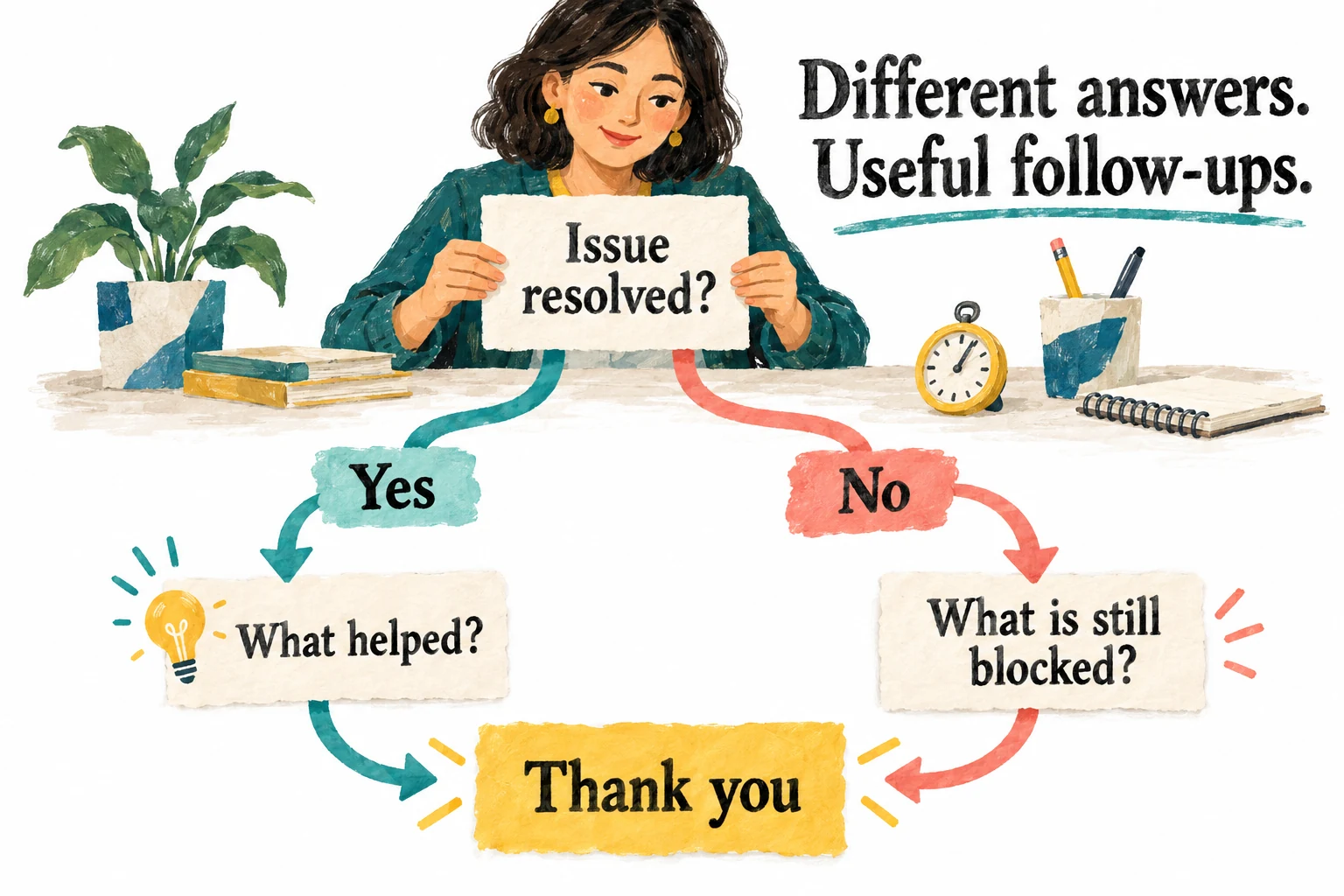
Our first illustration uses a support example. Ask whether the issue is resolved. A yes can lead to a question about what helped; a no can lead to the remaining obstacle. Both paths finish respectfully. This is a proposed design, not a capture of the application. In practice you may need a third option for uncertainty or a partially resolved case. The available answer set should reflect the situations you genuinely expect.

Draw the paths before implementing them. Give every branch an entry condition, a destination and a clear finish. Test a person who changes an earlier answer, leaves an optional field blank or selects a combination you did not anticipate. Verify that skipped questions do not later become required and that the exported record remains understandable. The point is not to create a clever maze. It is to remove unnecessary corridors.

Disqualification needs particular care. Excluding people outside the intended audience can be appropriate; excluding dissatisfied people because they spoil the result is not an honest feedback process. Decide eligibility before collecting responses and preserve a record of the rule. If a business wants to understand failed onboarding, people who failed are not inconvenient exceptions. They are central to the question, and the survey should not politely escort them out before they can explain.

Sources: Branching, identification, publishing and package-specific features; AkioSurvey product overview and supported survey workflows

A researcher routes resolved support issues to a helpful feedback question and unresolved issues to a question about remaining problems
Our proposed support-feedback branch: different answers lead to relevant follow-ups. This is an explanatory illustration, not an AkioSurvey interface capture.

Choose answer formats that preserve the distinction you care about

AkioSurvey's question guide describes choice inputs, short and longer text, dates, addresses, matrices and weighted rating scales. These formats are not interchangeable decorations. A multiple-choice item gives comparable categories; an open comment can reveal a situation you did not anticipate. A rating summarizes a judgment but may hide the reason. Choose the format from the decision you need to make rather than from whichever control looks most polished.

Pew Research Center explains that wording, available choices and question order can affect responses. For a practical business survey, begin with a modest rule: ask one thing at a time and make the meaning of the choices clear. Consider the difference between asking whether support was fast and helpful versus asking about speed and resolution separately. A person can reasonably find the answer quick and completely useless. One combined score loses that distinction.

Use our upload example again. A choice question can distinguish a file that was rejected, a process that stalled and a task the customer abandoned before starting. An optional comment can explain what the person saw. These are original example categories, not claims about a built-in template. Before launch, check them with people familiar with the experience. If their situation does not fit, revise the instrument rather than asking them to choose the least wrong box.

Take numeric validation seriously without making it hostile. A field that rejects a legitimate answer can damage the dataset just as effectively as one that accepts nonsense. Distinguish a blank response, not applicable and a genuine zero in the exported interpretation. Where the tool allows configuration, test the exact behavior you select. The goal is information that survives analysis, not a form that proudly refuses to let anyone continue until they give an answer you happen to like.

Sources: Documented question types, validation and informative elements; Pew Research Center guidance on question wording and response choices

Freeze the meaning of a live survey before comparing results

The FAQ allows editing a published survey but warns that doing so can create inconsistent responses. That is an important operational warning, not a minor interface detail. A column with the same label may contain answers to different questions if the wording or answer options changed halfway through collection. The export can look tidy while the comparison is no longer meaningful. Keep the questionnaire version with the data.

For example, suppose the first group rates satisfaction with the whole service and the second rates satisfaction with the latest support reply. Both might produce a number from one to five, yet the numbers answer different questions. Renaming the column does not repair that difference. If a substantive correction is necessary, note when it happened and keep the groups separate in analysis rather than quietly treating them as one continuous result.

Before launch, save a readable copy of the questions, choices, branching rules and introduction. Record the intended audience and distribution dates. This need not become an elaborate research repository. A short version note and a clean export folder can prevent a surprising amount of confusion when a manager asks why this month's score differs from last month's. The person who built the survey may not be available to reconstruct the details from memory.

For recurring feedback, distinguish deliberate evolution from accidental drift. You may have a good reason to ask a better question next quarter. That improvement should be documented rather than concealed in a chart that pretends nothing changed. Likewise, do not refresh wording merely to make the questionnaire feel new if continuity matters. Consistency is sometimes the unglamorous feature that makes the results useful, even when nobody wants to put it on a product launch banner.

Sources: Branching, identification, publishing and package-specific features

A larger response allowance does not buy a representative audience

AAPOR's guidance distinguishes the population of interest from the people actually reached and describes the limits of nonprobability recruitment. Applied to a small business, the basic issue is straightforward: the customers easiest to contact may not be the customers whose experience you need to understand. A survey link is a collection mechanism. It is not, by itself, a method for making the resulting group representative of everyone who matters.

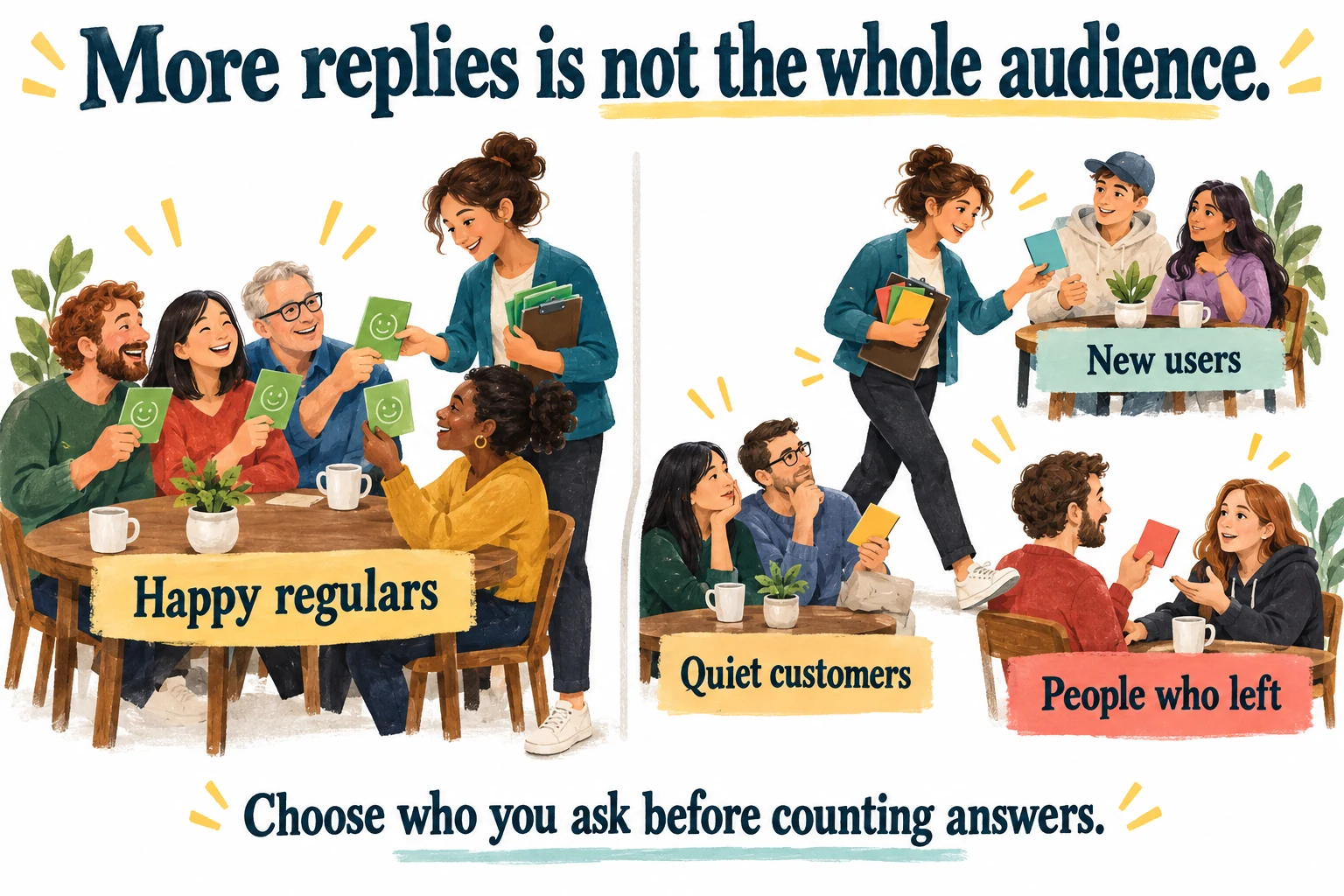
Imagine asking only the enthusiastic users in your community channel why people stop using the product. You may receive thoughtful answers, but you are asking people who stayed to explain people who left. A thousand replies will not necessarily repair that mismatch. Our second illustration contrasts convenient regulars with a more deliberate plan that considers newcomers, quieter customers and former users. It illustrates a planning question, not a statistically validated sampling design.

Keep a simple invitation ledger outside the questionnaire: which group you intended to reach, how you contacted them and when. Avoid collecting personal details inside the response merely because the invitation list already exists elsewhere. If one relevant group is missing, report that limitation. You can still learn from a small directional study without dressing it as a definitive verdict on the entire market or attaching a confidence claim the method cannot support.

This is also why response quotas should follow the research need. Buying a higher allowance may be sensible for a busy operation, but it does not create respondents or improve their relevance. A useful follow-up conversation with someone who encountered the actual problem may be worth more than many vague ratings from a convenient audience. The software can hold the answers; your invitation strategy determines whose voice gets into the room in the first place.

Sources: AAPOR guidance on survey sampling, testing and interpretation

A researcher compares feedback from happy regular customers with separate conversations involving new users quiet customers and people who left
An illustration of a sampling blind spot, not measured customer data. A fuller invitation plan matters more than collecting many replies from one convenient group.

Identified follow-up and anonymous feedback are different promises

AkioSurvey describes respondent identification through individual links in its Professional package; the lifetime offer has its own entitlement list. That can support follow-up when you need to connect a response to a known person. It should not be presented as anonymous collection. Before selecting the feature, decide whether identifying the respondent is necessary for the purpose and whether the people answering understand how the connection will be used.

For an unresolved service issue, a customer may welcome a reply from support. For candid internal feedback, the same link structure may change what a person is comfortable saying. Neither use case should inherit the other one's introduction by accident. Write a short explanation of who can see the response and whether follow-up is optional. Do not promise anonymity merely because you omitted a name field from the visible questionnaire.

Content itself can identify someone. A highly specific incident, job title or date may make a response recognizable even when the export lacks an email address. Review what you actually need to ask. A general operational question often does not require a full address, exact birthday or detailed personal history. Reducing unnecessary collection makes the survey easier to answer and leaves less material to manage after the project ends.

Test the invitation and response process with dummy identities before using it for real participants. Check what the survey owner sees, what the recipient sees and what appears in the export. Keep the mapping only where it is needed and control access to it. This review does not establish the account's full access-control model, so an organization with strict confidentiality requirements should obtain that information before treating the tool as an approved research environment.

Sources: Branching, identification, publishing and package-specific features; Published agreement, data responsibilities and license restrictions

Public participation and public results deserve separate checks

The FAQ distinguishes making a survey publicly answerable from enabling public results. Those are separate decisions with different consequences. You may want a broad invitation while keeping the responses private. Conversely, you may want to publish a carefully prepared summary without exposing individual comments. Do not treat a general sharing control as proof that all underlying material has the intended visibility. Check the exact link and setting involved.

Our recommended test uses a browser session outside the survey owner's account. Open the participation link, complete a dummy response and inspect any result or report link you intend to share. Verify the material visible before and after submission. This should be done with invented test data, not a real customer's complaint. A harmless test can reveal an unexpected exposure before it becomes a problem requiring explanations and cleanup.

The published agreement places visibility responsibility on the customer. In practical terms, assign someone to approve the sharing choice rather than leaving it as an incidental setup step. Record whether results are private, available to a named audience or deliberately public. If colleagues reuse a survey, require them to recheck that choice. A setting suitable for a public event poll may be entirely wrong for feedback about a service failure.

Publishing a summary also deserves editorial care. Remove identifying details that are not needed to communicate the finding, distinguish a quotation from your interpretation and avoid turning one vivid comment into a claim about all customers. When a small group is involved, even a category label can reveal more than intended. The right output is the minimum information necessary for the decision, not the maximum detail the export happens to contain.

Sources: Branching, identification, publishing and package-specific features; Published agreement, data responsibilities and license restrictions

Mobile-friendly does not mean your questionnaire is comfortable on a phone

The vendor describes a responsive survey experience. That is a useful starting point, but the questionnaire you build can still be awkward. A long matrix, an essay field with an ambitious required minimum or a confusing sequence of pages can make a technically responsive form unpleasant to complete. Evaluate the actual questions on the device and in the circumstances your respondents are likely to use, not just in a wide desktop preview.

Picture a customer answering immediately after an appointment while standing outside. They may have one free hand and limited patience for a long list of subtle distinctions. This does not mean every survey must contain three questions. It means the burden should match the value of the information. Place the essential question where the respondent can answer it clearly, and reserve longer explanation for situations where it genuinely adds useful context.

Test text enlargement, keyboard navigation and error messages as part of the pilot. A visible label should remain connected to its field, an invalid entry should explain what needs correction and a required item should not be discovered only after an unexplained failure. These are evaluation checks, not an accessibility certification of AkioSurvey. If your organization requires documented conformance, request the relevant evidence rather than assuming responsiveness proves it.

Embedded surveys need a separate pass on the real host page. Check whether the frame introduces awkward scrolling or hides the final action, and whether the surrounding page distracts from the task. A standalone link may be simpler for some campaigns. Choose the delivery method from the respondent's experience, not from a desire to demonstrate every distribution option. A form that is easy to place is not necessarily a form that is easy to finish.

Sources: AkioSurvey product overview and supported survey workflows; Documented question types, validation and informative elements; Survey creation, preview, distribution and reporting guide

A useful support survey separates politeness from resolution

The vendor's post-support template is intended to examine the support experience and problem resolution. That is a good use case for this kind of tool because a single overall score can conceal important differences. A representative may be courteous while the underlying issue remains open. Another interaction may be brief and unremarkable but solve the problem immediately. A business deciding what to improve should not flatten those experiences into the same general sentiment.

Our proposed version begins with whether the customer got the help needed for that specific issue. An unresolved answer leads to the remaining obstacle, while a resolved answer can ask what made the explanation useful. Keep the time reference narrow enough that someone knows which interaction you mean. If several tickets were involved, a generic invitation may otherwise receive feedback about a different case from the one the team is trying to evaluate.

Avoid turning the form into a performance contest for individual staff members. A negative answer may reflect a product limitation, a policy or a missing escalation route rather than the person who replied. Review the explanation before assigning blame. If follow-up is appropriate, make it clear how the customer can request it and who will receive that request. A survey is not a substitute for the support channel itself, especially when something still needs attention.

At review time, group the problems into actions the organization can take. An unclear answer may require a better help article; a repeated failure may require an engineering investigation; an expectation mismatch may require clearer product communication. Keep the original comment available to the responsible reviewer without distributing it unnecessarily. The value is a better response to the next customer, not merely a chart that shows how pleased the previous customer was with the chart-making process.

Sources: Post-support feedback template introduction; Documented question types, validation and informative elements

For onboarding, connect the answer to a specific point of friction

AkioSurvey lists an app-onboarding template aimed at first-use obstacles and an MVP template aimed at early product feedback. Those are useful starting contexts, but a team should still define what success means for its product. Creating an account, finding a feature and completing a meaningful task are different milestones. Ask about the point you can actually improve, and avoid assuming that a completed signup means the user has experienced the value you intended.

Consider a hypothetical service where new users must upload a file before receiving a result. Ask whether they attempted that step, what happened and what they expected to see next. Pair the feedback with appropriately handled operational evidence where available, rather than asking people to remember every technical detail. A complaint that nothing happened may reflect a hidden progress state, an unsupported file or uncertainty about the next action. Each possibility leads to a different investigation.

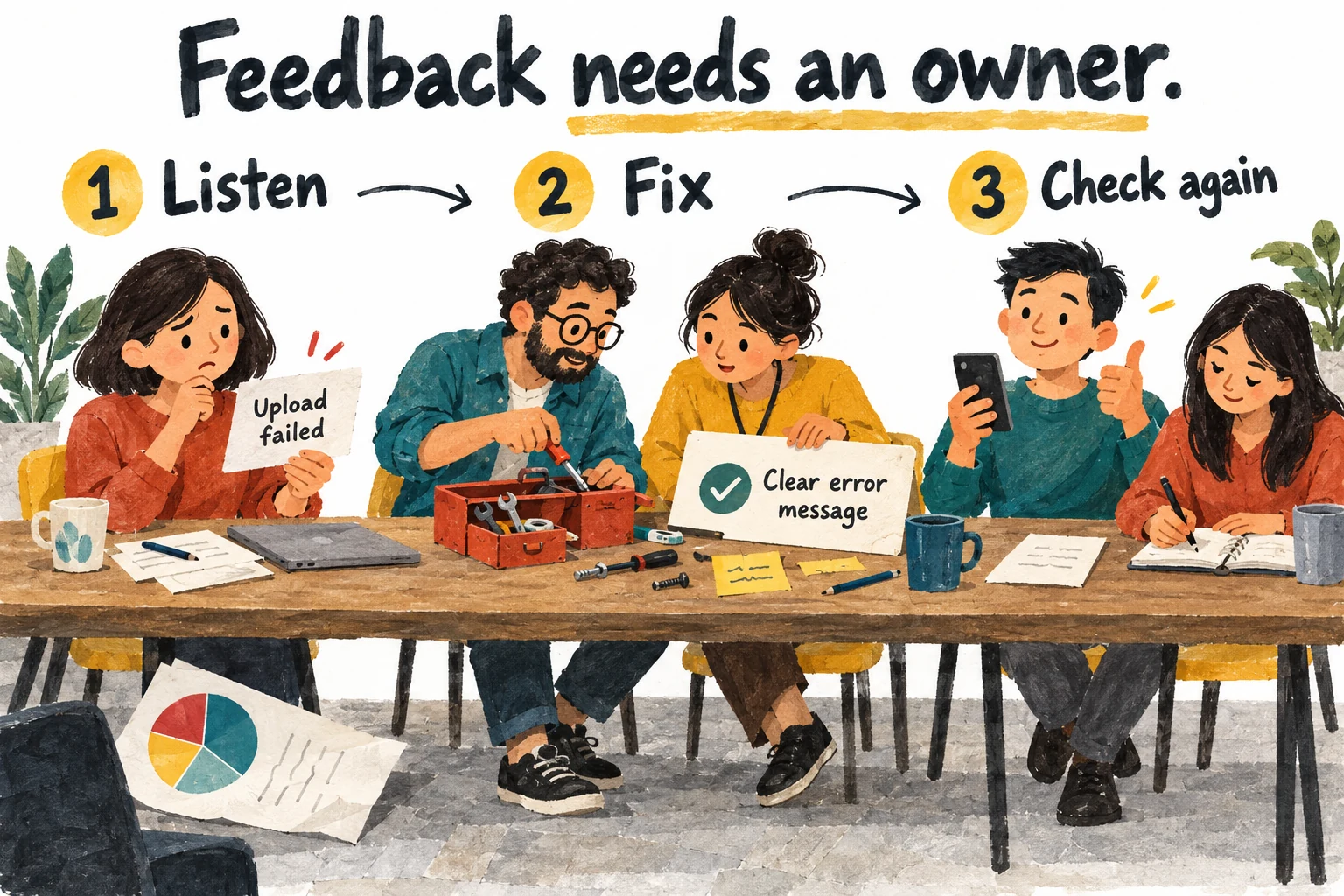
Our third illustration shows the operational loop: a user reports a failed upload, a team improves the error message and someone checks the revised experience. It does not claim that this is an automatic AkioSurvey feature or a measured outcome. The important element is an owner. Without a named person and a concrete next step, useful feedback can remain suspended between the support inbox and the product roadmap indefinitely.

After making a change, examine the same task again with suitable users. Keep the question and conditions comparable where you intend to compare results, while noting material differences. Do not interpret a happier comment as proof that revenue or retention improved. It can still be valuable evidence that an explanation became clearer. Product learning works best when each claim stays close to what was actually observed, rather than stretching a small survey into a dramatic business victory.

Sources: App onboarding experience template introduction; MVP feedback template introduction

A team reads feedback about a failed upload improves the error message and checks the revised experience with a user
Our suggested feedback-to-action loop: assign an owner, make a specific change and check the experience again. No improvement rate is implied.

Export is the bridge between a convenient chart and a defensible finding

The creation guide describes reviewing individual responses and summaries and exporting them to XLS, CSV or PDF. That matters because a dashboard view may not be the final form of your analysis. You may need to compare a subgroup, examine comments beside a selected answer or retain a stable copy for a later review. Test the export with known dummy responses before relying on it for a live project.

Build a tiny test dataset containing the cases that usually expose ambiguity: a skipped optional field, a genuine zero, a not-applicable choice, a long comment and an answer containing punctuation or non-English characters. Open the result in the software your team will actually use. Check column labels and whether the values retain the distinction you intended. This is a proposed acceptance test, not a claim that any of these cases currently fail in AkioSurvey.

Keep an untouched original export and perform cleanup in a separate working copy. Note any exclusions and why they were made. If you group comments into themes, retain enough context to avoid making a person's answer sound more definite than it was. A concise explanation of how the data became the final chart is more useful than a complicated visualization that nobody can reproduce a week later.

Show the denominator when reporting proportions, especially for branched questions. Ten people answering a follow-up is not the same as ten people out of the entire invitation list. Distinguish the number invited, the number responding and the number eligible for the particular item. You do not need to turn every internal report into a statistics paper. You do need to make it difficult for a busy reader to mistake a narrow finding for a universal one.

Sources: Survey creation, preview, distribution and reporting guide; Documented question types, validation and informative elements

Treat privacy claims as a starting conversation, not a completed assessment

The home page makes broad assurances about data handling. The published agreement identifies the customer as controller of survey information and the provider as processor, and allows processing through other providers used by the licensor. Its stated effective date is January 2016. These public statements do not establish every current technical or contractual detail a business may need. Ask for up-to-date documentation appropriate to the information you plan to collect.

A sensible request distinguishes several questions: where the data is stored, who can access it, how deletion works, what service providers are involved and which account protections are available. If AI generation is part of the workflow, ask what prompt information is transmitted and retained. We have not independently verified these controls. An absence of confirmation in this review is not proof that a control is absent, but it is a reason not to promise it to your own participants.

For ordinary low-sensitivity product feedback, you may be able to reduce risk substantially by asking less. Avoid collecting details that are not required for the decision, set a retention plan and restrict the copies circulated internally. For sensitive or regulated research, involve the people responsible for privacy and security in your organization before upload. A template labeled for a particular sector does not itself establish that the service is suitable for every kind of data from that sector.

The agreement also contains license-sharing restrictions, so do not assume one purchase is a multi-user research workspace. Confirm seats, roles and any client-use arrangement that matters to you. This is practical procurement caution, not a legal interpretation of the contract. The right plan is the one whose actual permissions and controls match the work, not merely the one with enough questions to hold everything the team could possibly ask.

Sources: AkioSurvey product overview and supported survey workflows; Published agreement, data responsibilities and license restrictions

Run a pilot that can fail before committing the real audience

A good pilot is not a ceremonial click through the happy path. AAPOR recommends testing both the questionnaire and the procedures around collection. For an AkioSurvey evaluation, define a small acceptance checklist before starting. You want to establish that the intended people understand the questions, that the routing behaves as planned and that the resulting data can support the decision. A successful form submission alone proves much less than that.

Use dummy answers for technical checks and a few suitable volunteers for comprehension. Ask a participant to explain what they think an item means before discussing whether they like it. A confusing question can produce a fluent, confident answer that is still unrelated to your intended measure. Record the mismatch and revise the wording. Keep this exercise small and focused so it remains a useful checkpoint rather than a second project competing with the first.

Then test the surrounding operation. Can the person responsible retrieve the result, recognize an unresolved issue and hand it to the right colleague? Can the team distinguish test records from real responses? What happens if the wrong link is distributed or collection needs to close early? Decide these procedures before the campaign, using the controls actually available in the account. Do not assume an undocumented automation will cover a gap because another survey product has one.

Set a clear stop condition for the purchase decision. If a required export, visibility rule or access arrangement cannot be established, pause that use case rather than compensating with optimism. If the core process works and the remaining limitations are acceptable, proceed with a modest first campaign. The point of a pilot is permission to discover a mismatch cheaply. A test that is not allowed to change your mind is mostly a rehearsal for the sales pitch.

Sources: Survey creation, preview, distribution and reporting guide; AAPOR guidance on survey sampling, testing and interpretation

Our verdict: practical survey fundamentals, provided somebody owns the outcome

Our editorial assessment is 76 out of 100: 17 for problem fit, 16 for capabilities, 16 for workflow, 12 for evidence and 15 for value. This is our reasoned buying assessment, not a customer-review average or a measured benchmark. AkioSurvey earns credit for addressing a clear recurring task with documented conditional questions and portable results. Confidence is limited by the account behaviors and organizational controls that have not been independently tested here.

The strongest buyer already has an audience and a repeatable feedback question. They know what action different answers would trigger, can keep the questionnaire focused and will review the results promptly. For that person, the product may reduce friction between asking and understanding. The weakest buyer expects the tool to create research discipline, recruit the right people and persuade colleagues to act simply because a new dashboard is available.

Before paying, confirm the exact license, the necessary features and the complete reporting path. Keep the pilot small enough to inspect manually. Compare it with the process you already have, including setup, analysis and follow-up time. Do not award value points merely for a large allowance, and do not reject a modest tool merely because it lacks an elaborate enterprise story you do not need. Fit is more useful than feature counting.

The final recommendation is conditional but positive for focused small-team feedback. Buy when the documented workflow survives your own pilot and solves a recurring task better than your current arrangement. Skip when a simpler form is sufficient or when essential controls remain unresolved. Most importantly, assign the answers an owner. A survey can tell you where the experience hurts; someone still has to put down the chart, open the task list and fix the thing people took time to explain.

Sources: AkioSurvey product overview and supported survey workflows; Lifetime Silver and Gold offer, allowances and redemption terms; Direct Free, Standard and Professional package comparison

Frequently asked questions

Should I buy Silver or Gold?

Choose from the actual capacity and feature requirements of your survey. The higher allowance alone is not a reason to upgrade; first identify whether branding, identification or response volume genuinely changes the job you can complete.

Does an anonymous-looking link guarantee anonymous feedback?

No. Identification settings, answer content, invitation handling and your own records can affect whether a person is recognizable. Describe the process accurately and avoid collecting details you do not need.

Can AI write the whole questionnaire for me?

It can provide an editable starting point, but you still need to examine what each question assumes, whether the answer choices fit and what decision the result would support.

Will more responses automatically make my findings representative?

No. More replies from the same narrow audience can reinforce an existing blind spot. Define whom you need to hear from and be explicit about the limits of the resulting evidence.

Can I use this review as confirmation of legal compliance?

No. This is a product evaluation, not legal advice or a security assessment. Obtain the current contractual and technical documentation appropriate to your data and organizational requirements before proceeding.

More marketing & seo deals

Marketing & SEO

Inrō

A strong candidate for businesses already receiving relevant Instagram conversations. Start with a narrow, supervised flow and verify the plan's limits. It can improve response handling, but it does not create an audience or make every stored contact reachable.

$59 · checked Nov 14, 2026

Marketing & SEO

Nuwtonic SEO

Nuwtonic SEO monitors rankings, optimizes pages, and generates GEO-ready content for AI search, helping teams improve visibility in both traditional and AI-generated answer ecosystems. The product is designed for teams that need a repeatable marketing & seo process and want clearer control over the core task. It fits best when the buyer has a defined use case, realistic input data, and a way to judge output quality before rolling it out across a wider workflow.

$69 · checked Nov 14, 2026

Marketing & SEO

Skillplate

Skillplate uses an AI agent, Overmind, to help users build products, websites, checkouts, and marketing campaigns from a single platform. This aims to streamline the process of launching and growing an online business. The product is designed for teams that need a repeatable marketing & seo process and want clearer control over the core task. It fits best when the buyer has a defined use case, realistic input data, and a way to judge output quality before rolling it out across a wider workflow.

$79 · checked Nov 5, 2026

Marketing & SEO

SheetXAI

SheetXAI automates spreadsheet tasks using AI and natural language, eliminating the need for formulas or coding. It integrates directly with Excel and Google Sheets, streamlining data cleaning, content generation, and bulk operations. This tool is suitable for teams seeking to automate repetitive spreadsheet workflows, allowing them to focus on strategic tasks rather than manual data management.

$49 · checked Nov 6, 2026

Deal alerts

Get marketing & seo deal alerts by email.

SoftScout will send short buying notes when offers like AkioSurvey look worth checking or worth skipping.

Short buyer verdicts

Useful offers before checkout

Editorial note

Our 76/100 score rewards a clear feedback use case and practical survey fundamentals. Unverified operational controls, package differences and the lack of a hands-on account test limit confidence. A smaller well-designed survey is a better purchase outcome than a large unused allowance.

For vendors

Have a better deal for AkioSurvey?

Send current partner terms, coupon limits, refund rules, and the best buyer fit. We review offers before adding them to SoftScout pages or Telegram alerts.

Submit terms