Back to deals
Content & WritingLifetime Deal

AudioHero Lifetime Deal: buy or skip?

A useful candidate for solo video and podcast creators who regularly need music and effects together. Audition it against a real brief, confirm the license and account terms, and keep evidence with each project. Royalty-free does not mean claim-proof.

Product overview

What AudioHero does

AudioHero is a stock audio library with music, sound effects, search tools and an additional sound generator. The meaningful question is whether it helps you finish a particular edit, not how many files its catalog contains.

This research-based review separates advertised access from daily download policy, finished-production rights from raw-file redistribution, and supported capabilities from our suggested production workflow. Audio quality and search speed have not been benchmarked hands-on.

Read the full AudioHero review

Best for

  • Solo creators making recurring narrated videos, tutorials or podcasts
  • Editors needing both music beds and specific sound effects within one library
  • Freelancers willing to manage license evidence and clarify client deliverables

Why we picked it

  • Music and sound effects can serve different stages of the same production
  • Search and alternate versions may reduce unnecessary manual editing
  • A documented license trail makes client delivery and later support requests easier to explain

Check before buying

  • Audition candidates against one real narration, one transition and one atmosphere requirement, recording search time and rejected matches rather than catalog size.
  • Confirm the offer, daily limit, number of users, client handoff and new-production rights in the exact license associated with the purchase.
  • Save track identifiers, invoice, applicable terms and project dates, then test the exported mix and examine any platform claim before deciding how to respond.

Buy if

A representative edit proves that the library contains suitable music and effects without excessive searching.

Verify first

Audition candidates against one real narration, one transition and one atmosphere requirement, recording search time and rejected matches rather than catalog size.

Skip if

You need exclusive music ownership, raw audio resale rights or an unrestricted shared library for several editors.

SoftScout sends you to the source after the risk checks, so you can verify live terms before buying instead of trusting stale coupon text.

Check Source Offer

Source transparency

Source
Source marketplace
Link type
Source page
Last checked
Oct 28, 2026

Buyer checklist

  • Audition candidates against one real narration, one transition and one atmosphere requirement, recording search time and rejected matches rather than catalog size.
  • Confirm the offer, daily limit, number of users, client handoff and new-production rights in the exact license associated with the purchase.
  • Save track identifiers, invoice, applicable terms and project dates, then test the exported mix and examine any platform claim before deciding how to respond.

AudioHero: the buying decision

AudioHero puts music and detailed sound effects in one searchable production library, which can be useful for a creator who needs both an unobtrusive narration bed and precise scene sounds. Its value depends on finding suitable material quickly and maintaining a clear license trail, not merely having access to a large catalog.

Research-based review, not a hands-on test. Sources checked on 2026-10-24. The assessment below is our editorial judgment, not a customer rating. Editorial assessment: 80/100.

Consider it if

  • A representative edit proves that the library contains suitable music and effects without excessive searching.
  • Your single-user production workflow and client deliverables fit the confirmed synchronization license.
  • The final offer terms and actual recurring need justify another audio source after accounting for subscriptions you already have.

Skip it if

  • You need exclusive music ownership, raw audio resale rights or an unrestricted shared library for several editors.
  • Your intended workflow feeds library recordings into external generative systems without separate authorization.
  • You expect any stock-audio provider to guarantee that a platform will never issue a claim or interrupt a release.
Problem fit: 18/20
Creators repeatedly need affordable music and precise effects together, and a single production library can address that recurring practical requirement.
Capabilities: 17/20
Search, playlists, alternate versions and a sound generator cover useful discovery needs, but compatibility and plan-specific behavior require a trial.
Workflow fit: 15/20
A structured selection and evidence process is workable, although mixing, rights checks and occasional claim handling remain the editor's responsibility.
Evidence confidence: 14/20
Detailed licensing and support pages expose real boundaries, while unlimited-download wording conflicts with the FAQ and no independent listening benchmark was performed.
Value: 16/20
Frequent solo production can justify the checked one-time price, whereas occasional use, existing subscriptions and team requirements can weaken the purchase case.

AudioHero review: a library earns its place in the finished edit

A stock audio subscription is easy to buy and surprisingly easy to use badly. The trailer-sized drum hit is available, the timeline has an empty track, and suddenly a screen recording about invoice settings sounds like the final evacuation of a space station. AudioHero is interesting because it offers both music and sound effects in one place. Whether that breadth helps depends on your ability to select the few sounds that actually improve the piece.

The vendor advertises more than 300,000 tracks and effects. We have not independently counted them or conducted a listening benchmark. The useful buyer question is smaller: can you find an appropriate background bed, a convincing specific effect and a workable ending for the kind of content you actually publish? A large library with poor matches to your style may be less useful than a modest collection you understand well.

This assessment draws on current product pages, license terms, support documentation and relevant YouTube and Adobe guidance, checked on October 24, 2026. It separates documented capabilities from suggested workflows. No claims of measured search speed, avoided copyright problems or improved audience retention come from a private trial. The examples below are practical ways to investigate fit rather than results we can promise on your behalf.

Our overall view is positive for a solo creator who needs varied production audio frequently and will maintain reasonable records. It is more cautious for teams, buyers seeking exclusive ownership, and anyone expecting a library purchase to remove every platform or licensing complication. AudioHero supplies ingredients and access. It does not decide what belongs in your film, mix the dialogue for you or replace the responsibility to understand a client's delivery requirements.

Sources: AudioHero direct lifetime offer; Current AudioHero offer, included features and account limits

Check the $105 offer against the account you are actually buying

The checked offer shows $105 for lifetime access with one user, a sixty-day redemption requirement and stated sixty-day refund protection. The direct lifetime page separately advertises $199 using a promotion code. Neither number is a completed checkout result in this review. Before paying, compare the actual final total, account entitlement and applicable terms. A general website banner should not be treated as evidence that every older license receives every new capability.

That last point matters here because the offer specifically distinguishes the 2018 and 2019 lifetime deals from the current one. An existing customer should inspect their current account before assuming they need a second purchase or that an upgrade is automatic. The cheapest redundant account is still a redundant account. If a feature is essential, ask for confirmation tied to your license rather than relying on a screenshot of someone else's dashboard.

Evaluate the price per useful production, not per available file. Suppose, purely as an illustration, a $105 purchase supports twenty suitable projects: the upfront access cost spreads to $5.25 per project before your time and other expenses. At two projects it is $52.50 each. That arithmetic does not predict future output or service longevity. It simply exposes why frequent creators and occasional hobbyists may reach different sensible decisions about the same offer.

Include existing subscriptions in that decision. You may already have adequate music through another tool, while your real gap is a small set of specific effects. Alternatively, one combined source may simplify a scattered process. Write down the gap before comparing prices. Buying because a discount looks impressive is an efficient way to build a collection of login screens, which is not generally the deliverable a client had in mind.

Sources: Current AudioHero offer, included features and account limits; AudioHero direct lifetime offer

Start with a sound brief, not an endless search session

AudioHero advertises plain-language and similarity search together with filters such as mood, genre, duration and tempo. Those are useful discovery mechanisms, but their practical value needs to be established against a real request. Start with a short brief: what the viewer should feel, where speech must remain clear, how long the cue needs to last, and what should happen at the ending. These are more actionable criteria than searching for something vaguely cinematic.

For a software demonstration, a hypothetical brief might request a restrained, steady instrumental bed with no attention-grabbing lead line, a calm introduction and an ending that can resolve around the final instruction. For an energetic product announcement, the desired shape might be different. The point is not that one genre is inherently correct. It is that a stated purpose makes it possible to reject attractive but unsuitable tracks without spending another hour negotiating with yourself.

Build a shortlist of three candidates and compare them under the same rough cut. Do not audition one at a flattering volume and another barely audible. Note the exact reason each fails: distracting melody, an early climax, a change of mood, insufficient space for speech or an awkward finish. That record teaches you which search terms work for your projects. It also gives a collaborator something more useful than an unexplained preference for the second option.

Use similarity search with material you are allowed to upload, and avoid sending unreleased client audio without permission. A reference can communicate rhythm or texture, but resemblance is not a license to imitate another recording closely. If a result feels too close to a recognizable work for the intended use, choose a different direction or seek appropriate advice. Discovery assistance should expand the search, not turn creative judgment into a similarity contest.
Sources: Current AudioHero offer, included features and account limits

Treat alternate versions as an editing advantage, not a universal promise

The FAQ says many compositions have shorter edits, underscore or rhythm versions; it does not promise every track has every variant or separated stems. Check the specific candidate. An underscore may work better beneath narration than a full arrangement that sounded impressive alone. A ready-made shorter ending can also be more natural than cutting a track at an arbitrary moment and hoping the fade conceals the interruption.

Listen to the opening, middle and ending before committing the edit. A track that starts restrained may introduce a prominent melody later. That change can clash with the most information-heavy section of a tutorial. Conversely, a cue with an intentional build may provide a useful transition if the script has a matching turn. Place the music against the story rather than assuming its first fifteen seconds describe the whole recording.

For recurring series, consider whether a small family of related cues supports consistency without making every episode sound identical. A main bed, a quieter variant and a brief ending can be enough. Keep the choice connected to the audience and subject. A technical explainer and an emotional customer story can share a brand while using different sonic energy. Consistency means recognizable judgment, not necessarily the same loop under every sentence.

Do not spend the whole revision allowance rebuilding a cue that almost works. If the structure requires repeated awkward cuts, a different track may be the better production decision. This is where auditioning alternatives early has tangible value. The library should save you from forcing unsuitable material into place. It should not become a vast warehouse of parts from which you reluctantly assemble one exhausted minute of background music.

Sources: AudioHero formats, download limits, subscriptions and support FAQ

Keep narration in front and let music do a quieter job

A useful music bed can provide continuity and emotional direction without demanding conscious attention. For spoken tutorials, start by making the voice intelligible on its own, then bring music underneath it. If you need to raise the narration repeatedly to defeat a busy arrangement, try a less crowded cue. Choosing appropriate material is often a cleaner solution than treating the mix as an argument that the voice must win through volume.

Adobe documents automatic ducking in Premiere: music or ambience can be reduced in response to tagged dialogue, with adjustable behavior and editable keyframes. This is an editor capability, not a claim that AudioHero mixes your video automatically. Use it as a starting point and listen to the transitions. A mechanically correct dip can still feel abrupt, or rise into a pause where the speaker is about to deliver an important final word.

There is no single volume setting in this review that guarantees a good result across recordings, voices and playback devices. Try the mix through headphones and the ordinary speaker a viewer is likely to use. Pay particular attention to consonants, quiet phrases and quick instructions. If a listener needs subtitles just to compete with the soundtrack, the music has been promoted beyond its job description. Lowering it is usually cheaper than asking the audience to concentrate harder.

Silence is also a valid production choice. A difficult instruction, a meaningful pause or a concise conclusion may work better without a continuous bed. Compare versions with and without music before assuming more sound means more polish. The evaluation should concern whether the viewer understands and feels the intended moment. A catalog can offer many possible additions; good editing includes deciding which of those additions the piece does not need.

Sources: Adobe Premiere dialogue-aware audio ducking

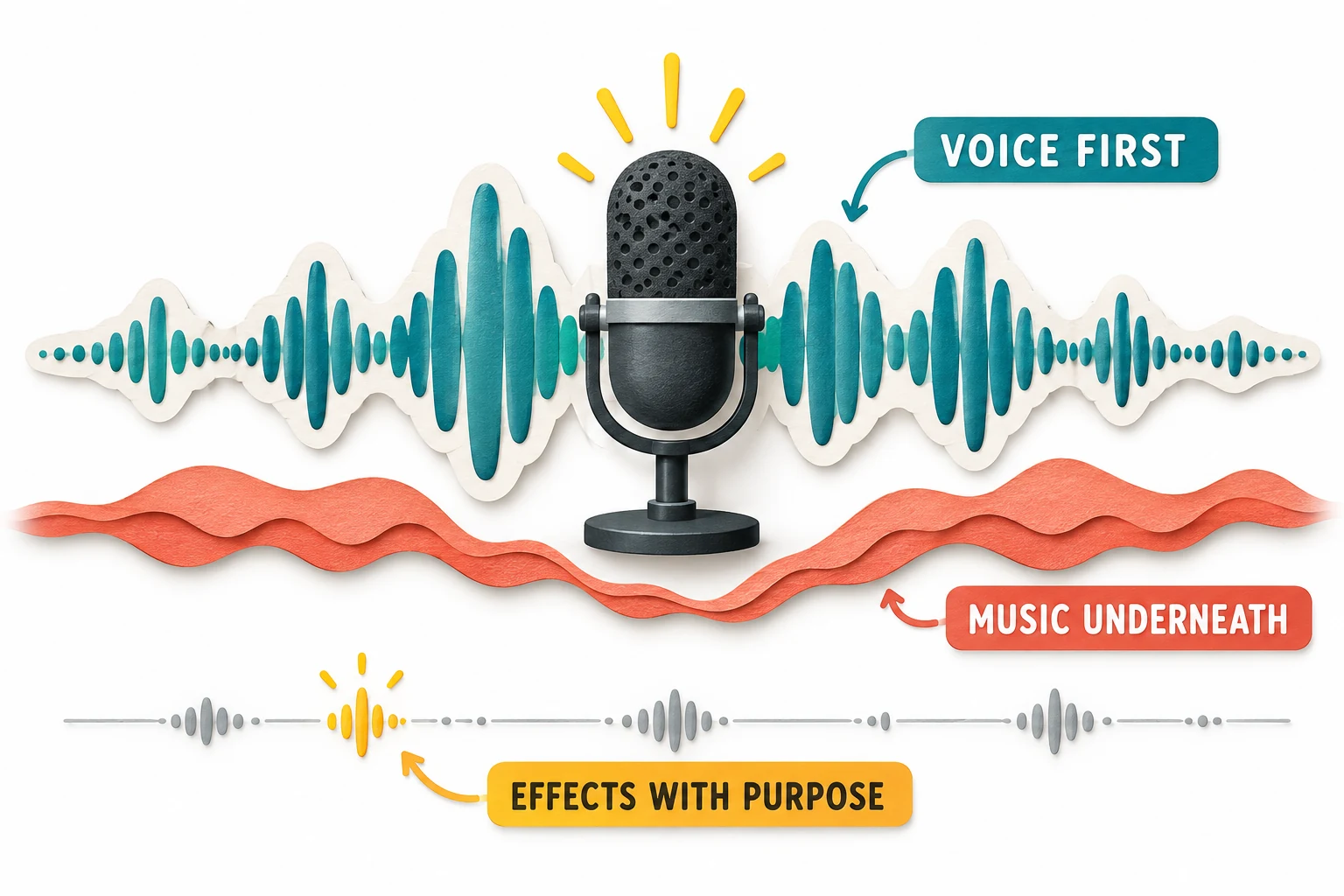
A foreground microphone and speech waveform sit above quieter music and occasional purposeful sound effects
Conceptual mixing illustration, not an AudioHero interface or measured waveform. In a narrated video, the music supports the message rather than competing with it.

Use sound effects to explain a moment rather than decorate every cut

A broad effects library is especially useful when a scene needs a specific physical texture: a small latch, a distant mechanism, a subtle movement or an appropriate ambience. Search with the action, material and perspective in mind. A close metallic click and a distant industrial impact may share a keyword but serve entirely different purposes. The correct effect should make the scene more convincing, not merely prove that an effect was available.

For an on-screen interface demonstration, consider what an added click communicates. It can draw attention to an important change, but a loud sound for every cursor movement soon becomes tiring. Use repetition deliberately. A recurring confirmation tone might establish a pattern; the same dramatic sweep on every transition can turn a useful lesson into an unusually elaborate presentation template. The person watching still wants to know which setting to change.

Audition effects at the intended point in the edit and inspect their start and decay. A long tail can overlap the next line of speech. A strong low-frequency impact may feel impressive on headphones but disappear or distort on a small speaker. These are reasons to test the final mix rather than judge a file in isolation. No description or waveform alone establishes how the sound will behave in your particular sequence.

Keep a short note explaining the purpose of each prominent effect. Attention cue, continuity, location and emotional emphasis are different jobs. If an effect has no clear purpose, try removing it. This makes client revisions easier too: you can discuss what the sound contributes instead of defending it because you spent twenty minutes finding it. The time spent searching is already spent; it is not a reason to keep an unnecessary noise.

Sources: AudioHero direct lifetime offer

Choose practical file formats and plan around the real daily limit

The documented download formats are 16-bit 44.1 kHz Broadcast WAV and 320 kbit MP3. The FAQ also specifies 100 downloads per day, despite unlimited-download language elsewhere. Confirm the policy for your account before planning a large batch. For an ordinary small production that limit may be ample; for a deadline involving extensive effects selection, the difference between a marketing headline and operational allowance becomes relevant.

Use a format that fits the editing and delivery workflow, and verify that your editor handles it correctly. Do not assume a downloaded file matches every project setting without checking. Keep the original authorized download identifiable rather than repeatedly exporting and renaming it until its provenance disappears. A project folder containing several indistinguishable files called final-music-new is not an asset-management strategy, even if one of them eventually sounds right.

Preview first and download purposeful candidates rather than attempting to accumulate the entire library. Apart from the account policy, indiscriminate downloading creates a selection and recordkeeping problem. A focused shortlist is easier to compare, license and revisit. If a production genuinely needs a large number of effects, organize the requirements by scene and priority so an account limit does not become a surprise at the most time-sensitive stage.

Check file integrity and the complete duration after downloading. Then confirm the final export contains the intended version, not a preview, an old alternate or a muted track. This is straightforward quality control, but it catches mistakes a feature comparison cannot. The value of convenient access is realized only when the correct audio reaches the finished work with a traceable identity and without creating an avoidable late-night reconstruction exercise.

Sources: AudioHero formats, download limits, subscriptions and support FAQ

An editor extension is convenient only when the complete workflow works

The offer lists a Premiere extension. We have not installed it or verified compatibility with every current operating system and editor version. Treat that as something to test in your environment, not an assurance that every integration label means an equally deep native connection. A dependable file-download workflow can still be sufficient; a plugin that disrupts a stable production environment is not automatically an upgrade just because it saves a browser switch.

Test the round trip on a disposable project: find the candidate, bring it into the editor, move the project folder, reopen it and confirm the media remains linked. Record where the file lives and whether a collaborator could understand that location without your memory. This does not authorize sharing a single-user library. It is a way to avoid accidental dependence on a temporary folder or a machine-specific path during ordinary editing.

For joins between cues, Adobe describes several crossfade types, including Constant Power, Constant Gain and Exponential Fade. Their behavior differs, so listen rather than selecting one by habit. The main production test is whether the transition feels appropriate in context and avoids an unwanted jump or gap. A smooth technical join can still be a poor musical decision if it connects two incompatible moods or interrupts a phrase awkwardly.

Keep the editing decision separate from the product evaluation. AudioHero may provide a suitable file while your chosen transition needs work; a beautifully executed fade may also conceal the fact that the selected music never suited the scene. Diagnose the layer that failed. This makes a trial much more informative than concluding that the whole service is good or bad from one rough edit assembled under deadline pressure.

Sources: Current AudioHero offer, included features and account limits; Adobe Premiere audio crossfade types

Understand synchronization before promising a client raw source files

The core license grants synchronization rights, not copyright ownership. It is single-user and prohibits redistributing unsynchronized recordings. Rights in a finished production can pass to its end user. That makes a completed client video materially different from handing over a reusable folder of stock audio. The exact license controls; this is a buyer-oriented explanation, not a legal opinion about a particular contract or disputed use.

Define deliverables before quoting the job. A client may casually request all source files while expecting to reuse music in future campaigns with a different editor. Ask what they actually need: a finished master, versions in several aspect ratios, an editable project, or unrestricted access to every underlying asset. Those are different deliverables. Clarifying them early is more professional than discovering a licensing mismatch after both parties believe the project is complete.

If editable delivery is essential, obtain a clear answer from the provider about the proposed transfer and any separate license the client or next editor needs. Describe the real workflow instead of asking an abstract question about commercial use. Include who will access the files, whether they will create new productions and how the audio will be stored. A precise support answer is easier to apply than a general reassurance detached from the actual requirement.

For broadcast or public performance, the license also identifies cue-sheet considerations. Do not assume online-video arrangements answer every distribution question. Ask the distributor what documentation it requires and seek appropriate professional advice for consequential uncertainty. Administrative detail is not the glamorous part of an edit, but a clear rights package can matter more to a commercial buyer than another dramatic transition. Nobody should discover the scope of the delivery only after launch.

Sources: AudioHero synchronization license and restrictions

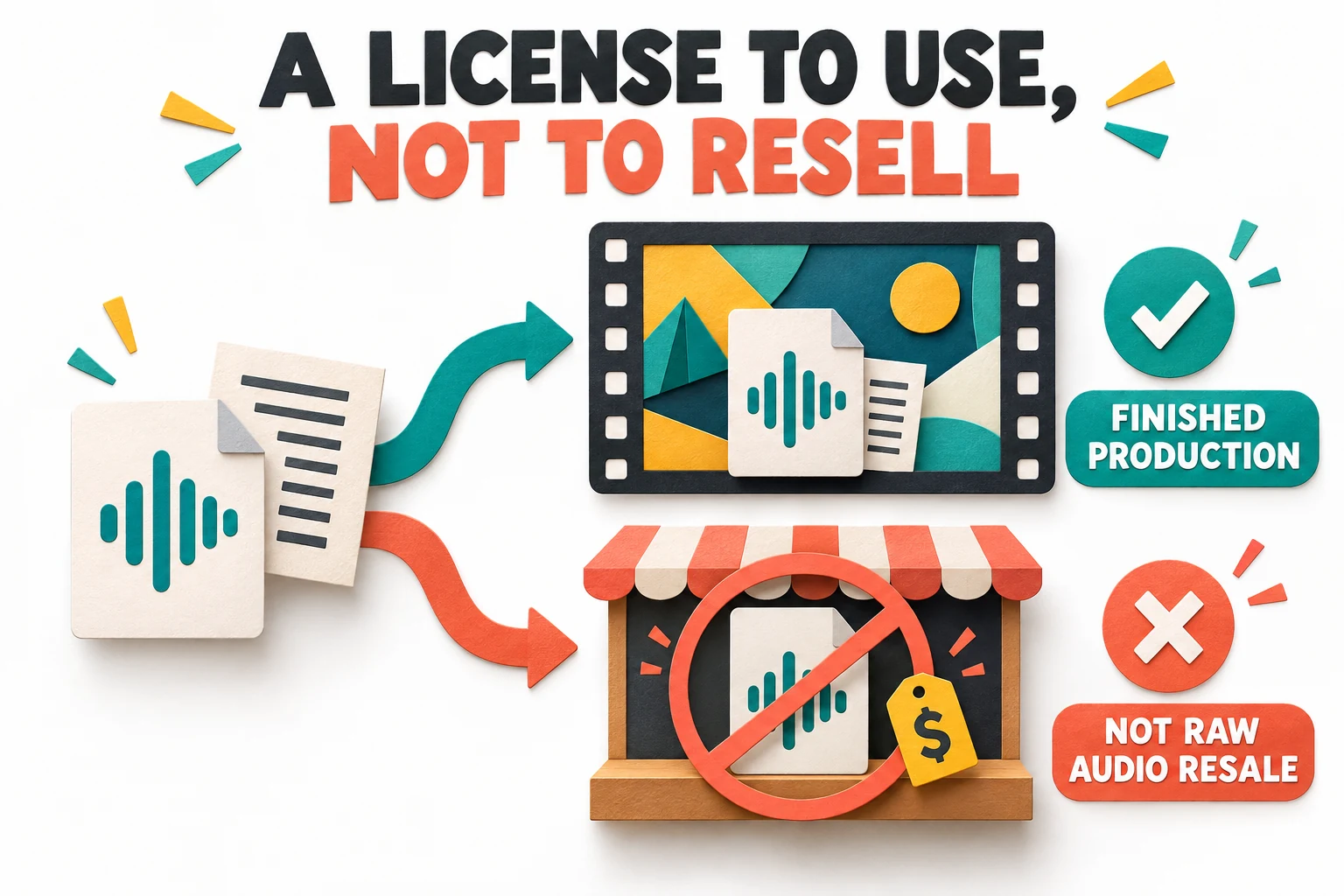
A licensed audio file goes into a finished video while standalone raw audio resale is crossed out
Simplified illustration of synchronized production versus raw-file redistribution. Check the actual license and any special use with the vendor; this diagram is not legal advice.

Lifetime access, subscription access and a bundle are different purchases

The vendor distinguishes continuing rights in productions made during an active subscription from permission for new uses after it ends. It separately describes bundles as perpetual licenses for their included tracks. A lifetime catalog offer is another access arrangement again. Do not collapse these into a single assumption that every downloaded file can be used forever in every new project regardless of the product purchased.

Write down the purchase type and the source of the entitlement alongside the project records. For an existing customer, an old receipt may describe a different package from the one currently advertised. If you are planning to cancel a subscription or move to another account, clarify unfinished projects and later revisions before the change. A general marketing sentence is a weak foundation for deciding whether a substantially new production is covered.

The practical question for a recurring client is often not whether the original video can remain online, but what happens when they request a new version next year. A minor correction, a new campaign and a new production may raise different questions under the applicable terms. Do not invent a universal answer. Describe the intended change to the vendor when it matters, and retain the reply with the relevant license evidence.

This is also why bulk downloading is not a sensible substitute for understanding access rights. Having a file on a drive does not by itself establish permission for a later use. A well-organized small collection tied to real projects is easier to manage than a large archive whose origin and permissions are unclear. The benefit you are buying is authorized production capability, not a contest to see who can occupy the most storage.

Sources: AudioHero formats, download limits, subscriptions and support FAQ; AudioHero direct lifetime offer

A YouTube claim is a workflow issue to investigate, not a promised impossibility

YouTube explains that Content ID matches can lead to blocking, monetization or tracking, potentially by territory, and that claims differ from copyright strikes. It also specifies that Shorts longer than one minute with an active claim are blocked. These rules make it inappropriate to describe any licensed library as guaranteed claim-proof. Permission to use a recording and an automated system recognizing that permission are not the same event.

Before a consequential release, allow time to inspect the uploaded video's status and any identified segment. Check the actual track, claimant and production history rather than reacting only to a warning email. Do not assume an unfamiliar claimant is necessarily fraudulent or that every claim requires the same response. The objective is to understand the specific issue with enough evidence to choose a valid next step, not to win an argument with a dashboard.

YouTube's dispute guidance requires a valid basis, such as having the necessary rights or a genuine identification error. Merely crediting the artist, owning a copy or not monetizing is insufficient. The initial claimant response period can be thirty days, and unsupported escalation carries risk. Use the current platform guidance and seek qualified advice when uncertain. A release calendar should not depend on a support process resolving instantly just because the video is ready.

Maintain an alternative production plan for time-critical work. That might mean selecting another properly licensed cue and preserving the original edit, subject to the client's approval. It does not mean evading a legitimate restriction or changing audio to defeat detection. The sensible goal is a lawful, understandable release with fewer surprises. A provider's helpful support can be valuable, but it is not the same as a guarantee about another company's decisions.

Sources: YouTube copyright claims, restrictions and Shorts; YouTube valid reasons and process for disputing copyright claims

Build the evidence folder while the details are still easy to find

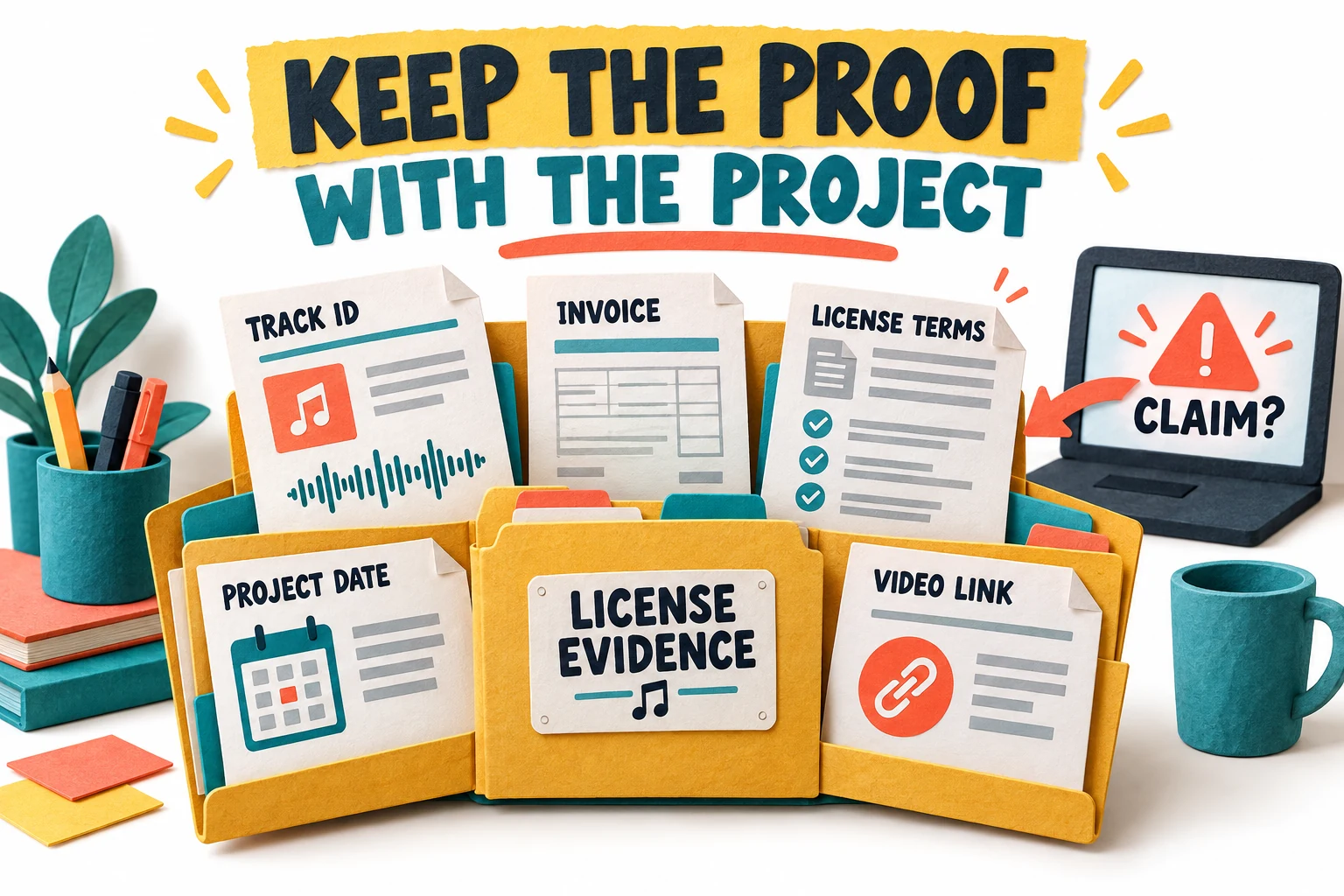
Our suggested project record contains the track title and identifier, source link, invoice, applicable license terms, account entitlement and dates connecting the audio to the production. Add the final video link when one exists. Keep this material with the project rather than relying entirely on a browser history or a person's memory. The FAQ warns that invoices disappear from the account after unsubscribing, so preserve your records before making account changes.

Use a simple naming convention that distinguishes the licensed source from edited derivatives and final exports. The record should let a future editor identify which piece of audio is in the timeline without playing twenty similar files. Include a note when an alternate version is used. A claim against a thirty-second edit is easier to investigate when you know which underlying recording it came from and have not renamed every asset to something inspirational.

If a claim arises, assemble the relevant evidence before contacting support. Explain the specific affected video and segment, the track identity and the entitlement under which the production was made. AudioHero's FAQ describes a support escalation path, but we do not treat it as a guaranteed resolution time. A concise, complete request is more actionable than a message saying that the channel is broken with no link, screenshot or recording identifier.

Keep access to the evidence proportionate to the project. An invoice can contain personal or billing information that should not be posted publicly as proof. Share only what a legitimate support process needs through an appropriate channel. Good recordkeeping is not a demand to publish your account history; it is a way to make authorized use explainable when someone with a valid reason asks. That is a useful production habit regardless of the library selected.

Sources: AudioHero formats, download limits, subscriptions and support FAQ; YouTube valid reasons and process for disputing copyright claims

An organized project folder keeps track identifiers invoices license terms project dates and the video link together
Our suggested evidence pack. Keeping documents together can make a support request clearer, but it does not guarantee that a claim will be removed or resolved by a deadline.

The sound generator does not remove the library's AI restrictions

AudioHero now describes a sound generator included with membership. Its own explanation ties generated output to the license and synchronized productions rather than unrestricted raw-file resale. Meanwhile, the library license prohibits feeding its recordings into external AI, machine-learning or neural-network systems. The existence of a vendor-operated generator is not permission to upload licensed catalog files into any other model you prefer.

Evaluate generated effects on the same production criteria as recorded ones. Does the sound fit the action, have a clean beginning and ending, and avoid unwanted artifacts? Does it introduce something that was not requested? Do not assume a compelling prompt produces a usable result automatically. For a precisely timed mechanical effect, listening and synchronization still matter. The generator changes how a candidate is obtained, not whether the candidate needs editorial judgment.

Use a concrete hypothetical brief when testing: a short soft switch movement in a quiet room, for example, rather than an expansive cinematic description with several conflicting actions. Compare the result with an existing library option. If a recorded effect already solves the need, generation may add iteration without adding value. If a highly particular sound is missing, a generator may be useful, provided the account entitlement and intended use are clear.

Avoid promising exclusivity, ownership beyond the terms or universal acceptance by distributors. Ask the relevant client or platform about any requirements concerning generated assets, and keep the origin distinguishable in your project notes. The creative attraction is understandable: a difficult sound might become easier to obtain. The purchasing mistake would be treating that convenience as a blanket answer to rights, quality and disclosure questions that still depend on the actual production.

Sources: AudioHero sound generator and separate licensing explanation; AudioHero synchronization license and restrictions

Choose a team workflow that does not quietly become account sharing

A solo editor and a small studio have different requirements even if they publish the same number of videos. The checked offer grants one user per account, and the license restricts access to unsynchronized recordings. Do not assume a shared drive full of raw assets is covered because everyone works for the same client. If several people need to search, download or reuse files, confirm an appropriate arrangement before building the process around it.

Map the handoff explicitly. One person may select music, another may edit and a third may manage client delivery. Determine who needs access to the original recording and who only needs to review a finished draft. These distinctions can reduce unnecessary sharing without obstructing collaboration. A review link to a rendered production and access to a reusable sound library are not interchangeable, either practically or under the license.

Think about staff changes as well. A project should not depend on a personal account whose owner is unavailable when the client asks for a revision. That does not justify transferring a nontransferable license informally. It means the business should obtain the right account structure and retain understandable records from the beginning. Ask the provider about the real continuity requirement, including who may handle future edits and where authorized assets can remain.

For a one-person business, this may be straightforward. For a distributed agency, account and handoff requirements may outweigh an attractive individual price. That is not a flaw in either business model; it is a fit question. Evaluate the total cost of doing the work correctly instead of multiplying a solo-use headline by an imaginary number of editors. A bargain becomes less convincing when the proposed workflow depends on ignoring its central limitation.

Sources: AudioHero synchronization license and restrictions; Current AudioHero offer, included features and account limits

Run one complete pilot before making it your default audio source

Choose a representative project with a real script and a defined destination. Include one narration bed, one purposeful effect and one ending or transition. Set a reasonable search window, shortlist candidates and record the reasons for your choices. This gives you a practical comparison with your existing workflow. The important result is whether you can make an appropriate finished piece with acceptable effort, not whether the browsing session felt entertaining.

Then take the candidate all the way through editing and export. Check speech clarity, musical structure, effect timing, file identity and the complete ending. Ask another person to watch without explaining what they should notice. A useful question is whether anything made the message harder to follow. Avoid leading them toward praise for the soundtrack; the best background choice may be the one they do not consciously notice at all.

Complete the administrative part too: save the entitlement, confirm the delivery scope and prepare the evidence folder. For an authorized upload, examine the platform status before committing a release schedule. No clean initial upload proves that a later claim is impossible, but the exercise reveals practical friction. If support clarification is essential, obtain it while a purchasing decision can still be reconsidered under the applicable offer terms.

Compare the outcome honestly. Did AudioHero provide a sound you could not otherwise find, reduce time spent switching sources, or make the result more appropriate? Did it introduce account, licensing or editing work that cancels those benefits? Keep the successful cue and lessons even if the purchase is not right. A pilot is valuable when it prevents an unsuitable commitment as well as when it confirms a good one.

Sources: Current AudioHero offer, included features and account limits; Adobe Premiere dialogue-aware audio ducking

Our verdict: 80 out of 100 for a disciplined solo production workflow

Our editorial score is 80 out of 100, formed from five separate judgments rather than copied from a donor site's average or review count. Problem fit receives 18, capabilities 17, workflow 15, evidence 14 and value 16. It is an assessment of the documented buying proposition, not a measurement of listening quality or a prediction of your revenue. A product can have a useful offer and still require a careful trial.

The strongest case is a creator who regularly needs both music and detailed effects and can find suitable material efficiently. The combined library and search options address a real recurring task. The main deductions reflect unresolved practical questions: the difference between unlimited marketing and the documented daily cap, account-specific entitlements, rights management and the absence of our own compatibility or listening benchmark. Those limits should remain visible rather than disappear behind an enthusiastic score.

Consider buying when a complete pilot works, the selected license matches your delivery obligations and the total cost improves on what you already have. Skip or delay when you need shared raw assets, exclusive ownership, unsupported AI uses or a guarantee of zero platform claims. Occasional users should also compare the purchase with a smaller authorized source that meets their actual needs. More available audio is not automatically more useful audio.

The practical recommendation is simple: let the finished edit make the case. If the voice remains clear, the effects have a purpose, the rights are understood and the records are easy to retrieve, AudioHero may earn a place in your production toolkit. If the main achievement is that you now have hundreds of thousands of possible choices and no finished video, the library has not yet solved the problem you bought it for.

Sources: Current AudioHero offer, included features and account limits; AudioHero formats, download limits, subscriptions and support FAQ; AudioHero synchronization license and restrictions

Frequently asked questions

Is AudioHero really unlimited?

The offer uses unlimited-download language, while the vendor FAQ specifies 100 downloads per day. Confirm the policy for the account you intend to buy, especially if a production requires substantial batch downloading.

Does royalty-free mean YouTube cannot issue a claim?

No. Licensing and platform detection are different systems. Keep evidence of the specific track and permitted use, inspect any claim and follow the current platform process only when you have a valid basis.

Can a client receive the finished video?

The license provides for rights in a synchronized production passing to its end user. That is different from giving the client a reusable raw audio library; clarify editable project and source-file delivery before agreeing to it.

Can I train an AI tool with AudioHero tracks?

The library license prohibits use in AI, machine-learning or neural-network systems. The vendor's own sound generator does not grant you general permission to upload licensed library files into another model or service.

Have you tested the sound quality yourself?

This is a source-researched editorial assessment, not a listening benchmark. The proposed audition and mixing exercises are a way for a buyer to establish suitability on their own material before relying on the service.

More content & writing deals

Content & Writing

Keyshift AI

Keyshift AI addresses the inefficiency of switching between applications and AI tools for text refinement. It allows Windows and Mac users to rewrite, translate, or summarize text directly within any app using keyboard shortcuts or voice input. This streamlines content creation and communication for individuals and teams who frequently work with text across various platforms, enhancing productivity without leaving their current workflow.

$19 · checked Nov 5, 2026

Content & Writing

Aivolut Books

The product addresses the challenge of maintaining consistency and structure when writing long-form content with AI. It provides a guided workflow to turn ideas or source material into structured drafts, covers, and metadata. This tool is suitable for individuals and small teams focused on efficient content creation and publishing, aiming to streamline the book production process.

$59 · checked Nov 11, 2026

Content & Writing

Vocable AI

Vocable AI generates 30 days of multichannel content plans using AI. It streamlines content creation and distribution for various platforms. The product is designed for teams that need a repeatable content & writing process and want clearer control over the core task. It fits best when the buyer has a defined use case, realistic input data, and a way to judge output quality before rolling it out across a wider workflow.

$89 · checked Sep 21, 2026

Content & Writing

AIWriteBook

Create books with voice-matched chapters, covers, and KDP-ready exports from one AI workspace. It helps writers generate full chapters, design covers, and export publish-ready files. The product is designed for teams that need a repeatable content & writing process and want clearer control over the core task. It fits best when the buyer has a defined use case, realistic input data, and a way to judge output quality before rolling it out across a wider workflow.

$79 · checked Nov 13, 2026

Deal alerts

Get content & writing deal alerts by email.

SoftScout will send short buying notes when offers like AudioHero look worth checking or worth skipping.

Short buyer verdicts

Useful offers before checkout

Editorial note

Confirm the selected account's limits and rights before purchase. Evaluate tracks under actual dialogue, and do not treat stock audio as copyright ownership, a shared team library or immunity from platform claims.

For vendors

Have a better deal for AudioHero?

Send current partner terms, coupon limits, refund rules, and the best buyer fit. We review offers before adding them to SoftScout pages or Telegram alerts.

Submit terms