Back to deals
Marketing & SEOLifetime Deal

BacklinkScan Lifetime Deal: buy or skip?

Potentially useful for a small SEO team that wants a focused monitoring routine. Confirm account entitlements and test data freshness first. Its strongest role is organizing investigations; AI labels and attractive charts do not prove ranking impact.

Product overview

What BacklinkScan does

BacklinkScan brings new and lost link tracking together with related visibility tools. The practical question is whether it helps you identify and resolve meaningful changes more efficiently than your existing reports, without encouraging unnecessary cleanup.

This assessment uses public product information and primary Google guidance checked October 24, 2026. No paid account, crawler-coverage benchmark or ranking experiment was performed. Examples are proposed evaluation methods, not claims of first-hand product results.

Read the full BacklinkScan review

Best for

  • Small SEO teams maintaining a known set of client or company websites
  • Publishers checking earned placements and investigating broken destinations
  • Agencies that can review alerts and explain evidence instead of forwarding automated risk labels

Why we picked it

  • Recurring backlink changes can support a manageable investigation routine
  • Search-performance and internal-link views can add context to external-link questions
  • AI answer previews offer a starting point for a carefully defined brand-visibility sample

Check before buying

  • Verify a representative set of known links, including redirects and removed placements, and compare the recorded status with the actual referring pages.
  • Get written confirmation of paid projects, per-project versus shared quotas, export access and channel-specific refund terms before upgrading.
  • Keep disavow, outreach and site modifications behind human review; record which alerts produced a justified action during the trial.

Buy if

A free evaluation finds useful, verifiable changes on a site you own and reduces the time spent checking them.

Verify first

Verify a representative set of known links, including redirects and removed placements, and compare the recorded status with the actual referring pages.

Skip if

You want an automatic ranking fix or plan to upload every generated disavow list without expert review.

SoftScout sends you to the source after the risk checks, so you can verify live terms before buying instead of trusting stale coupon text.

Check Source Offer

Source transparency

Source
Source marketplace
Link type
Source page
Last checked
Oct 24, 2026

Buyer checklist

  • Verify a representative set of known links, including redirects and removed placements, and compare the recorded status with the actual referring pages.
  • Get written confirmation of paid projects, per-project versus shared quotas, export access and channel-specific refund terms before upgrading.
  • Keep disavow, outreach and site modifications behind human review; record which alerts produced a justified action during the trial.

BacklinkScan: the buying decision

BacklinkScan combines recurring link monitoring with search-performance and AI-mention views, potentially giving a small SEO team one place to notice changes and decide what deserves investigation. Its practical value is a shorter path from an alert to a verified action, not automatic authority or guaranteed ranking growth.

Research-based review, not a hands-on test. Sources checked on 2026-10-24. The assessment below is our editorial judgment, not a customer rating. Editorial assessment: 73/100.

Consider it if

  • A free evaluation finds useful, verifiable changes on a site you own and reduces the time spent checking them.
  • The vendor confirms project counts, quota scope, reporting features and support for your specific purchase channel.
  • You have a reviewer who can distinguish monitoring signals from justified SEO changes and explain the evidence.

Skip it if

  • You want an automatic ranking fix or plan to upload every generated disavow list without expert review.
  • You require proven large-scale crawler coverage, exact refresh guarantees or agency reporting features that have not been demonstrated.
  • Your current tools already provide the same actionable alerts and the extra dashboard would not replace meaningful work.
Problem fit: 17/20
Noticing meaningful link changes across a small portfolio is a concrete recurring need that focused alerts can address.
Capabilities: 16/20
Backlink, internal-link, keyword and AI-mention views provide useful breadth, although some reporting features remain advertised as future additions.
Workflow fit: 15/20
A shared monitoring routine can reduce manual checks, but users still need source verification, contextual interpretation and careful approval of actions.
Evidence confidence: 11/20
Public feature pages explain the intent, while legacy project restrictions and inconsistent timing language leave important operational details unresolved.
Value: 14/20
Pricing can suit a small portfolio if the advertised entitlements are delivered and alerts save time without generating unnecessary remediation work.

The useful outcome is a verified action, not a larger link count

BacklinkScan is aimed at the moment when a website owner has plenty of link data but little clarity about what to do next. A page gained a mention, another link disappeared and a score changed color. None of those events automatically requires action. The product is interesting if it makes the important changes easier to identify and investigate, especially for a small team that cannot spend each morning touring several SEO dashboards.

The proposed combination includes backlink monitoring and related visibility information. That can support a useful routine: notice a change, inspect the source, connect it to the relevant page and decide whether there is something worth fixing. It should not be confused with a system that knows which individual link caused a ranking change or can guarantee that a cleanup will improve traffic.

Our verdict is cautiously positive for focused monitoring, with important buying conditions. Public documentation disagrees about project licensing, some feature promises are broader than the evidence available, and automatic disavow messaging needs particular care. A tool can save work while still requiring an informed operator. In SEO, a confident red badge is not a substitute for knowing why the badge is red.

This is a source-researched review checked on October 24, 2026. We have not measured BacklinkScan's index against competing crawlers or run a paid account on a client portfolio. The evaluation scenarios below are our own proposed checks. They are designed to help a buyer establish usefulness without inventing a test result, borrowing an anonymous testimonial or turning a product's marketing vocabulary into a guarantee.

Sources: Product positioning and combined monitoring workflow; Vendor help introduction and reported link metrics

Resolve the project-license conflict before calculating savings

The current lifetime listing advertises Plan A at $99 for five projects, with 50,000 backlinks per project, one year of history and ten daily research allowances per project. Plan B is $169 for twenty projects, with 250,000 backlinks per project, five years of history and one hundred daily research allowances per project. Redemption is stated as sixty days, with a thirty-day source-channel refund period.

An official help article last updated July 14, 2025 describes a different arrangement: each paid plan applies to one project and additional projects require separate upgrades. That may be legacy documentation, but it remains a material inconsistency for a buyer. The current pricing page supports a multi-project model; nevertheless, the account entitlement should settle the question, not our guess about which page the vendor intended to replace.

Ask a precise question before purchase: after redeeming this exact offer, how many separate domains will receive the paid monitoring features, and are the stated link and research limits shared or per project? Request an example showing the account's entitlement screen. The distinction matters more than a small price difference because a portfolio purchase can become a single-site purchase if the scope is misunderstood.

Also clarify whether a project means a root domain, a subdomain, a specific property or something else. Ask what happens when a client leaves and another site replaces it. A plan that covers the right number of current websites may still be awkward if projects cannot be reassigned as expected. Do the practical arithmetic only after those definitions are clear; a large allowance is useful when it measures the thing you actually need.

Sources: Lifetime license allowances, redemption and source-channel terms; July 2025 help article describing one paid project per plan

The free tier is the sensible place to test the core value

Direct pricing lists a free plan with one project, one thousand backlinks and six months of history. The displayed annual-billing rates are $6 monthly for Lite and $18 for Pro. Those are annual-billed equivalents, not evidence that the same amount can be paid one month at a time. The direct FAQ also says upgrades are non-refundable, unlike the separate source offer's channel-specific guarantee.

These differences make a limited evaluation especially useful. Begin with a site you own and a small collection of links you can independently inspect. The goal is not to exhaust every feature in the first hour, but to answer whether the product provides a clearer monitoring routine than the reports already available to you. A free tier that reveals no useful action is not automatically improved by purchasing more capacity.

Before upgrading, ask what happens at the cap. The pricing FAQ says monitoring or analysis may be limited while the account remains accessible. Determine whether the interface makes that state obvious and how existing records are treated. A dashboard that still opens can create a false sense that all links are receiving the same attention, so the operational behavior matters as much as the nominal allowance.

Keep the intended purchase channel and its written terms together. Do not assume a marketplace refund promise applies to a direct subscription or that a direct subscription policy cancels a separate seller's guarantee. Record the plan, period and redemption details before paying. The best use of an inexpensive trial is to reduce uncertainty, not to accumulate another tool whose login remains bookmarked as an ambitious future project.

Sources: Current direct plans, limits and refund wording

Daily monitoring and instant discovery are not interchangeable

BacklinkScan's feature material uses both daily-monitoring language and descriptions of instant alerts after detection. Those statements do not establish an exact time from a link being published anywhere on the web to its appearance in your account. Discovery, rechecking and notification are separate parts of the process. Ask which schedule applies to your plan and whether a last-checked timestamp is available for each record.

Our first illustration separates three events: publication of the link, discovery by a monitoring tool and crawling by a search engine. The last two need not occur in a fixed order, and neither is guaranteed to coincide with publication. A new alert may describe an old page that has only just entered the tool's dataset. Treating every discovery as a fresh marketing win can make a report more exciting than accurate.

Google's own Links report is not a complete live inventory: it samples and groups data, and may retain links that have since disappeared. This helps explain why two tools can disagree without either necessarily fabricating information. Compare what each record means and when it was checked before judging coverage from a single total. A historical record and a current status check answer different questions.

For a trial, select several known placements with documented URLs and approximate publication dates. Check whether the tool finds them, what timestamp it assigns and how it handles a later change. Do not create spam links merely to test a crawler. Use existing legitimate pages or controlled test material, and keep the outcome separate from claims about the entire web. A small sample can validate your workflow without proving universal coverage.

Sources: Backlink monitoring, scoring, filters and email alerts; Google Links report sampling, grouping and historical limitations

Three differently positioned clocks distinguish link publication tool discovery and search engine crawling without promising a measured delay
Conceptual timestamps, not measured crawl speed or a fixed sequence between monitoring systems. Discovery is not the same event as publication.

Investigate a lost link before contacting the publisher

A lost-link alert is a useful invitation to inspect the source page. It is not necessarily proof that a publisher deliberately removed your mention. The page may have moved, temporarily failed, changed its rendering or redirected to a new address. The destination on your own site may also have changed. A short investigation can prevent an unnecessary email asking someone to restore a link that is still present.

Open the referring page and follow the relevant link as a reader would. Check the final destination and whether it still serves the intended content. If the page is temporarily unavailable, record that observation and recheck later rather than immediately interpreting it as a permanent editorial decision. Preserve the original URL and a brief note so the next reviewer does not have to repeat the entire search.

Prioritize by practical value. A relevant mention that sends engaged visitors or supports an important reference deserves more attention than a low-context entry nobody uses. Consider whether the linked page has been replaced and whether a useful updated destination exists. Reclaiming a broken path is more defensible than demanding that an editor preserve an outdated reference simply because a link tool counted it last month.

When outreach is appropriate, make the request specific and helpful: identify the page, explain the broken or outdated destination and provide a relevant correction. Do not lead with a score or imply that the publisher owes you a ranking benefit. BacklinkScan earns value if it helps you find and resolve these real issues efficiently, not if it increases the number of worried messages sent in response to every temporary crawl discrepancy.

Sources: Backlink monitoring, scoring, filters and email alerts; Google Links report sampling, grouping and historical limitations

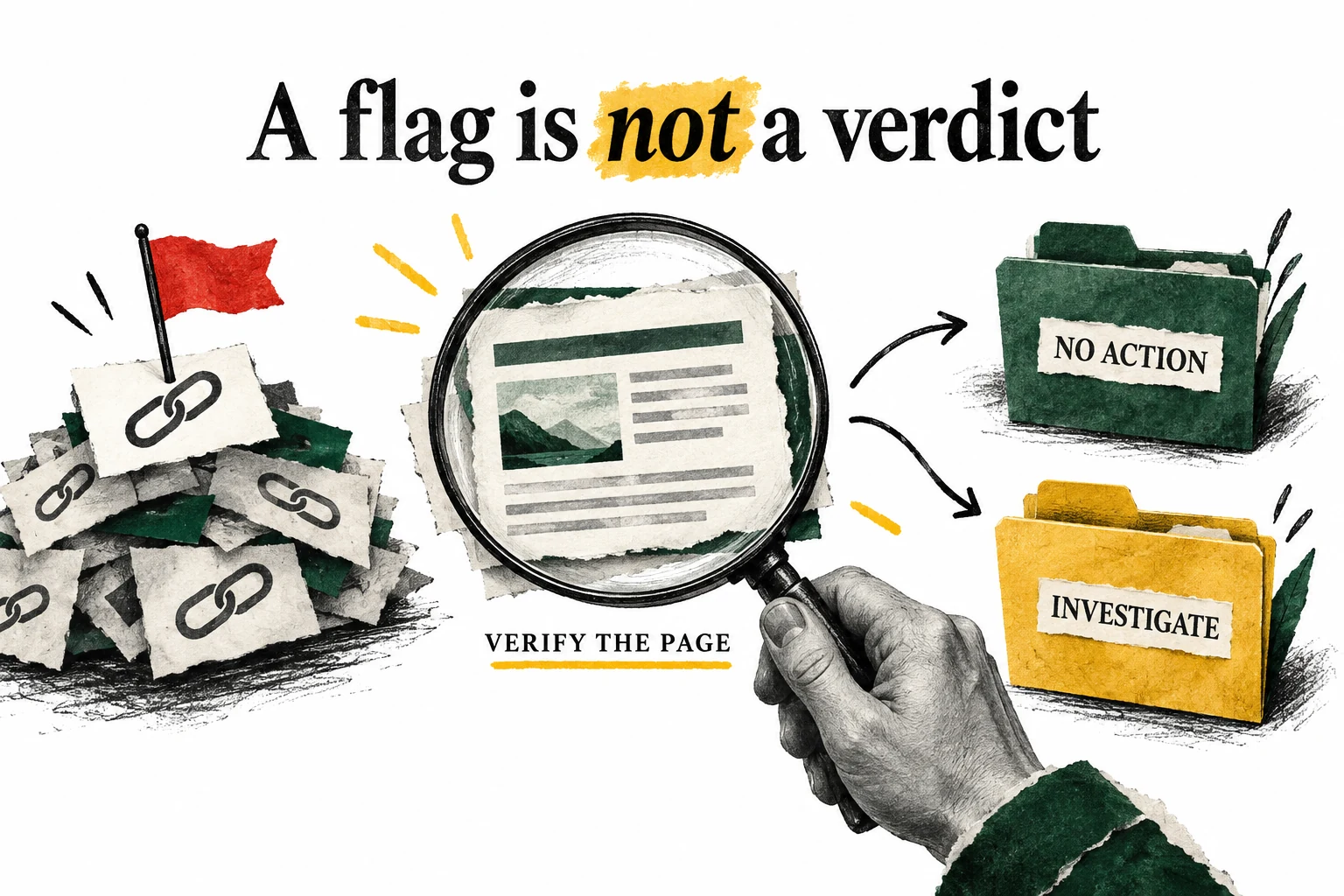
A risk score is a triage label, not Google's verdict

The product describes automated authority and spam-oriented evaluation. These labels may help organize a large list, but their meaning depends on the provider's method and data. We have not verified the scoring model or calibrated its predictions against actual search outcomes. A low score should therefore prompt inspection when relevant, not establish that a link is harmful or that a site has received a penalty.

Google says most websites do not need its disavow tool and warns that incorrect use can harm search performance. Its stated conditions involve a substantial problematic link pattern together with a manual action or a likely manual-action risk. That is a much narrower decision than automatically rejecting every domain below an arbitrary authority threshold. The software's cleanup convenience should not change the standard for deciding whether cleanup is justified.

Inspect context before drawing conclusions. A small specialist publication can be highly relevant despite a modest third-party metric. A familiar-looking large domain can host an irrelevant page. Consider the placement, topic, destination and how the link was acquired. Document what is actually suspicious instead of letting the label become the explanation. A number is helpful when it points you toward evidence, not when it replaces it.

For ordinary monitoring, the correct action on many unfamiliar links may be no action. That can feel unsatisfying in a tool designed to generate tasks, but restraint is part of competent SEO. A dashboard should make a working website easier to maintain, not create a new weekly ritual of removing anything that looks untidy. Treat the risk view as an organizer for informed review rather than an automated emergency department.

Sources: Vendor help introduction and reported link metrics; Google's conditions and warnings for disavowing backlinks

Keep generated disavow files behind a deliberate approval step

BacklinkScan advertises rules that prepare disavow files and send them by email. Preparing a file is not the same as establishing that its contents should be submitted. We would keep that output as a draft requiring review, with the reason for every consequential inclusion understood. Broad domain rules deserve particular attention because their scope can be much larger than the individual page that first attracted suspicion.

If an experienced reviewer determines that a submission is warranted, preserve the existing list and review the change as a complete replacement, not merely a collection of new lines. Google's guidance says uploading a new list replaces the previous one for that property. A convenient generated file can therefore accidentally omit earlier decisions if the workflow assumes each upload simply adds another batch.

Keep a record outside the tool of who reviewed the action, what evidence supported it and which property it concerned. This is our suggested operational safeguard, not a claim that BacklinkScan includes a particular approval system. It is especially important in an agency where the person configuring a filter may not be the person accountable for the client's search performance.

Do not run a live disavow experiment merely to see whether the feature works. Validate the export format and review process without making an unnecessary search-engine submission. A tool that reduces clerical effort can be useful even when its most consequential button is rarely used. The right measure is whether it helps carry out a justified decision carefully, not how many domains can be moved into a text file before the next coffee break.

Sources: Backlink monitoring, scoring, filters and email alerts; Google's conditions and warnings for disavowing backlinks

A flagged link card is inspected with a magnifying glass before being assigned to no action or further investigation
A score can prioritize inspection. It does not establish a penalty or authorize automatic disavowal.

Link attributes explain relationships, not a simple good-or-bad ranking

A link report may show labels such as follow, nofollow, sponsored and UGC. Google says ordinary links do not require a special rel value, while paid placements should be qualified as sponsored and user-generated links can use UGC. That is more nuanced than treating every non-follow label as a failed placement. The attributes describe how a relationship is qualified, not whether a human reader can find the reference useful.

The term dofollow is often used informally for an ordinary unqualified link. Do not assume a report's wording is a literal HTML attribute that should be added everywhere. Likewise, browser-related attributes and search-related qualifications should not all be interpreted as interchangeable ranking switches. When a report flags an unfamiliar value, inspect its actual role before changing a site's markup.

For an earned mention, consider relevance, destination and the audience it reaches. A link can send useful visitors even when it is qualified. For a paid placement, the correct response is not to pressure a publisher into removing disclosure in pursuit of a more attractive metric. Keep commercial relationships accurately represented and assess the placement on the business purpose it was intended to serve.

Use attribute filters to answer a clear question, such as whether a known sponsorship is correctly labeled or whether a broken destination needs updating. Avoid turning the distribution into a target percentage with no evidence behind it. A clean-looking ratio can be achieved by making poor decisions, while a varied profile may simply reflect the different legitimate ways people refer to a website. Context remains part of the analysis.

Sources: Google guidance for ordinary, sponsored, UGC and nofollow links; Internal-link checks, anchors and HTTP status reporting

Search Console integration adds context, not proof of causation

The organic-keyword feature brings clicks, impressions, click-through rate and average position into the product's broader workflow. That can make it easier to examine a page after a link change without repeatedly switching tools. The convenience is real if the data is current and correctly scoped. It does not establish that the link caused a movement in search performance simply because two lines changed during the same week.

Google defines CTR as clicks divided by impressions, and average position is an aggregate rather than a promise of one fixed position for every searcher. Compare equivalent periods and dimensions. A shift in the mix of queries, devices or countries can change the average without the same underlying page moving uniformly. Keep those distinctions visible when preparing a client explanation.

For example, a page might begin appearing for a broader range of queries while its average position becomes numerically worse. That could coexist with more impressions and useful clicks. Conversely, a better average might result from losing visibility on lower-position queries. These are illustrative interpretations to investigate, not measured BacklinkScan outcomes. The headline metric needs the supporting query and page context.

Use annotations or an external change log to record content updates, migrations, campaigns and other events. Then review the link information alongside those changes instead of assigning credit to whichever event is most convenient. A focused monitoring tool should help you ask a better question about performance. It should not encourage a report in which every improvement belongs to the newest backlink and every decline belongs to a mysterious toxic one.

Sources: Organic keyword and page-performance feature description; Search Console performance metrics and comparison dimensions

Choose the right property and keep access proportionate

Connecting search data involves choosing a property and granting access to a service. Before doing so, identify the website and reporting scope you intend to analyze. A company may have several domains, subdomains and historical properties with similar names. A successful connection to the wrong one can produce convincing charts that answer the wrong business question.

Review the actual permission request and the vendor's current data-handling terms. We did not inspect a live authorization flow and do not claim that a particular scope, retention period or security control is present. Grant only the access needed for the intended use, and obtain the appropriate approval when client data is involved. A monitoring feature does not justify casually connecting every property visible in an account.

After connecting, compare a small sample with the underlying report using the same dates, filters and aggregation. Look for a clear refresh time and an understandable explanation of any discrepancy. Do not expect a perfect match when the views are scoped differently, but do require enough information to explain the difference. A client should not have to accept that two numbers are both correct because two interfaces happen to display them.

Establish an offboarding procedure before adding multiple clients. Know how to remove access, export the records needed for continuity and handle a departing team member. These are evaluation questions rather than verified product controls. The tool is easier to trust when you understand not only how data enters it, but also how the relationship can be ended without leaving unnecessary access or losing the reporting history you still need.

Sources: Organic keyword and page-performance feature description; Search Console performance metrics and comparison dimensions

Internal-link checks may produce the most immediately useful tasks

The internal-link feature advertises broken-link detection, anchor review, attributes and HTTP status information. These checks can lead to concrete improvements because the website owner controls the affected pages. Fixing a navigation link that sends visitors to an error page is a clearer task than trying to infer the exact ranking value of an external mention. Start with problems that have an identifiable user consequence.

Prioritize important journeys: a guide pointing to a discontinued destination, a product page linking to the wrong support resource or a menu item leading through an unnecessary chain. Inspect the source and intended destination before making a replacement. A redirect is not automatically an error, and a removed page may have been intentionally retired. The right fix depends on what the user was trying to reach.

For anchor text, prefer wording that accurately describes the destination. Do not rewrite every link into an exact-match keyword merely because an export makes repetition easy to count. A reader should understand where the link leads without decoding a generic label or a phrase inserted only for a search engine. Review the sentence around the link as well as the link itself.

During the trial, check whether the tool supplies enough source-page detail to make a fix quickly and whether a later scan verifies the change. A list of broken destinations without their referring locations can create substantial extra work. The practical benefit is a short, prioritized queue of issues you can resolve and confirm, not another large export that waits indefinitely beside the previous large export.

Sources: Internal-link checks, anchors and HTTP status reporting; Google Links report sampling, grouping and historical limitations

AI brand visibility is a sample of answers, not a market census

BacklinkScan's brand-visibility page describes testing natural-language questions against more than a dozen AI models, tracking mentions, position and sentiment, and showing answer previews. It also says users can suggest questions. This is potentially useful for examining how a brand is represented in a defined set of answers. It should not be interpreted as direct observation of every real customer's conversation or a universal share-of-market score.

The prompt set is part of the measurement. A question naming your brand is different from an unbranded buying question, and a broad category question is different from a specific use case. Decide what you want to learn before collecting results. Otherwise it is easy to improve a visibility percentage simply by changing the questions until they happen to produce the desired name more often.

Keep the conditions as consistent as the tool allows: question wording, language, model, date and any location or retrieval settings. Inspect the actual answer when a sentiment label changes. A negative phrase might describe a limitation accurately rather than indicate a reputation problem, while a positive mention might contain a factual error. The useful work is understanding the context and deciding whether public information needs clarification.

Our third illustration shows a small sample board in front of a much larger audience. That is the right mental model for interpreting the feature. It can reveal patterns worth checking and help compare a stable question set over time. It cannot tell you that everyone sees the same recommendation or that a higher sampled position will turn into a particular number of customers.

Sources: AI answer sampling, sentiment and competitor visibility

An analyst compares question cards model symbols and dated answer samples while a larger audience remains outside the sample board
A proposed measurement discipline, not actual BacklinkScan results: keep the prompt set and conditions visible when comparing AI mentions.

Backlink ideas are research leads, not permission to mass-message

The product positions backlink ideas and research as ways to discover potential opportunities. A useful suggestion should lead to a relevant publication, resource or relationship where your contribution would genuinely help the audience. It is not evidence that the suggested website accepts unsolicited pitches, that a contact address is appropriate or that a link can be acquired on acceptable terms.

Review a short list manually. Ask why the site would mention your page, whether the proposed destination adds something missing and whether the topic fits the publisher's readers. A relevant original study, practical tool or well-supported guide gives an editor a reason to care. A generic request to exchange authority has much less value, regardless of how efficiently software can prepare the email.

Keep outreach separate from monitoring until the workflow and permissions are understood. We have not verified sending limits, mailbox integration, consent handling or deliverability controls. Do not assume that a feature label for bulk outreach establishes those details. A buyer whose main requirement is email operations should request a focused demonstration rather than purchasing a backlink product on the strength of a checklist entry.

Measure the quality of opportunities acted on, not the size of the exported prospect list. A handful of relevant conversations can be more useful than hundreds of weak requests that create cleanup work and damage relationships. BacklinkScan's research function is most attractive if it reduces the search for a credible next step. It is not a shortcut around having something worth referring people to.

Sources: Product positioning and combined monitoring workflow; Backlink monitoring, scoring, filters and email alerts

Reporting should distinguish observed changes from business outcomes

The checked plan descriptions include CSV exports but still label PDF reports as coming soon. The source offer also marks Social Voice as a future feature. Do not count either as a delivered requirement without a current demonstration. If a polished client-ready PDF or social-listening workflow is essential today, a roadmap label is not an adequate substitute for the output you need to send.

Build a sample report during the evaluation. Separate observations, interpretations and completed actions. An observation might be that a known placement no longer resolves. An interpretation might be that a site migration caused the change. The action might be correcting your destination or contacting the publisher with a useful update. Keeping those layers distinct makes a report credible even when some questions remain unresolved.

Include the date range, project scope and relevant data freshness. Avoid presenting an AI mention count as traffic or a link count as revenue. Where business outcomes are available from your own analytics, connect them carefully and explain the limits of attribution. A report can show progress without pretending that every measured change has an isolated financial cause.

For agencies, test how much preparation remains after export. Check whether the file retains the fields needed to verify a claim and whether different clients can be kept separate. If the final deliverable requires substantial rewriting, include that time in the cost comparison. Attractive reporting is valuable when it communicates the truth more efficiently, not when it makes uncertain conclusions look finished.

Sources: Current direct plans, limits and refund wording; Lifetime license allowances, redemption and source-channel terms; Organic keyword and page-performance feature description; AI answer sampling, sentiment and competitor visibility

A coverage test should use a balanced sample, not one impressive total

Backlink datasets differ in discovery, historical retention and how records are grouped. That makes a single total a weak basis for declaring one tool more accurate. A useful trial starts with links whose current state you can inspect. Include a mix of ordinary editorial mentions, redirects, image links, qualified links and placements known to have changed. Choose examples relevant to your site rather than a random collection designed to favor a particular result.

For each example, record the referring URL, destination, observed status and time of your check. Then compare the tool's description. Does it show the correct target? Can you distinguish a historical discovery from a recent verification? Is an unfamiliar classification explained? These questions are more actionable than asking which dashboard displays the largest number in the most prominent typeface.

Track false alarms and missed useful changes as well as successful detections. A system that finds more records but generates constant unhelpful warnings can cost more review time than it saves. Conversely, a smaller dataset may serve a narrow placement-monitoring routine well if it reliably covers the links that matter to that routine. The verdict should match the intended use.

Do not generalize a small test into a claim about the entire backlink index. Our review does not establish comprehensive coverage, exact latency or comparative accuracy. It gives you a way to evaluate the product's fit with evidence you can inspect. That modest approach is more useful than pretending that a marketing screenshot or one unusually large domain can settle the performance of a crawler across the web.

Sources: Vendor help introduction and reported link metrics; Google Links report sampling, grouping and historical limitations

Configure alerts around a decision someone will actually make

An alert has value when a person knows what to do with it. Begin with a small number of questions, such as whether an important earned placement has changed or whether a destination on your own site is broken. Assign an owner and a review cadence. A notification sent to everyone can become a notification owned by nobody, which is a surprisingly efficient way to build an unread archive.

Verify the actual delivery schedule and controls in your account. Public pages discuss daily monitoring, daily alerts and weekly notifications in different contexts. Determine which events trigger a message and whether the settings support the frequency you want. Do not describe the product as instantaneous unless the vendor supplies an applicable guarantee and your workflow genuinely requires one.

Keep a brief action log for the first few weeks. Record which alerts were useful, which reflected temporary conditions and which needed no action after inspection. Adjust the routine based on that evidence. If the product cannot suppress a noisy category, consider whether a scheduled review is more appropriate than forwarding every event into a team's working conversation.

Also decide what constitutes an escalation. A verified broken destination on a high-value page may deserve prompt attention; a newly discovered low-context link may not. These are examples of prioritization, not universal rules. The objective is to preserve attention for meaningful changes. More notifications do not automatically mean better monitoring, just as a smoke detector is not improved by announcing every piece of toast to the entire company.

Sources: Backlink monitoring, scoring, filters and email alerts; Organic keyword and page-performance feature description

Buy a focused workflow, not a promise to replace every SEO tool

BacklinkScan's breadth can be attractive, but a buyer should identify the specific work it will replace or improve. Monitoring known placements, reviewing a small portfolio and collecting related context are reasonable candidates. A full technical audit, extensive keyword research, enterprise reporting or a measured competitive index may require capabilities that this public review has not established. Do not let a long feature list blur those boundaries.

Estimate the time currently spent on the chosen routine, including checking alerts and preparing a useful explanation. Then repeat the routine with the trial. If the product saves twenty minutes but creates forty minutes of verification work, the lower software price does not make the process cheaper. If it reliably surfaces an important issue that would otherwise be missed, that may justify the cost even without a large time saving.

Consider duplication. A team already paying for a broader platform may have adequate alerts and exports available but poorly configured. Improving that setup could be more efficient than adding another account. A smaller business without those tools may benefit from a focused product, provided it confirms the licensing and sees useful results on its own site.

Make the decision around present needs and demonstrated behavior. Future modules, larger quotas and a long-term discount can support a purchase after the core workflow works, but they should not be the reason to overlook unresolved basics. The most economical SEO stack is not necessarily the one with the lowest total subscription price; it is the one that supports sound decisions without requiring an extra part-time job to reconcile its dashboards.

Sources: Product positioning and combined monitoring workflow; Internal-link checks, anchors and HTTP status reporting; July 2025 help article describing one paid project per plan

Our verdict: useful monitoring if interpretation stays in human hands

Our editorial score is 73 out of 100. BacklinkScan addresses a real need for a simpler monitoring routine and combines several relevant views at an accessible price. The score is not a measurement of crawler quality or a prediction of traffic growth. It reflects the usefulness of the proposed workflow, the breadth described, the unresolved buying questions and the care needed when acting on its output.

The strongest buyer is a small SEO team willing to inspect source pages, confirm account scope and keep a concise record of what each alert led to. That team can use the product as an organized starting point for investigation. The weakest fit is someone expecting an automated cure for rankings or a green score that makes a website safe without further thought.

Before paying, resolve the project entitlement, verify data on a representative sample and test the report you actually need to deliver. Check new features in the account rather than assuming every item on a landing page is included in the offer. Treat AI brand results as a defined sample and explain search-performance changes with the relevant context instead of assigning causation from a convenient timeline.

A successful purchase should produce fewer mysteries, fewer unnecessary tasks and a clearer understanding of what changed. It should not leave the owner anxiously refreshing a spam score or sending a new cleanup file every week because the software made one available. Buy BacklinkScan for the practical work it helps you do well. Keep the judgment, the evidence and the final decision with the people responsible for the website.

Sources: Vendor help introduction and reported link metrics; AI answer sampling, sentiment and competitor visibility; Search Console performance metrics and comparison dimensions

Frequently asked questions

Does a high spam score mean I should disavow the link?

No. Treat the label as something to investigate, not a Google finding. Most sites do not need routine disavowal, and an incorrect submission can create harm rather than protection.

Does the offer really cover multiple websites?

The current sales material advertises several projects, but an older help article describes a different model. Confirm which domains receive paid functionality in your account before relying on a portfolio-wide price.

Will a newly discovered link have been published today?

Not necessarily. Discovery time belongs to the monitoring system. Publication, a later recrawl and the time a link changes are separate events, so inspect the evidence before attributing a new alert to a new placement.

Can AI brand visibility tell me what every potential customer sees?

No. It reflects the prompts, models and conditions sampled by the tool. It can support a consistent comparison, but it is not a census of all answers or a direct measure of market share.

Should I choose this instead of using Search Console?

Use it only if the added workflow earns its place. Search Console remains important for first-party search data; an additional tool should make interpretation or monitoring easier, not replace checking the underlying source.

More marketing & seo deals

Marketing & SEO

Inrō

A strong candidate for businesses already receiving relevant Instagram conversations. Start with a narrow, supervised flow and verify the plan's limits. It can improve response handling, but it does not create an audience or make every stored contact reachable.

$59 · checked Nov 14, 2026

Marketing & SEO

Nuwtonic SEO

Nuwtonic SEO monitors rankings, optimizes pages, and generates GEO-ready content for AI search, helping teams improve visibility in both traditional and AI-generated answer ecosystems. The product is designed for teams that need a repeatable marketing & seo process and want clearer control over the core task. It fits best when the buyer has a defined use case, realistic input data, and a way to judge output quality before rolling it out across a wider workflow.

$69 · checked Nov 14, 2026

Marketing & SEO

Skillplate

Skillplate uses an AI agent, Overmind, to help users build products, websites, checkouts, and marketing campaigns from a single platform. This aims to streamline the process of launching and growing an online business. The product is designed for teams that need a repeatable marketing & seo process and want clearer control over the core task. It fits best when the buyer has a defined use case, realistic input data, and a way to judge output quality before rolling it out across a wider workflow.

$79 · checked Nov 5, 2026

Marketing & SEO

SheetXAI

SheetXAI automates spreadsheet tasks using AI and natural language, eliminating the need for formulas or coding. It integrates directly with Excel and Google Sheets, streamlining data cleaning, content generation, and bulk operations. This tool is suitable for teams seeking to automate repetitive spreadsheet workflows, allowing them to focus on strategic tasks rather than manual data management.

$49 · checked Nov 6, 2026

Deal alerts

Get marketing & seo deal alerts by email.

SoftScout will send short buying notes when offers like BacklinkScan look worth checking or worth skipping.

Short buyer verdicts

Useful offers before checkout

Editorial note

Our 73/100 score recognizes a useful monitoring combination and accessible pricing, with deductions for conflicting project documentation, unverified coverage and overly confident cleanup messaging. Treat scores as triage aids and confirm the exact licensed scope before purchase.

For vendors

Have a better deal for BacklinkScan?

Send current partner terms, coupon limits, refund rules, and the best buyer fit. We review offers before adding them to SoftScout pages or Telegram alerts.

Submit terms