Back to deals
Websites & No-CodeLifetime Deal

Blupry Bundle Lifetime Deal: buy or skip?

Worth considering for a FlutterFlow builder who needs one or two specific patterns and can inspect and maintain them. It is a development shortcut, not a finished business. Confirm the exact files, license, compatibility and purchase-channel refund terms before buying.

Product overview

What Blupry Bundle does

An editable example can make unfamiliar application logic easier to understand than a blank canvas. Blupry's value depends on the fit between a particular template and the product you actually intend to build, not on the number of famous services mentioned in the offer.

This is a source-researched review checked October 24, 2026. We have not imported the paid bundle, audited its private code or tested its deployed apps. References to related individual components provide context, not proof that every bundle file contains the latest version.

Read the full Blupry Bundle review

Best for

  • FlutterFlow users who already understand their target workflow and need a concrete starting pattern
  • Independent builders comfortable configuring services and reviewing custom actions
  • Small development teams evaluating reusable components for a narrowly scoped prototype

Why we picked it

  • Several distinct application patterns can support learning and focused prototyping
  • Editable project copies offer more flexibility than a closed demonstration
  • A good-fit component may save repetitive setup while leaving room for a genuinely original product

Check before buying

  • Request the exact bundle inventory, last update dates, dependency versions and a demonstration of the feature you plan to use.
  • Confirm commercial and client-project permissions, delivery mechanics and refund conditions for the actual checkout channel before payment.
  • Evaluate one complete workflow with test data, restricted credentials, failed requests and your intended mobile devices before promising a launch.

Buy if

You can identify a specific included pattern that materially shortens a project you already intend to build.

Verify first

Request the exact bundle inventory, last update dates, dependency versions and a demonstration of the feature you plan to use.

Skip if

You expect seven complete businesses with hosting, customers, content rights and operational support included.

SoftScout sends you to the source after the risk checks, so you can verify live terms before buying instead of trusting stale coupon text.

Check Source Offer

Source transparency

Source
Source marketplace
Link type
Source page
Last checked
Oct 24, 2026

Buyer checklist

  • Request the exact bundle inventory, last update dates, dependency versions and a demonstration of the feature you plan to use.
  • Confirm commercial and client-project permissions, delivery mechanics and refund conditions for the actual checkout channel before payment.
  • Evaluate one complete workflow with test data, restricted credentials, failed requests and your intended mobile devices before promising a launch.

Blupry Bundle: the buying decision

Blupry Bundle gives a FlutterFlow builder several concrete starting patterns for media, location, commerce and interface work. The useful advantage is having an editable example to study and adapt for one specific application, rather than treating familiar brand comparisons as evidence that a complete production business is included.

Research-based review, not a hands-on test. Sources checked on 2026-10-24. The assessment below is our editorial judgment, not a customer rating. Editorial assessment: 73/100.

Consider it if

  • You can identify a specific included pattern that materially shortens a project you already intend to build.
  • A current demonstration or sample confirms compatibility with your FlutterFlow version and target devices.
  • The seller confirms your intended commercial use, project delivery, support scope and applicable refund terms in writing.

Skip it if

  • You expect seven complete businesses with hosting, customers, content rights and operational support included.
  • You have no practical way to inspect custom code, secure the backend or maintain the resulting application.
  • Your purchase depends on unverified features such as real vehicle control, full creative editing or guaranteed app-store approval.
Problem fit: 17/20
Concrete editable examples can reduce blank-canvas work for builders who already know which application behavior they need to implement.
Capabilities: 16/20
The bundle spans several useful interaction patterns, but those patterns are narrower than the complete commercial products used as marketing comparisons.
Workflow fit: 14/20
Project copies can accelerate exploration, while integration, security review, device testing and maintenance still require a capable owner of the final application.
Evidence confidence: 11/20
Public descriptions establish intended scope, but the private files, current dependency compatibility and precise commercial license were not independently verified.
Value: 15/20
The purchase can be economical when one component fits a real project, provided external service costs and adaptation effort remain proportionate to the saved work.

Buy a useful starting point, not the name of a famous business

Blupry Bundle is most interesting when you approach it as a collection of worked examples. A builder facing an unfamiliar interaction can learn a great deal from a project that already connects the relevant pieces. That is a concrete benefit. It is different from receiving an entire business simply because a sales description compares a template with a recognizable service.

The strongest buyer has a narrow question: how can I add this particular experience to the product I am already building? The weakest buying brief is that seven apps sound better than one. A folder of unfinished possibilities can become a surprisingly efficient way to postpone choosing a customer, a problem and a launchable scope. The templates should support that decision, not make it on your behalf.

Our verdict is cautiously positive for someone comfortable with FlutterFlow and the services behind an application. We would not recommend it as a substitute for technical ownership. The person deploying the final product needs to understand what happens to user data, which requests cost money and how an error is handled. Those responsibilities do not disappear when a screen is assembled visually.

This review uses public product descriptions and primary platform documentation checked October 24, 2026. We did not purchase, import or audit the private bundle. Proposed tests are our recommendations, not reported results. That distinction matters particularly here: a good-looking demonstration can show the intended experience without proving that the delivered files are current, secure or suitable for your exact production environment.

Sources: Bundle contents, current purchase price and marketplace refund wording; Blupry project-copy delivery and direct-store refund FAQ

Translate the seven templates into actual functional scope

The offer presents seven familiar comparisons: Zoom, Uber, Spotify, Tesla, TikTok, Photoshop and WooCommerce. The described building blocks are more specific: video rooms, location and routes, background audio, a vehicle-style interface, a short-video feed, image cropping and a shop connected to commerce services. Read those functional descriptions as the starting scope rather than treating the comparisons as complete feature equivalence.

A video room is not automatically a meeting business with scheduling, recordings, billing and administrator controls. A route on a map is not automatically a dispatch operation. These are not criticisms of a focused component; focused components are often exactly what a developer needs. The problem begins when the buyer quietly fills every gap with the features they associate with the famous name.

Write down the one experience you want to deliver in plain language. For example, a customer can view a small authorized audio library and resume a lesson later. Then separate the template's stated contribution from everything else that experience requires. This produces a useful shopping list and makes it easier to ask the seller a question that can receive a concrete answer.

The vendor also sells related components individually. Those pages help explain the intended patterns, but they do not prove that a particular bundle download contains the newest revision. Ask for the actual inventory and versions. Treat any extra feature you cannot locate in the delivered project as unresolved until demonstrated, not as a benefit earned by association with the more ambitious comparison.
Sources: Bundle contents, current purchase price and marketplace refund wording; Related Blupry Agora video-call component and account requirements; Related Blupry live-location component and Firebase data design; Related Blupry background-audio component and project-copy access

The builder subscription is separate from the template purchase

FlutterFlow currently lists a free plan limited to two projects and a Basic plan at $39 per month on monthly USD billing, including source-code download. Higher plans add other collaboration and development capabilities. These are builder entitlements, not features purchased from Blupry. A template receipt does not turn a free account into a different FlutterFlow plan or pay for an unrelated service account.

Before buying, choose your intended delivery route. A web prototype shared with a few colleagues has different requirements from a native application maintained through a source repository. Identify which builder features are necessary at each stage and when you would need them. You may not need every advanced feature immediately, but you should not discover a required export entitlement only after promising a finished application.

Also distinguish owning a project copy from having a maintainable independent codebase. An export can be valuable, but someone must know how to build, configure and update it outside the visual editor. Decide where future changes will be made and how they will be preserved. Two competing versions of an app are not a backup strategy when nobody knows which one contains the latest fix.

For an existing FlutterFlow subscriber, the incremental cost may be modest. For a newcomer, the learning and account setup can be a larger part of the decision than the bundle price. Compare the purchase with the whole first project, not with an imaginary development process in which every other tool, hour and deployment step is free because the template is labeled lifetime.

Sources: Current FlutterFlow plans, project limits and export access; FlutterFlow project version information and paid code export tools

Verify the delivered project before decorating it

Blupry's FAQ describes delivery through a link that copies the creator's project into your account on the relevant no-code platform. That is an understandable mechanism, but the first useful milestone is a working copy under your control. Confirm that the link, account and project permissions behave as promised. A demonstration hosted by the seller is not the same artifact as the project you will maintain.

Inspect the project and dependency versions before changing colors or adding your logo. FlutterFlow exposes project and Flutter version information through its toolbar. Ask which version the seller last verified and whether any custom action requires an older package. A compatibility warning deserves an explanation before it becomes part of a client's launch schedule. We have not established the current build status of the private bundle.

Keep an untouched original and work in a separate evaluation copy. Replace demonstration connections with your own test configuration only after understanding their purpose. Check for sample records, hard-coded identifiers, placeholder permissions and assumptions about account ownership. The goal is not to turn a small purchase into an archaeological expedition; it is to avoid building a new floor on an example foundation you have never examined.

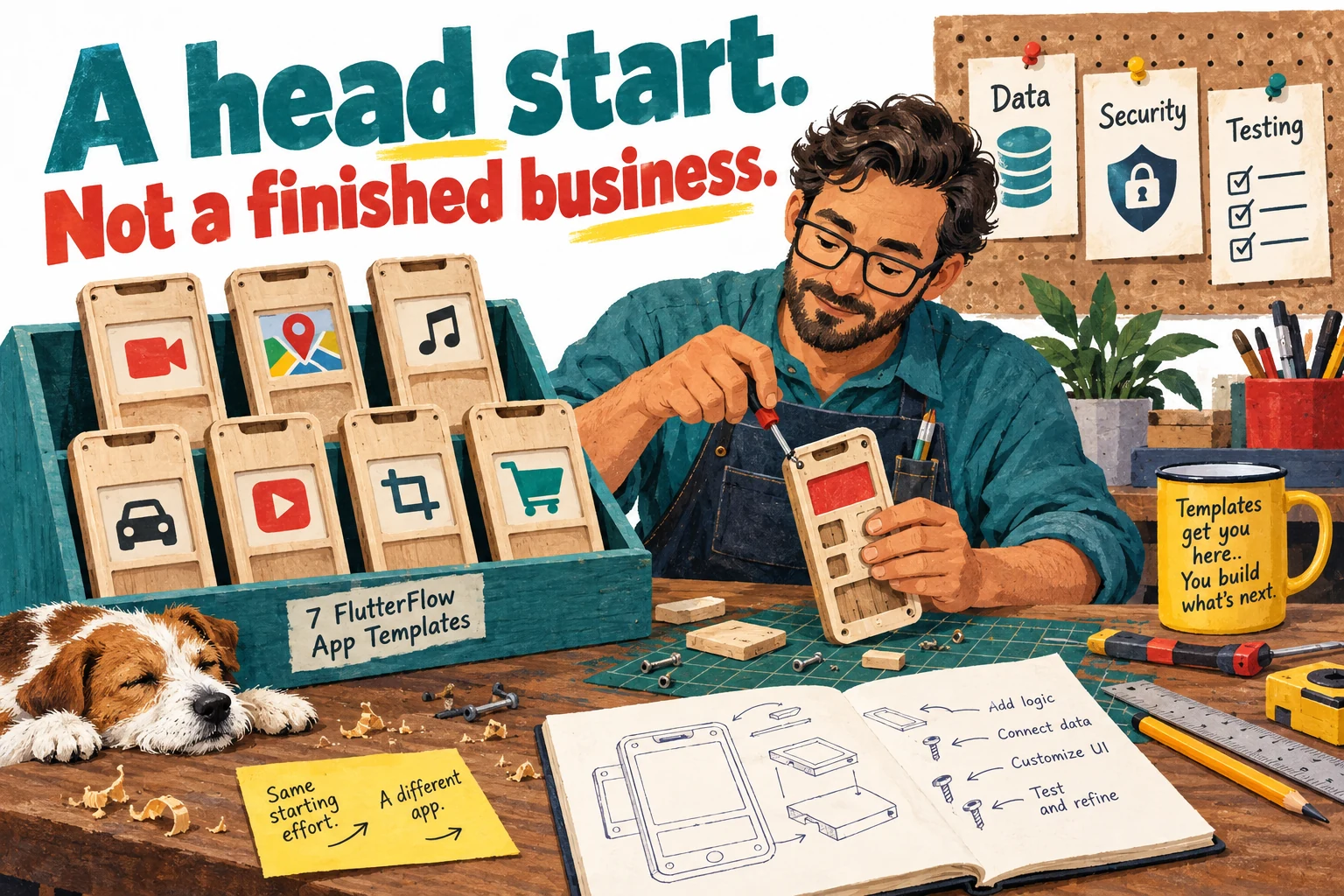
Choose one central workflow and make it pass before visual customization. If the selected audio item cannot play reliably or the shop cannot reconcile an order, a better splash screen will not move the project closer to useful completion. Our first illustration shows this order deliberately: select the relevant building block, understand it and finish the supporting work before presenting it as a product.

Sources: Blupry project-copy delivery and direct-store refund FAQ; FlutterFlow project version information and paid code export tools

A developer selects one unfinished phone template from a toolkit and works beside separate data security and testing tasks
Conceptual illustration: a useful template reduces starting work, while the application still needs its own data design, safeguards and testing. This is not a Blupry interface screenshot.

A video-call template needs a real room-access model

The related Blupry video component describes Agora integration and requires the buyer's own Agora account. That makes it a possible starting point for adding a call experience. Before treating it as a meeting solution, define who may create a room, who may enter it and when access ends. A room identifier is not a complete access policy merely because it is difficult to remember.

Agora's production guidance uses a server to issue authentication tokens. Ask how the delivered template handles that boundary and token renewal. Do not copy a temporary demonstration credential into a public release and assume the security architecture is finished. The seller's setup instructions need to be reconciled with the provider's current guidance, especially when a simplified example uses broad language about entering a key.

Evaluate ordinary call failures with consenting test participants: denied microphone permission, a participant leaving, a network interruption and a return to the room. Decide what each user should see and whether the session can recover without creating confusion. These are proposed checks, not observed defects. A usable call experience needs predictable failure behavior as much as a successful first connection.

If your use case involves private appointments, establish the surrounding workflow separately. Invitations, participant identity, retention decisions and customer support are not implied by a functioning camera button. Start with the smallest meeting experience your audience actually needs. Recreating every feature of a large conferencing product is a demanding hobby, and it becomes an even more demanding business when customers expect someone to answer the support email.

Sources: Related Blupry Agora video-call component and account requirements; Agora production token-server authentication design

Location tracking should answer who can see whom, and for how long

Blupry's related tracking component describes Firebase user coordinates, a last-seen value and Google Maps integration. These are useful primitives for a location-aware application. They do not by themselves establish a safe sharing model. Before adapting the interface, decide which people may see a location, what purpose that serves and when the permission or stored information should expire.

An explicit sharing session is usually easier to explain than a vague promise of continuous tracking. A hypothetical delivery app might reveal an appropriate location only during the active delivery, then stop exposing it when the job ends. That is a proposed product rule, not a verified bundle feature. The backend must enforce the intended audience rather than relying on a screen to hide information from everyone else.

Handle stale data honestly. A marker can remain in a perfectly plausible position after the device loses connectivity. Show freshness in a way users understand and avoid presenting an old coordinate as a live guarantee. Consider how denied permissions, battery-saving behavior and an interrupted session affect the experience. A map that looks precise can still communicate something misleading when its timing is invisible.

Google recommends restricting Maps keys by application and API, with appropriate separate keys for different uses. Configure those controls for your actual deployment and monitor consumption. A template that draws routes does not include unlimited mapping resources. Nor does it establish the operational rules for a transport business. Keep the software prototype, the service budget and the real-world activity as separate decisions that each need evidence.

Sources: Related Blupry live-location component and Firebase data design; Google Maps application and API restrictions for keys

Background audio is valuable when the content and listening experience fit

The related audio component describes a custom background player and a song list. That pattern may be useful for a small library of material you control, such as original lessons or licensed recordings. It should not be confused with acquiring a music catalog or permission to distribute whatever happens to play in a demonstration. The player and the content are different assets with different requirements.

Define the listening task before adding catalog size. A learner may care about returning to the right lesson and understanding what comes next more than about an elaborate discovery feed. A creator distributing spoken material may need readable titles, sensible ordering and a clear explanation of access. The best version of this template may be much smaller than the streaming service used to describe it.

Test on the devices your audience uses. Check what happens when the screen locks, another app plays sound, a connection drops or the listener switches outputs. Determine whether progress is retained and how the user resumes. We are not asserting which of those behaviors the bundle currently implements; they are the acceptance criteria that should shape an evaluation before you depend on background playback.

Plan how files are hosted and replaced. A correction to a lesson should not leave half the audience with an outdated copy and no explanation. Keep source files and rights records outside the template project, and choose an understandable versioning process. Audio is especially unforgiving of small production mistakes: a listener cannot skim past a broken transition with the same ease that a reader skips an awkward paragraph.

Sources: Related Blupry background-audio component and project-copy access

A short-video feed needs more than the next swipe

The bundle's short-video example describes feed behavior with likes and bookmarks. That can help a builder explore a familiar interaction. It does not establish recommendation quality, upload processing, moderation or the economics of serving many videos. A useful first product might be a curated library for a defined community, not an immediate attempt to create a general social network from a scrolling screen.

Choose whether content is supplied only by the operator or by users. That decision changes the work substantially. Apple requires safeguards for user-generated content, including ways to filter, report and address problematic material and block abusive users. Treat those requirements as product behavior to implement and operate, not a paragraph to add to a policy after launch. We have not verified that the template supplies them.

Even a curated feed needs a reason to exist. Ask what a viewer should learn or accomplish after several clips and how they can return to something useful. A relevant sequence and clear categories can matter more than an endless stream. Likes are easy to display; a coherent content proposition is harder, and the template cannot decide it from the shape of the playback button.

During evaluation, include a long session on a modest device and a slower connection. Observe loading, memory behavior, repeated playback and how failures are explained. These are your own tests to run, not performance results from this review. Decide how much media should load ahead and how spending is monitored. A swipe is a small gesture that can trigger a surprisingly large amount of infrastructure.

Sources: Bundle contents, current purchase price and marketplace refund wording; Apple app review rules for templates, original identity and user content

The vehicle-style interface is not evidence of vehicle control

The vehicle-related item is presented as a Tesla-style user interface. Do not infer that it includes authenticated access to a real vehicle, safe remote commands or a supported vehicle-service integration. An interface can be useful as a design exercise without possessing any of those capabilities. Confirm the exact behavior rather than treating a familiar dashboard shape as a technical integration statement.

For a concept presentation, clearly label simulated values and actions. If a button only changes local demonstration state, the audience should not leave believing it has operated physical equipment. This distinction also matters inside a development team: a polished prototype can make unfinished backend work disappear from a conversation unless someone explicitly names what is simulated and what is connected.

Give the final product its own identity. Apple's guidelines prohibit using another developer's icon, brand or product name in an app's icon or name without approval. More broadly, familiar inspiration should not become a misleading claim of affiliation. Ask what users actually need to understand, then design the interface around that task rather than copying recognition cues and hoping recognition will substitute for trust.

If the real project eventually controls equipment, commission the appropriate integration and safety review as a separate undertaking. A template review cannot establish that suitability, and this review makes no such claim. For most buyers, the sensible value is learning layout and state patterns. That may be enough to justify the component without recruiting it for a job its public description never demonstrated.

Sources: Bundle contents, current purchase price and marketplace refund wording; Apple app review rules for templates, original identity and user content

Image cropping is a focused utility, not a full creative suite

The image-related offering describes cropping and Firebase upload. That is a useful, limited task: preparing an avatar, fitting an image to a listing or giving a user control over framing. It is not evidence of the layers, color-management, retouching and production workflow associated with a full professional image editor. Evaluate the actual utility instead of borrowing expectations from the comparison name.

For a profile-picture flow, the important details are practical. Can the user understand which area will remain visible? Does the final image keep the intended subject? What happens when the original is unusually large, rotated or unsupported? A feature that handles the normal path attractively still needs a clear answer when the input is not the tidy square used in the demonstration.

Decide where processing happens and what is retained. A user may reasonably expect a canceled upload not to become a permanent public asset. Establish size limits, access rules and deletion behavior that match your application. These are recommended design questions rather than verified implementation details. Do not assume that connecting storage automatically creates the privacy and lifecycle policy your users would expect.

Check the output in the actual destination, not only in the crop preview. A profile circle, a product grid and a full-width article image need different compositions. Preserve a suitable original when your approved workflow requires later editing, and avoid repeated recompression without a reason. The modest component can be valuable precisely because it solves one task well; it does not need an exaggerated identity to deserve consideration.

Sources: Bundle contents, current purchase price and marketplace refund wording

A shop template must reconcile real orders, not just show a success screen

The shop example names WooCommerce REST integration, Firebase and Mollie. That suggests a storefront pattern connected to external services, not an included commerce operation. Establish which system owns products, prices, customer records and order state. When two systems both appear to be in charge, an attractive checkout can conceal an uncomfortable disagreement about whether an order exists and what the customer actually purchased.

Mollie's guidance says payment status should be retrieved from its API, with webhooks used to handle changes. A visitor arriving at a return page is not sufficient proof of payment. Design fulfillment around verified state and ensure repeated notifications do not repeat the business action. This is an architecture recommendation, not a claim that the private bundle does or does not already implement it.

Build a small acceptance set using test transactions: payment succeeds, payment fails, the customer closes the page, a notification arrives late and the same update arrives again. Inspect the resulting order records and customer messages. A correct happy path is only one case. The awkward cases are where a real shop learns whether its integration is a workflow or merely a very convincing sequence of screens.

Confirm merchant eligibility, supported payment methods, taxes, shipping and refund handling for your actual business and jurisdiction. The presence of a provider integration is not a promise that every buyer can use it under identical conditions. Keep administration available when automation fails. Someone should be able to explain an order's status from reliable records without asking the customer to send a screenshot of a celebratory checkout animation.

Sources: Bundle contents, current purchase price and marketplace refund wording; Mollie mobile payment guidance on keeping API keys on the server; Mollie payment-status verification and webhook handling

Separate public configuration from private credentials and permissions

Not every value called a key has the same security role. Agora's token architecture keeps generation on controlled server infrastructure; Mollie explicitly warns against storing its API keys in a mobile app; Maps client keys need appropriate restrictions. Classify each value using the provider's current guidance. A blanket instruction to paste all credentials into a project is not a sufficient production security design.

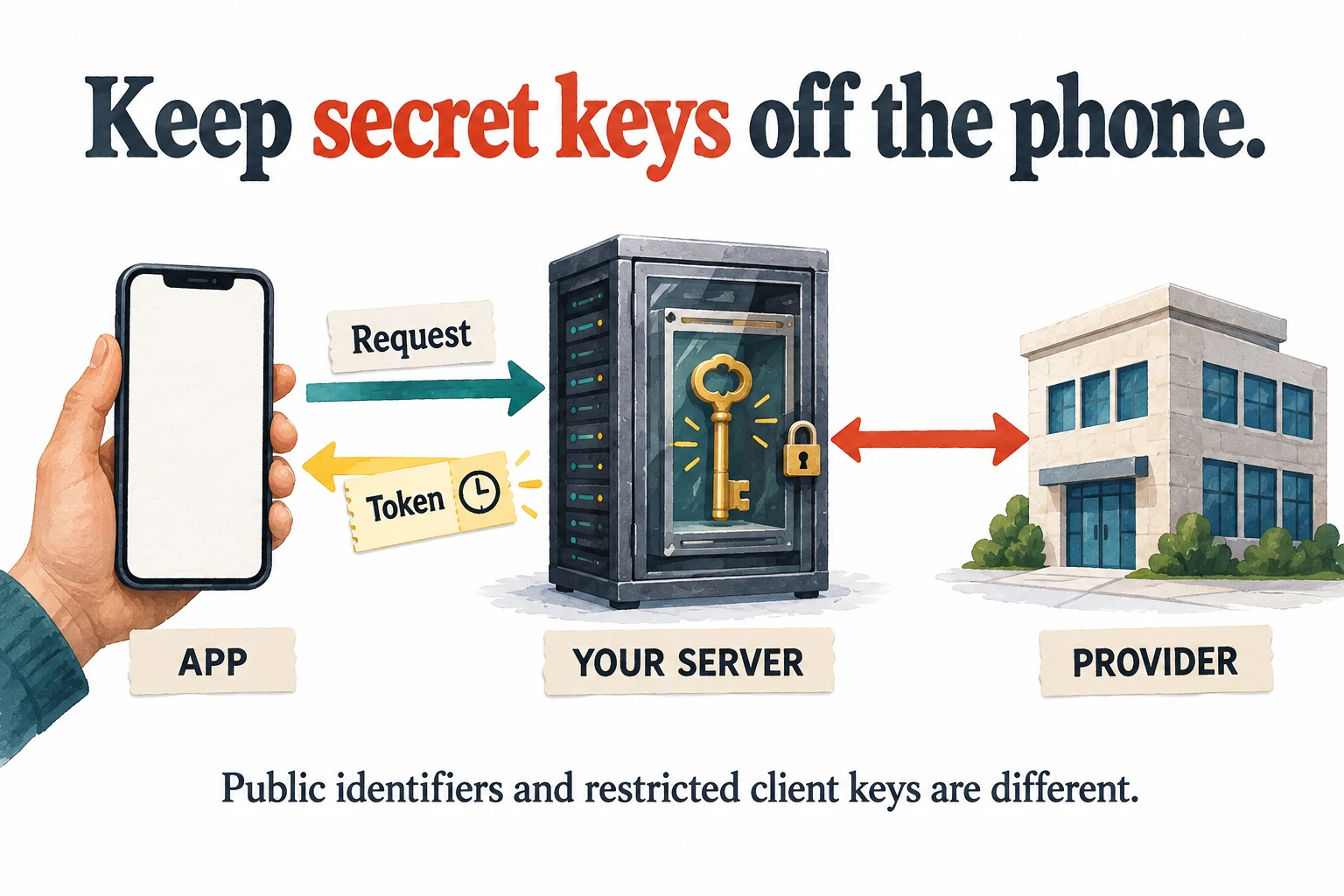
Our second illustration shows the important boundary: private authority stays on a trusted server, while the client receives only the access appropriate to its task. It is a conceptual diagram, not a verified description of Blupry's implementation. The actual network flow differs by service. Review the custom actions and requests in the delivered project before introducing anything with access to live money or private user information.

Firebase Authentication identifies a user; security rules determine what that user may read or change. App Check addresses app or device authenticity and complements user authentication rather than replacing it. Build tests around your own access model. A person signed into one account should not gain another person's records by changing an identifier, even when the normal interface never offers that option.

Use separate test resources and minimal permissions while evaluating. Keep credentials out of shared screenshots and source history, and arrange a controlled replacement process if a secret is exposed. Do not weaken production protections merely to make an example run. A template is supposed to save repetitive development effort; it should not save the particular checks that prevent a small prototype from becoming a much larger incident.

Sources: Agora production token-server authentication design; Mollie mobile payment guidance on keeping API keys on the server; Google Maps application and API restrictions for keys; Firebase security rules and user-based data permissions; Firebase app attestation and its distinction from user authentication

A phone requests access through a server that keeps a secret key in a locked vault and returns a temporary token
A simplified authentication boundary, not a complete network diagram or a claim about the bundle's implementation. Follow each provider's design for secret credentials, tokens and restricted client keys.

Resolve license and refund scope for the checkout you actually use

The checked marketplace advertises the bundle at $59 with a thirty-day refund promise, while Blupry's direct FAQ and digital-product terms say purchases are not refundable. Those statements describe different purchase contexts and should not be silently merged. Ask which conditions govern the checkout you choose and retain the answer. We are flagging a purchasing question, not making a legal conclusion about a particular transaction.

The general terms also discuss website access and restrictions without giving us a clear, bundle-specific explanation of commercial end-product rights. That does not prove commercial use is prohibited. It means a buyer planning client delivery needs a more precise license answer. Ask whether you may modify the project, publish a commercial app, reuse components across projects and transfer an end product to a client.

Separate end-product use from redistribution of the template itself. A license that permits building an app may have different conditions for reselling source material, sharing a copy link or placing the original project in a public repository. Do not infer unlimited redistribution from the technical ability to export. Also establish the rights to any bundled images, sample media, fonts or other assets you intend to retain.

Ask what support covers and how updates are delivered. A response explaining installation is different from a commitment to maintain compatibility with every future builder release. Keep the scope specific enough to evaluate. A small written clarification before purchase is much easier to work with than a disagreement after your client has approved a schedule based on assumptions neither seller nor developer actually confirmed.

Sources: Bundle contents, current purchase price and marketplace refund wording; Blupry published website terms and digital-product refund policy; Blupry project-copy delivery and direct-store refund FAQ

Price the project by usage and maintenance, not the discount percentage

The one-time template cost is only one line in an app budget. Add the builder plan, any required hosting, third-party usage, testing and ongoing maintenance. Some of those costs may already be covered by tools you use; others may begin only after launch. The right calculation is incremental and specific to your project, not an impressive total assembled from services you never intend to use.

Agora measures calling usage per participant. As a simple workload illustration, four people connected for thirty minutes represent one hundred twenty participant-minutes before considering the applicable media type and billing terms. That is not a price quote. It shows why counting meetings alone can understate consumption. Use the provider's current plan for your account rather than treating a template's broad capacity language as a prepaid service allowance.

For other components, identify the units that change with activity: requests, reads, writes, storage and delivered media. Estimate a quiet month and a busier scenario, then confirm how alerts and limits behave. An alert is useful information, but it is not necessarily a hard spending cap. Decide who responds when usage changes and how the application should behave if a dependency becomes unavailable.

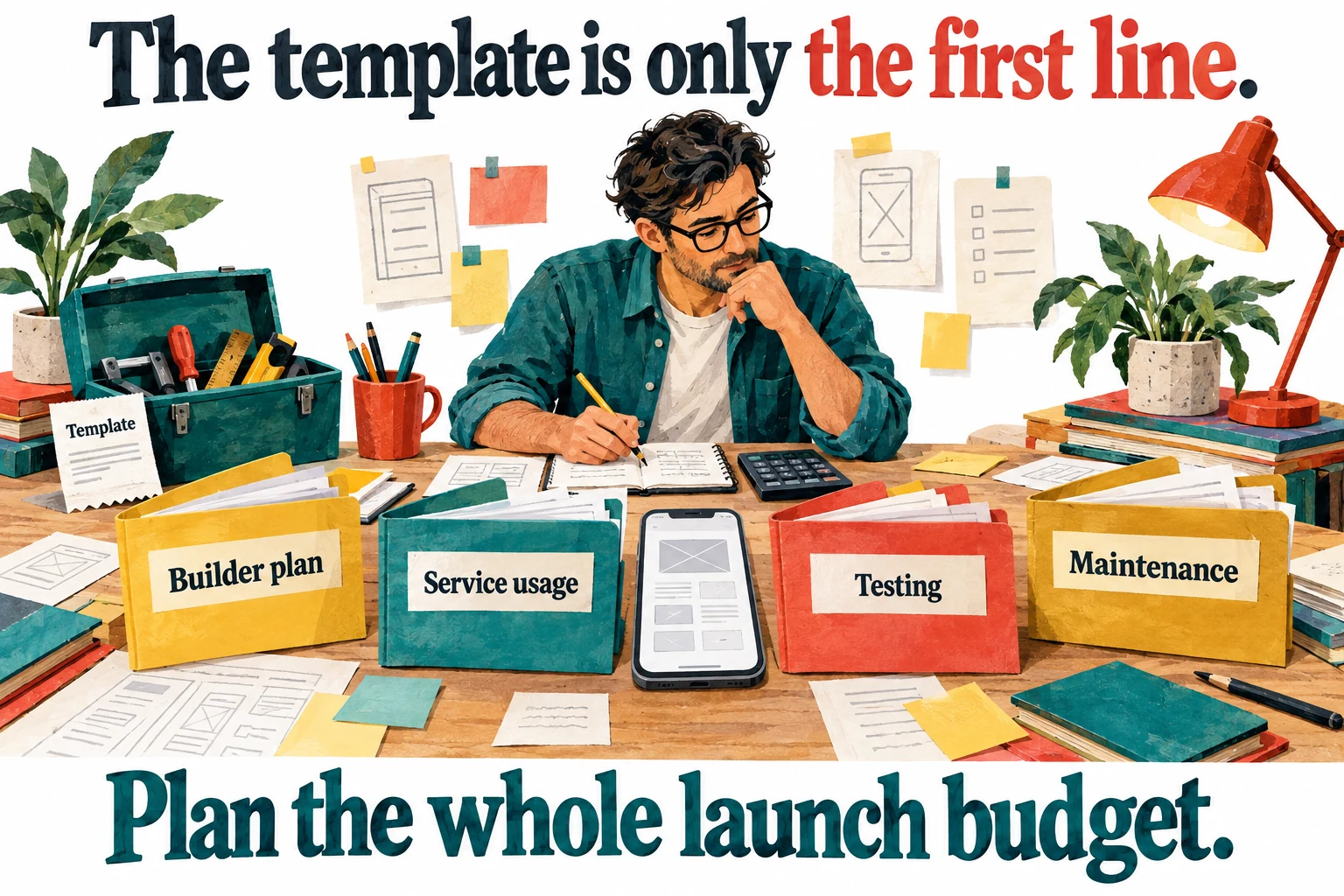
Include your time honestly. A component that saves an afternoon but needs several days of unfamiliar repair may not be the cheaper route. Conversely, a well-matched example that teaches a reusable pattern can have value beyond the first launch. Our budget illustration separates those categories so that the purchasing decision remains about total usefulness, not the excitement of buying a large number of possible projects at once.

Sources: Current FlutterFlow plans, project limits and export access; Agora video-calling usage measured per participant; Google Maps application and API restrictions for keys

A developer plans an app budget with separate folders for builder plan service usage testing and maintenance beside a template receipt
Our suggested budget categories. The one-time template purchase is separate from the resources and work required to launch and maintain your application.

Run one complete acceptance test before expanding the scope

Pick the component that matters most and define an observable outcome before importing anything. For a small content app, that might mean a user signs in, opens an authorized item, resumes it later and signs out without exposing another user's data. Write the sequence in ordinary language. This makes it easier to distinguish a useful application from a collection of individually attractive features.

Evaluate with realistic but non-sensitive sample data on the target platforms. Include a fresh account, missing data, a slow connection, denied permissions and a repeated action. Record what happened and what still needs work. The purpose is not to manufacture an enormous test plan; it is to expose the assumptions most likely to affect a real user's first attempt to complete the task.

Treat browser preview, device build and distribution approval as different milestones. Apple's template and minimum-functionality rules require more than a generic repackaged experience, including conditions around who submits template-based apps. Read the current rules for your intended route before selling a launch date. This is not evidence that a Blupry-derived app will be rejected; it is a reason not to promise acceptance from a preview alone.

Only then add secondary features. Keep the first release small enough that you can explain every permission and support every important state. A focused application with a dependable central task is easier to maintain than a broad demonstration with seven partially connected ambitions. The best use of a bundle may be to leave most of it untouched while one carefully chosen component becomes genuinely useful.

Sources: FlutterFlow project version information and paid code export tools; Apple app review rules for templates, original identity and user content

Client work needs an ownership and handoff plan

An agency should decide who owns the builder project and service accounts before connecting client data. The simplest arrangement for a prototype may not be appropriate for a long-running customer application. Document which accounts belong to the client, which belong to your business and which permissions you need to provide support. Ownership should not be an unpleasant surprise discovered during a contract renewal.

Create a handoff record that explains the app's main data flow, external dependencies, deployment process and known limitations. Include the approved license scope and the versions used for the final build. Avoid placing secrets in that document; describe the controlled location and responsible owner instead. A future maintainer should be able to understand the system without reverse-engineering a year's worth of chat messages.

Discuss updates as a service with a defined boundary. A template seller may provide an updated component, but integrating it into a customized client app is still work. Preserve your modifications and evaluate changes in a separate environment before replacing the live version. Do not assume that a new upstream copy can be dropped into a heavily adapted project without review or regression testing.

Be honest in the proposal about what you are delivering. Using a template is not inherently unprofessional; selling an unverified prototype as a fully supported system is. Charge for the actual problem you solve, the customization you perform and the support you can provide. A client rarely cares whether a blank canvas was involved, but they care greatly when nobody can explain why the app stopped working.

Sources: Blupry project-copy delivery and direct-store refund FAQ; FlutterFlow project version information and paid code export tools

Compare the bundle with a smaller component and a narrower build

The sensible alternative is not always an expensive custom application. It may be one individual component, an official integration example or a simpler product scope. Compare the specific work each route saves. A bundle is attractive when several included patterns are genuinely relevant or when one important component justifies the price on its own. Unused variety should not be counted as realized savings.

Consider your ability to understand the result. A smaller example with clear dependencies can be easier to adapt than a larger project containing unrelated screens and assumptions. Conversely, a coherent end-to-end starting point may save time if its data model closely matches your needs. Ask to see the structure relevant to your use case rather than evaluating only the polished public-facing demonstration.

If you are new to FlutterFlow, learning enough to build a modest interaction yourself can make a later template purchase more valuable. You will know which parts are routine, which are unusual and where help is necessary. Buying a shortcut before understanding the route can work, but it can also leave you unable to tell whether a detour is a feature or an error.

For an experienced builder, the decision can be brisk: inspect the fit, confirm the terms, estimate adaptation and move on. Do not spend days optimizing a small purchase while ignoring a major architectural mismatch. The bundle earns its place when it removes a real obstacle in a chosen project. It does not need to be the largest collection or the lowest theoretical price per unused template.

Sources: Related Blupry Agora video-call component and account requirements; Related Blupry live-location component and Firebase data design; Related Blupry background-audio component and project-copy access

Our verdict: useful raw material for a builder with a specific destination

Blupry Bundle receives 73 out of 100 in our editorial assessment: seventeen for problem fit, sixteen for capabilities, fourteen for workflow, eleven for evidence and fifteen for value, each out of twenty. This is our reasoned buying judgment, not a customer-review average. The score reflects potentially useful starting material with meaningful uncertainty around the actual delivered files and the effort required to finish a production application.

We would consider buying when a particular component fits a defined task, a current sample demonstrates compatibility and the license covers the intended use. The buyer should be able to configure the dependencies or have a capable person who will. Under those conditions, an editable example can save repetitive work and provide a useful learning reference without pretending that every difficult engineering decision has already been settled.

We would skip it when the attraction is mainly the idea of acquiring several famous businesses for a small payment. We would also pause when commercial rights, delivery or support answers remain vague and the project depends on them. A discount cannot compensate for a missing ability that determines whether the application is usable, nor can a familiar interface create a customer acquisition strategy.

The best outcome is deliberately unglamorous: one component becomes part of one useful, original application that you understand and can maintain. Verify the access model, test the failure cases and budget for the service behind the screen. Then let the template do the job templates are good at: helping you start further along, while leaving the final product unmistakably your own responsibility and achievement.

Sources: Bundle contents, current purchase price and marketplace refund wording; Blupry published website terms and digital-product refund policy; FlutterFlow project version information and paid code export tools

Frequently asked questions

Does Blupry Bundle include seven complete ready-to-run businesses?

No such outcome is established by the public evidence. Evaluate it as starting material for development, then budget for the particular data, operations, content, testing and customer experience your own product requires.

Can I use the free FlutterFlow plan for everything?

Check the specific builder features needed for your delivery route. Editing access, project capacity, source export and store deployment are separate questions; buying a template does not upgrade the underlying builder account.

Is the refund policy the same wherever I buy?

Do not assume it is. The public marketplace and direct-store wording differ. Obtain the conditions applicable to the checkout you choose and keep the receipt and written confirmation with the purchase.

Can I put every API credential directly into the app?

No. Classify each credential using its provider's guidance. Private server credentials must not ship to users, while client identifiers or restricted platform keys have their own controls and should not be confused with secret access.

Will a working preview guarantee app-store approval?

A preview only demonstrates the behavior it actually shows. Distribution review also considers completeness, identity, content, permissions and other platform rules. Evaluate the final customized app rather than assuming a template purchase guarantees admission.

More websites & no-code deals

Websites & No-Code

Foyer

Foyer adds an AI voice agent to your website to answer visitor questions, guide navigation, and capture high-intent leads. It integrates with popular CMS platforms to enhance customer engagement. The product is designed for teams that need a repeatable websites & no-code process and want clearer control over the core task. It fits best when the buyer has a defined use case, realistic input data, and a way to judge output quality before rolling it out across a wider workflow.

$59 · checked Oct 23, 2026

Websites & No-Code

Grigora

A promising fit for a compact business website that benefits from fewer systems. Verify the exact license and editor first: new AI workflows differ from legacy guides, shared email has limits, and exporting files does not move every hosted service.

$69 · checked Nov 8, 2026

Websites & No-Code

ShopLentor

Useful when an existing WooCommerce store needs repeatable layout control and several specific shopping features. Start with a focused staging test, not every module. A polished template is valuable only when customers can still pay, receive the right delivery option and see an accurate order.

$69 · checked Oct 24, 2026

Websites & No-Code

Stackby

Stackby can replace an increasingly fragile web of operational spreadsheets with connected records and clearer working views. It is most convincing for a small team willing to design its own workflow; the main buying trap is assuming that every advertised module comes with the entry lifetime license.

$109 · checked Nov 7, 2026

Deal alerts

Get websites & no-code deal alerts by email.

SoftScout will send short buying notes when offers like Blupry Bundle look worth checking or worth skipping.

Short buyer verdicts

Useful offers before checkout

Editorial note

Our 73/100 assessment values the practical starting material but deducts for unverified current compatibility, incomplete bundle-specific licensing evidence and the difference between a demo and a supported production app. Buy for a defined component you can evaluate, not for the promise of operating seven recognizable businesses.

For vendors

Have a better deal for Blupry Bundle?

Send current partner terms, coupon limits, refund rules, and the best buyer fit. We review offers before adding them to SoftScout pages or Telegram alerts.

Submit terms