Back to deals
Websites & No-CodeArchived deal

NoCodeBackend deal archive

Promising for a bounded prototype or straightforward data-backed application with a technically responsible owner. Confirm the current plan, test access with separate users, rehearse recovery and resolve documentation conflicts before committing production data. This page is kept as a historical SoftScout archive entry, so readers can compare past terms, category positioning, and buyer-fit notes.

Product overview

What NoCodeBackend does

NoCodeBackend combines a visual or AI-assisted database builder with generated APIs, documentation and additional application services. Its appeal is reducing repeated setup while keeping a conventional relational data model.

The historical deal is archived and the source listing is sold out. This source-based assessment does not claim a security audit, load test or completed migration. Specific documentation inconsistencies are identified so a buyer can verify them rather than inherit unsupported assumptions.

Read the full NoCodeBackend review

Best for

  • Builders prototyping a small relational application with defined permissions
  • Frontend developers who want generated CRUD endpoints and can validate the integration
  • Teams willing to test recovery, quotas and account ownership before launching

Why we picked it

  • Schema changes and generated API documentation are designed to stay connected
  • Built-in session authentication and pre-save rules can reduce repeated application work
  • Snapshot cloning provides a documented route to rehearse changes away from production

Check before buying

  • This offer is archived and may no longer be available at the original price.
  • Use this page as historical research for websites & no-code buying context.
  • Check the vendor's current pricing, limits, and refund terms before making any purchase.

Archived offer

This page preserves the deal context for research and SEO, but the original discount may be closed.

Use it for

Compare historical websites & no-code pricing, positioning, and buyer fit before choosing a current tool.

Next step

Browse active SoftScout deals or check the vendor's current terms before spending money.

This archive page stays live for research. Use active SoftScout listings when you are ready to buy.

Check Source History

Source transparency

Source
Source marketplace
Link type
Source page
Last checked
Oct 24, 2026

Buyer checklist

  • Treat this as a historical deal page, not a live checkout recommendation.
  • Use the notes to compare the old offer against the vendor's current pricing.
  • If the original source still opens, verify all terms before buying.

NoCodeBackend: the buying decision

NoCodeBackend connects a visually defined relational schema to generated REST endpoints and live API documentation, potentially shortening the gap between an application idea and a working data-backed prototype. The useful distinction is that connection between data structure and integration, not a promise that permissions, business rules and production operations no longer need engineering judgment.

Research-based review, not a hands-on test. Sources checked on 2026-10-24. The assessment below is our editorial judgment, not a customer rating. Editorial assessment: 75/100.

Consider it if

  • A small representative application passes your data, permissions, recovery and integration acceptance tests.
  • The current account entitlement covers realistic record growth, staging, backups, hooks and team ownership at an acceptable total cost.
  • The provider resolves your essential documentation and security-scope questions in a form you can retain and verify.

Skip it if

  • Your application depends on unverified transaction guarantees, complex organization permissions or strict residency requirements that remain unresolved.
  • You expect generated endpoints and an AI schema to eliminate the need for technical ownership or security testing.
  • You cannot obtain a workable data export, recovery rehearsal or acceptable explanation of live service limits and fees.
Problem fit: 17/20
Generated database endpoints address genuine repetitive setup work for small applications, provided the data model and access needs remain well understood.
Capabilities: 17/20
The documented combination includes schema tools, authentication, hooks, snapshots and billing, though availability depends on the account and several details need confirmation.
Workflow fit: 14/20
A conventional relational API is approachable, but permissions, quota planning, recovery and external services still require deliberate integration and testing.
Evidence confidence: 12/20
Detailed public guides help evaluation, yet conflicting endpoint, region and capability descriptions limit confidence without an account-specific trial and vendor clarification.
Value: 15/20
A suitable small app may save setup effort, while archived pricing, add-ons, live billing fees and future migration work prevent a universal bargain conclusion.

NoCodeBackend review: less setup is useful, less responsibility is not promised

A frontend prototype can look remarkably complete while its data lives in a temporary array and disappears on refresh. NoCodeBackend addresses the next step: turning a defined relational structure into a real database, API and integration documentation. That is a meaningful problem to solve. It is also the point where an attractive demo starts acquiring obligations to preserve records, separate users and behave predictably when something goes wrong.

The vendor documents a MySQL-based relational schema with automatically generated REST endpoints and Swagger-style documentation. The attraction is the connection between those pieces. A builder does not need to handcraft every routine data route before trying an application idea. Yet the generated infrastructure cannot decide your business rules for you. It does not know whether a canceled request should remain in an audit trail or who should be allowed to see a client's private note.

This review is based on public documentation and offer information checked on October 24, 2026. No production database was connected, no payment was made and no security or load benchmark was performed. The proposed tests are acceptance criteria for a buyer's own authorized environment. Where official pages disagree, we describe the discrepancy rather than select the most attractive version and present it as verified behavior.

Our best-fit buyer is a builder with a bounded application and enough technical ownership to investigate those questions. A simple customer portal, an internal tracker or a prototype may benefit from reduced setup. A system with complex billing, strict data-location rules or high-consequence transactions needs a deeper evaluation. The product name can remove code from some tasks; it cannot remove the need to understand what the application is supposed to do.

Sources: NoCodeBackend core concepts and getting started

The archived $79 price is not the whole capacity plan

The deal is archived on SoftScout, and the source listing currently says sold out. Its displayed entry tier starts at $79 with three databases and 50,000 records per database. Higher tiers and separate add-ons have different allowances. Treat those as historical offer details, not an invitation to an available checkout. We could not establish a current direct purchase total from the public pages reviewed, so a present-day quote needs separate confirmation.

The vendor also describes grandfathered capacity for earlier customers. That does not establish that a new account receives the same entitlement. Existing owners should inspect their own account rather than infer limits from a newer pricing table. Record the actual database count, row allowance, hooks, snapshots, invitations and AI credits available to the license you hold or are considering. These resources solve different problems and should not be combined into one vague statement of unlimited use.

Estimate records from the workflow. A hypothetical service with 500 customers, each creating 20 requests, already stores 10,000 request rows before comments, history or related records are counted. That is arithmetic, not a capacity benchmark. Ask how the provider counts rows across a database and what happens at the limit. A headline allowance is meaningful only when it is connected to the shape and expected growth of your application.

Reserve capacity for staging and recovery as well as the live app. If every database slot is occupied, a clone-based rehearsal may require a plan change at exactly the wrong time. Include external storage, email, payment processing and any platform commission in the cost model. The useful comparison is the cost of an operable application, not the lowest number visible on an old deal card beside a very ambitious crossed-out price.
Sources: Archived offer, capacity limits and dated vendor updates

A sensible schema prevents work that an instant API cannot repair

The manual builder documents column types, required fields, defaults and relationships. Use those controls to express what the data means, not merely to reproduce the fields on the first screen. For a service-request app, separate customers, requests and request updates when they have different lifecycles. Repeating a customer's contact details in every update may appear convenient until one change requires finding and correcting many inconsistent copies.

Decide which values are identifiers, which are quantities and which represent states. A phone number is not a quantity to add; an order state should not accept arbitrary spelling if later automation depends on exact values. OWASP distinguishes structural validation from whether a value makes sense for the intended operation. A valid date format does not prove that a completion date should precede the request's creation date.

Think through deletion before collecting real data. Should removing a customer erase their requests, prevent deletion while records exist, or preserve an anonymized history under your policy? The right answer depends on the business and applicable obligations. It should not be an accidental consequence of a relationship setting selected during a quick demo. Test the intended behavior with disposable records so the first surprise is not attached to an actual customer's work.

Keep a short data dictionary in ordinary language. Describe each important field, its owner and the reason it exists. This helps a future developer, a support person and an AI assistant work from the same assumptions. A schema is a shared agreement about reality. The easier the platform makes it to create columns, the more useful it becomes to resist creating several columns that mean almost the same thing.

Sources: Manual schema, column types and relationships; OWASP input validation and separate authorization checks

Use AI-generated schemas as a proposal you can inspect

The AI setup guide describes a blueprint stage that can be reviewed before creation. That is the right place to catch missing entities, inappropriate types and relationships that do not match the workflow. Write a concrete request with the few essential tables and the rules connecting them. Asking for a complete business platform in one paragraph usually hides the decisions that matter most beneath an impressively large initial result.

For a hypothetical maintenance tracker, specify that one location has many requests, each request has one current status, and several updates can belong to a request. Then inspect the generated structure against examples: two requests at the same location, a reassigned owner and a reopened issue. These cases reveal whether the model supports actual operations. A visually tidy diagram can still encode a business rule you never intended.

Use invented sample records rather than customer details in generation prompts. The purpose is to describe structure, not to provide a live export because it happens to be convenient. Review any generated seed data before allowing it into a non-test environment. Fictional records should remain clearly distinguishable so a demonstration account does not become an accidental source of operational truth after someone removes the test label.

Measure the benefit by the amount of correct work retained after review. If generation saves repetitive setup and the resulting structure is understandable, it has earned its place. If repeated prompts create incompatible versions that nobody can explain, manual refinement may be faster. AI assistance is most useful when it accelerates a decision you can verify, not when it makes uncertainty appear finished through the persuasive power of a complete-looking diagram.

Sources: AI schema generation and blueprint review

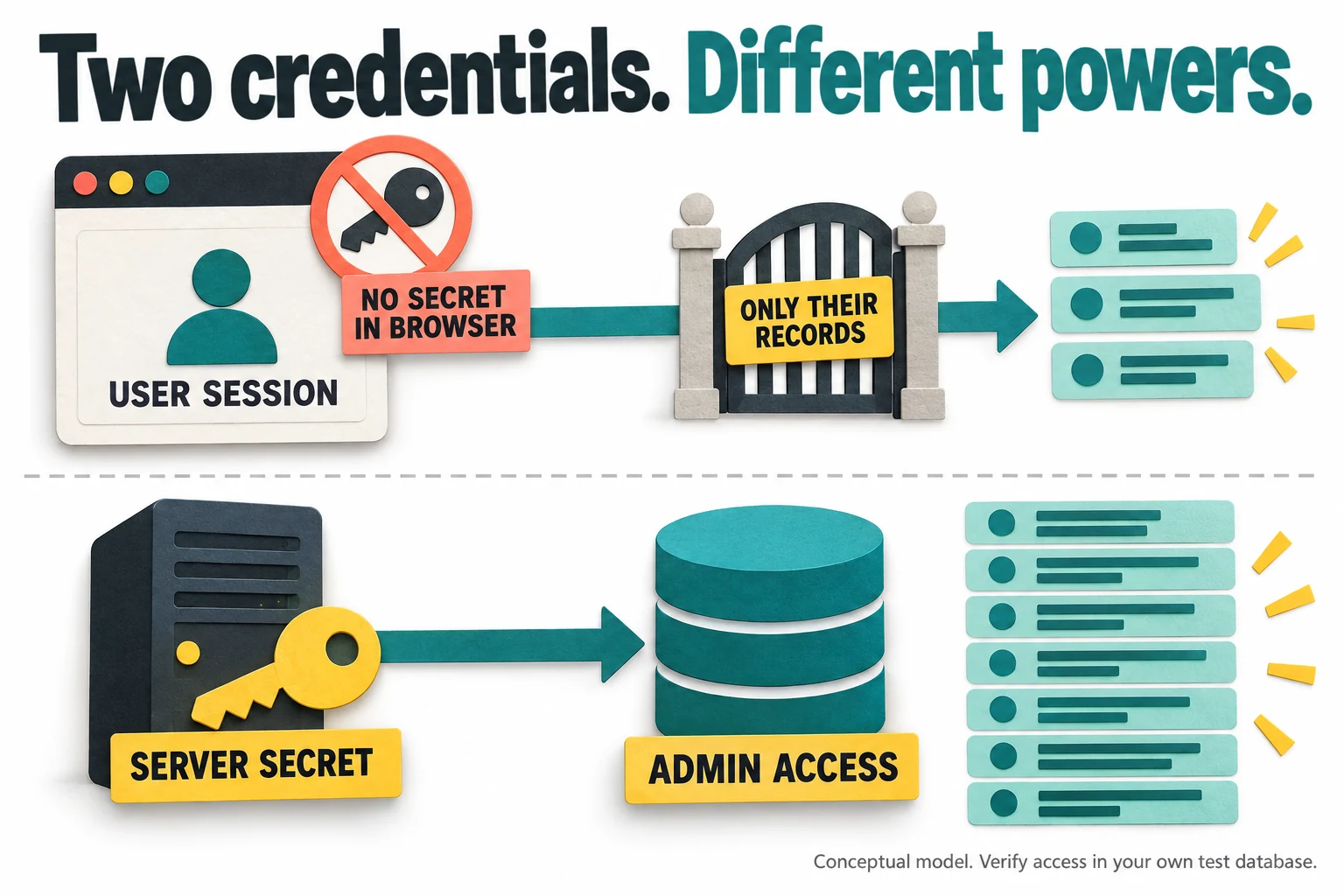
Keep user sessions and administrative database keys in different roles

The current authentication guide makes a crucial distinction: user-session requests are intended to receive row-scoped access, while database Secret Keys provide administrative access and bypass those restrictions. A secret key therefore belongs in a trusted server environment, not in a public browser bundle or a mobile binary. A working request is not evidence that it is using the appropriate authority for the person making it.

Map each connection before implementing it. A background import may legitimately require privileged server access. A customer opening their own support request should not inherit that same authority. If your application uses a server proxy, the proxy still needs to authenticate the caller and enforce the correct permissions; hiding the key behind an endpoint does not automatically make every action through that endpoint acceptable.

The documentation describes built-in account and session services, but verify the methods and configuration available in your actual account. Public pages are not perfectly consistent about every sign-in provider. Avoid advertising a login option to your users until registration, recovery, verification and sign-out have been exercised in the selected environment. A beautiful login screen is only one small part of a complete account lifecycle.

Plan how credentials are stored, rotated and revoked without putting them in screenshots, shared notes or repository history. Give each service only the access it needs when the platform supports that scope. If the available scope is broader than the workload requires, account for the resulting exposure explicitly. The convenience of a universal key is real, but so is the inconvenience of discovering that it was included in the JavaScript sent to every visitor.

Sources: Session authentication, row access and administrative keys; Database-scoped secret keys

A user session reaches only its own records while a separate server secret has administrative database access
Conceptual access model based on the documented distinction. A real application's policies and integration still need testing; the illustration is not a security certification.

Test permissions with two users, not only the happy-path owner

OWASP emphasizes authorization at the specific object and operation, not merely whether a request comes from someone who logged in. Apply that principle in a disposable database you control. Create two test users with separate records and verify what each can read, edit and remove through the same paths the application uses. Include an unauthenticated request and a signed-out or expired session. These are proposed checks, not claims about results obtained here.

A list that displays only the current user's records is not enough. Check a direct single-record request, a related record and a write operation against a record the other test user owns. A frontend filter can create the appearance of separation while the underlying request remains overly powerful. Conversely, an intentionally shared team record may need broader access than a simple owner-only rule. Write the expected result before interpreting the response.

Separate personal ownership from organizational membership. A small team may need several people to edit the same request while keeping another company's requests inaccessible. Do not assume that a documented user identifier filter expresses this whole model. Ask how groups, roles and read-only access are represented in the current product. If the required policy cannot be stated and tested clearly, the app is not ready for private customer data.

Retain these checks as regression tests when the schema, policies or integration change. A successful first demonstration is not a permanent certificate. Test with harmless fictional content and authorization limited to your own environment; there is no reason to probe another customer's application. The value of this exercise is not theatrical security testing. It is the ordinary confidence that one customer's perfectly valid session does not become another customer's unexpected visitor.

Sources: OWASP object-level authorization guidance; Session authentication, row access and administrative keys

Use the generated API contract because the public examples disagree

The public documentation contains multiple endpoint styles and pagination conventions. The REST guide shows operation-specific paths such as read and create, then uses shorter resource paths in later examples; the starter guide and REST guide also differ in paging parameter names. The secret-key article illustrates another path form. That is a documentation inconsistency, not proof that a deployed endpoint is broken. It does mean copying examples blindly is a poor integration strategy.

Start from the generated documentation for the actual database and record the request path, method, authentication, payload and response shape together. Verify one create, read, update and delete cycle using disposable data. Check the status codes your client actually receives, including validation failures. Several guides use different success-code examples, so avoid making the application depend on a narrower assumption than its verified contract supports.

Test pagination with enough fictional rows to require several pages. Confirm there are no missing or repeated records under the chosen ordering, and use a stable sort when the workflow needs one. A demo containing four rows cannot tell you whether a list remains usable with thousands. Also check empty results and loading failures; those are common user experiences, not rare technical footnotes to be considered after launch.

Keep the integration small until the behavior is understood. Wrap the verified request details in a focused application layer so a later endpoint change does not require editing every screen. This is not an argument for elaborate architecture. It is a way to make uncertainty local and observable. Generated documentation is valuable precisely when it reduces guessing; where the public guide creates ambiguity, the account-specific contract and a reproducible test should settle it.

Sources: Generated REST API, endpoint examples and pagination; NoCodeBackend core concepts and getting started; Database-scoped secret keys

Pre-hooks can enforce rules, but the source of a value still matters

Pre-hooks are documented as synchronous steps before a database insert, update or delete. They can validate or transform incoming data. That is useful because business rules should not rely solely on a browser form. However, moving a calculation to the server is not sufficient if every input to the calculation is still supplied by an untrusted client. Server location and trustworthy data are related concerns, not synonyms.

The guide's illustrative checkout calculation multiplies an incoming price by quantity. Our caution is that recomputing a total this way does not establish that the incoming price is authorized. A production purchase flow should obtain the applicable price from trusted server-side product data or another authoritative source and validate the requested quantity. This is analysis of the example's limits, not evidence that every NoCodeBackend checkout has that flaw.

There is also a capability question to resolve: the pre-hook guide labels fetching another record as coming soon, while a dated vendor update describes database-query steps as available. Confirm the current account's actual capabilities before designing a rule that needs a lookup. For partial updates, determine what existing values are available when the request omits a field. A rule written for complete inserts may behave incorrectly when only one property changes.

Test rejected input, missing input and boundary values as deliberately as successful requests. Keep validation messages useful without revealing private implementation details. Avoid placing slow external work inside a synchronous path unless its behavior is understood and necessary. The goal is a small, predictable set of rules that protects the data. A complicated visual workflow can become just as difficult to maintain as complicated handwritten code, only with more dragging.

Sources: Server-side validation before database changes; OWASP input validation and separate authorization checks; Archived offer, capacity limits and dated vendor updates

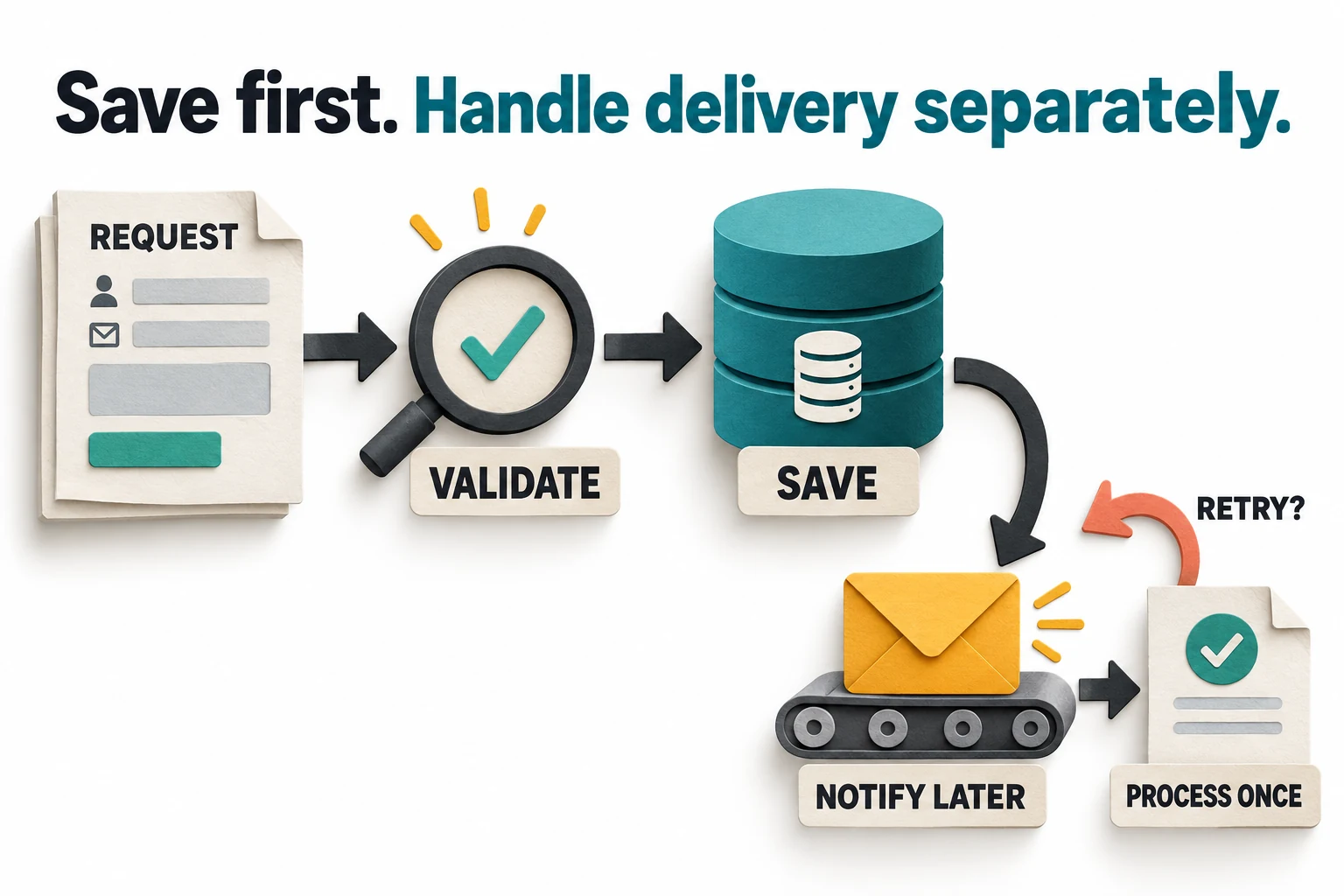
Webhooks need duplicate handling and an observable delivery path

The outbound webhook guide places delivery after the database save and describes retries when delivery fails. It expects a receiver response within five seconds. That makes a webhook different from a pre-save validation step: an external notification can fail even though the record was successfully created. Design the user experience and support process around that distinction instead of reporting every missing email as if the original submission disappeared.

A receiver should authenticate the incoming request, validate the expected event and durably record accepted work before acknowledging it. Heavy work can then run separately. Returning success before anything durable exists may avoid a timeout while losing the task if the process stops. The right implementation depends on the receiving system, but the acceptance test is clear: a temporary failure should not silently erase an important follow-up.

Plan for the same delivery to arrive twice. Do not send two customer confirmations or create two downstream jobs simply because a network retry occurred. Use a reliable event identity and an appropriate deduplication record. A database row identifier alone may be insufficient when several legitimate updates can happen to that row; ask what event identifiers and retry behavior the service exposes rather than inventing an exactly-once guarantee.

In a test environment, simulate a receiver failure and a duplicate delivery, then confirm the intended final outcome and inspect the logs. Also check whether the payload includes more data than the destination needs. Integration convenience should not become an excuse to transmit every field to every service. A well-designed notification path is understandable when it succeeds, diagnosable when it fails and unexciting when a harmless retry occurs.

Sources: Post-save webhook delivery and retries

A request passes validation before saving and then sends a separate notification with duplicate handling
Conceptual sequence: validate before saving, handle notification delivery afterward. Process once describes a receiver design goal, not a guarantee of exactly-once webhook delivery.

Billing requires a separate test plan, especially inside a demo

The billing guide describes Stripe integration, plan-based row limits and a demo wired to the connected database and keys. It explicitly distinguishes test keys from live keys and notes a platform commission on live sales, without giving the rate in that guide. A page labeled demo is therefore not proof that actions are financially inert. Confirm the account mode and use isolated test records before exercising any checkout flow.

Ask for the actual live fee schedule and the scope of requested credentials before making a commercial commitment. Include that fee alongside payment processing, refunds and other operating costs. Verify which events update access and how the application handles a failed renewal, cancellation, downgrade or delayed payment. A successful first purchase demonstrates only one path through a billing system; the continuing relationship is where many important edge cases live.

Stripe's own documentation warns that events can arrive more than once and out of order, and describes verification and duplicate handling. Even when a platform manages the webhook infrastructure, test the observable result in your app. Refreshing a success page should not create a second entitlement, and an interrupted browser return should not prevent a genuinely completed payment from being reconciled. Do not equate a redirect with authoritative payment state.

Define what happens when a paying user exceeds a new plan's record allowance. Blocking a new record, hiding existing records and deleting existing data are very different responses. Decide the customer-facing policy and verify the platform behavior supports it. If you cannot explain the outcome of an ordinary downgrade without guessing, postpone real billing. A celebration animation after checkout is pleasant, but it is not a substitute for an entitlement model.

Sources: Stripe integration, demo environment and live fees; Stripe webhook verification, duplicate delivery and ordering

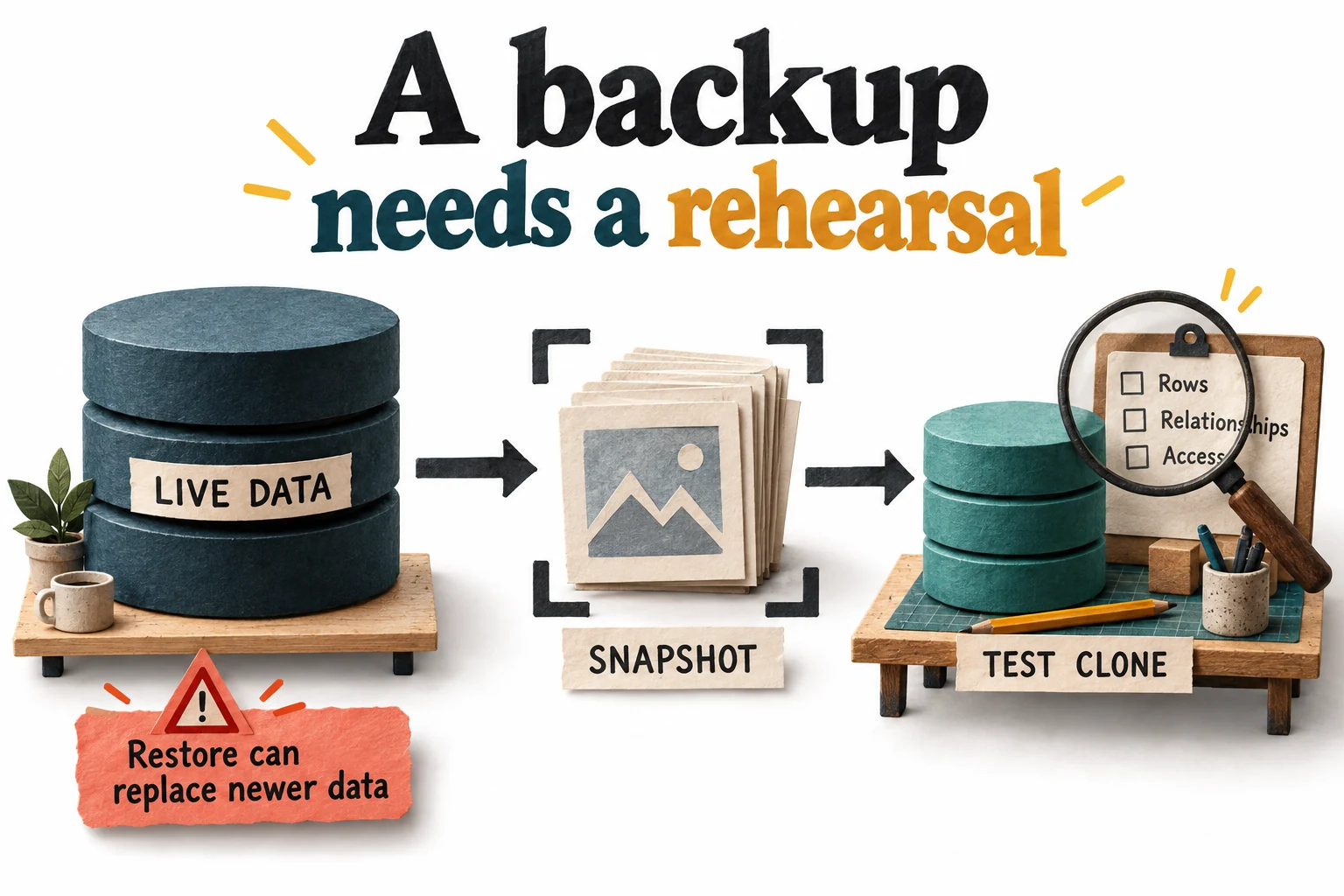
A snapshot is useful only if recovery has been rehearsed

The snapshot guide describes schema, rows, constraints and authentication configuration in a database snapshot, with daily and manual options subject to plan limits. It distinguishes restoring over an existing database from cloning into a new one. The restore path replaces current state, including records created after the snapshot. That distinction should be understood before a recovery incident, when time pressure makes a large reassuring button unusually tempting.

For evaluation, create a small known dataset and clone a snapshot into a separate test database. Compare expected rows, relationships, permissions and the application's ability to connect. Confirm that the clone uses its own credentials and that test notifications or billing cannot accidentally reach real customers. The purpose is to establish a recovery procedure you can explain, not merely to prove that a snapshot appears in a list.

Record how much data could be lost between backups and how long restoration takes in your own scenario. A daily schedule does not automatically satisfy a business that cannot afford to lose a day of changes. Likewise, a vendor phrase about restoring in seconds is not a measured recovery time for your schema, data volume and dependencies. Include reconnecting the application and checking access in the rehearsal, not just waiting for a database status change.

Separate database recovery from external systems. A restored row does not necessarily restore a deleted file in object storage, reverse an email already sent or reconcile a payment that occurred afterward. Create a small dependency checklist so recovery does not reproduce an internally consistent database alongside inconsistent outside services. A backup strategy is not complete because a copy exists; it becomes credible when the intended business operation can be recovered and verified.

Sources: Database snapshots, overwrite restore and cloning

A database snapshot becomes a separate test clone where rows relationships and access can be checked
Our suggested recovery rehearsal. Restoring over a live database can replace newer records; first inspect a separate clone with appropriately protected test data.

Account residency, database location and backup location need separate answers

The residency guide distinguishes account-level information from individual database deployment. It says choosing Frankfurt for account residency does not automatically move existing databases from Phoenix. It also describes residency as locked after selection. Consequently, a region badge should not be treated as a complete map of where every part of an application resides. Confirm the location of the actual database you will use, not just the account profile.

There is an unresolved documentation conflict worth raising before relying on strict location requirements. The residency page describes regional backup storage, while the snapshot guide discusses replication across regional hubs. We cannot establish the real storage topology from those statements alone. Ask the provider which data, snapshots, logs and support processes cross regions under the specific configuration. Keep the answer and applicable contractual information rather than infer compliance from a country name.

For a US-focused app, location still affects practical evaluation even when a strict residency requirement is absent. Test response times from the intended audience's environment and examine the full path through your frontend host and external services. A nearby database is only one component. Do not accept an unmeasured promise of ultra-low latency as a substitute for a representative request with the schema, authentication and query that the app will actually use.

Treat compliance claims as inputs to an assessment, not a legal conclusion supplied by this review. Different organizations have different obligations, contracts and risk tolerances. A provider may offer useful regional options while additional questions remain for a particular workload. The purchasing decision should reflect those requirements explicitly. It is cheaper to discover an incompatible data-flow requirement during a trial than after explaining the platform choice to a customer who has already entrusted it with records.

Sources: Account residency versus database deployment regions; Database snapshots, overwrite restore and cloning

File storage has its own permissions, costs and recovery story

NoCodeBackend documents a connection to your own Cloudflare R2 account. Its setup guide requests Admin Read and Write credentials so it can create and configure buckets. Cloudflare distinguishes that administrative scope from narrower object permissions. This is a meaningful access grant, not a decorative setup field. Ask whether your required workflow supports a narrower preconfigured arrangement; do not assume one is supported without confirmation.

Use a deliberately scoped storage arrangement for the application and understand which service can read, write or delete which files. Keep secrets out of the client bundle and ordinary support screenshots. Connecting storage should be an intentional security decision with a known owner and revocation path. Convenience during the first upload does not remove the need to know what an exposed or misused credential could affect later.

Separate public product images from private customer attachments. A public delivery URL is appropriate for one and may be wholly unsuitable for the other. Test access after sign-out and with a different test user when the file is meant to be private. Database row permissions alone do not prove that a directly accessible object URL has equivalent protection. Follow the documented storage access model rather than rely on an interface hiding a link.

Budget for storage operations and retention, and verify how files are exported or recovered separately from database snapshots. A row containing an attachment URL is not the attachment itself. When a record is deleted, decide whether the corresponding object should remain, be removed or enter a retention process. Orphaned objects and broken links are opposite failure modes of the same missing lifecycle rule. An integrated upload feature is useful only when that lifecycle is understood.

Sources: Cloudflare R2 integration and requested permissions; Cloudflare R2 token permissions

An invited builder is not automatically a harmless extra seat

The invitation guide describes isolated invitee accounts with delegated quotas rather than an assumption that every invited person shares the owner's entire dashboard. It also describes deletion as permanently purging the invitee's account and databases. That is a much more consequential operation than simply revoking access. Before using invitations for client work, clarify ownership, transfer and offboarding with the provider and verify the current account behavior.

Write down who should own the completed backend. An agency may be building for a client who needs continuity after the engagement ends. A contractor may leave while the app remains live. Those are normal business events, not exceptional emergencies. The handoff plan should identify who controls billing, credentials, data exports, backups and domain configuration without relying on a person who is no longer available.

Quota delegation also changes the owner's remaining capacity. Allocate enough for the intended work and understand what can be reclaimed without affecting active databases. Do not treat deleting an invitee as a routine way to free a seat merely because the interface makes it accessible. Confirm a recoverable transfer or export route first. Resource accounting should not accidentally become a data-retention policy selected by the person tidying the team list.

During a trial, use a disposable invitee if the plan permits and document the lifecycle without placing real work at risk. Verify separation, access and the supported handoff steps. The review does not claim that these account actions were exercised here. The point is to make a future purchase answer the organization you actually have, not the imaginary organization in which nobody changes roles and every client project belongs to the same account forever.

Sources: Isolated invitee accounts, quota delegation and deletion

MCP can improve context, but read access is still access

The current MCP guide lists schema inspection, generated API documentation and read-only SQL. Broader marketing discusses AI-assisted backend creation, so verify the actual exposed tools and permissions rather than assume that every advertised workflow happens through the same connector. A read-oriented integration can still be useful: it gives an assistant the real structure and contract instead of asking it to invent plausible endpoints from a product name.

Read-only does not mean non-sensitive. Schema names, customer records and business data can reveal information even when the assistant cannot change them. Connect a test account or sanitized database for evaluation and review the data handling of the chosen assistant environment. Keep tokens separate from prompts, screenshots and source control. Prefer a supported credential mechanism that avoids placing secrets into ordinary URLs that might be logged or shared.

Ask the assistant to explain the observed schema and propose a small change before granting any separate write capability. Compare the proposal with your data dictionary and tests. Where a connector is limited to reads, retain that limit instead of improvising a privileged route merely to make an impressive demo work. The benefit should come from better grounded development, not from removing every checkpoint between a sentence and a live database change.

Keep human review around consequential migrations and access changes. An assistant may understand a table's shape without knowing why an apparently unused field must remain for reporting or contractual reasons. That missing business context is not solved by faster endpoint discovery. The strongest workflow combines accurate system context with explicit intent and a reversible implementation path. It is less dramatic than asking for an entire production system in one message, and considerably easier to maintain.

Sources: MCP tools, read access and token scope; Archived offer, capacity limits and dated vendor updates

Make the pilot include an exit, not only a successful first insert

Use a small application that resembles your real workload, with a few related tables, two test users and one external notification. Define success before building: correct records, correct permissions, understandable failures and a recoverable state. Include enough data to exercise paging and the intended queries. Keep the experiment separate from real customer records and live billing so discovering a limitation remains an evaluation result rather than an incident.

Exercise ordinary interruptions. Submit an invalid value, repeat an authorized request, temporarily make the test receiver unavailable and reopen a session after expiration. Observe what the user sees and what the operator can diagnose. Avoid measuring only the fastest successful request. A dependable small app needs a clear answer when a request is rejected or a downstream service is unavailable, even if most daily traffic is uneventful.

Then export the data through a supported route and confirm that it can be understood outside the platform. Include relationships, identifiers, timestamps and any separately stored files needed to reconstruct the workflow. Do not assume that an internal snapshot is an independent portable backup. Ask about the supported exit format and the treatment of authentication data and configuration. A credible migration plan makes a service easier to adopt, not less attractive.

Evaluate the effort honestly. Generated APIs may save substantial routine setup while a specific requirement still needs custom application logic. That can be a good trade. It becomes a poor trade when the missing behavior is fundamental and the workaround grows more complicated than the backend it replaced. Keep the pilot narrow enough to finish, but complete enough to reveal that distinction before the platform becomes the foundation of a promise to paying customers.

Sources: Generated REST API, endpoint examples and pagination; Database snapshots, overwrite restore and cloning; Post-save webhook delivery and retries

Our verdict: 75 out of 100, with production suitability to prove

Our editorial score is 75 out of 100: 17 for problem fit, 17 for documented capabilities, 14 for workflow, 12 for evidence and 15 for value. This is not a security certification or a copied customer average. It reflects a useful proposition with several account-specific and documentation questions still unresolved. The score should not be used to conclude that a particular application is safe merely because the product has a reasonably positive overall assessment.

The positive case is straightforward. Connecting a relational model to usable APIs and documentation can reduce repetitive work, and the surrounding services may cover needs that a small builder would otherwise assemble separately. The main reservations concern consistency and verification. Endpoint examples, capability descriptions and regional-storage wording need reconciliation, while billing, invitee deletion and privileged credentials deserve more care than an automatic-backend headline suggests.

Proceed when a representative pilot passes, the actual entitlement fits realistic growth and the provider answers the questions material to your workload. Delay or choose another architecture when essential requirements depend on unverified transaction behavior, permissions or recovery guarantees. An archived deal should never create urgency to overlook those gaps. The product can be worth evaluating even though the old offer is unavailable and not every application belongs on the same foundation.

The most useful buying test is whether the platform makes your small application simpler to operate as well as faster to demonstrate. If records remain correct, users remain separated, failures are visible and recovery is rehearsed, reduced backend setup is a real advantage. If nobody can explain what happens after a retry, a role change or a restore, the code may be shorter but the uncertainty is not. That is the part worth fixing before launch.

Sources: NoCodeBackend core concepts and getting started; Archived offer, capacity limits and dated vendor updates; Generated REST API, endpoint examples and pagination; Account residency versus database deployment regions

Frequently asked questions

Can I still buy the $79 lifetime deal?

The source listing was sold out when checked, and SoftScout keeps this offer archived. The $79 figure is historical context, not a claim that checkout is available today. Verify any current direct offer separately.

Can I put the database secret key in my React app?

No. The current documentation describes that key as administrative access that bypasses row-level restrictions. Keep it on a trusted server and use an appropriate user-session path for client-facing requests.

Does the billing demo guarantee that no real money moves?

No. The guide says the demo uses your connected database and Stripe keys. Live keys can lead to real checkout activity. Use separate test data and verified test credentials for an evaluation.

Does choosing Frankfurt move all existing databases there?

The residency guide says account location and database location are separate, and existing databases can remain in their previous region. Backup-region wording also needs clarification before relying on a strict location requirement.

Is this a hands-on security review?

No. This is an editorial assessment of public sources with a proposed acceptance-test plan. Documentation gaps are reasons to verify behavior, not proof that a deployed application has a particular vulnerability.

Current alternatives to NoCodeBackend

Websites & No-Code

Foyer

Foyer adds an AI voice agent to your website to answer visitor questions, guide navigation, and capture high-intent leads. It integrates with popular CMS platforms to enhance customer engagement. The product is designed for teams that need a repeatable websites & no-code process and want clearer control over the core task. It fits best when the buyer has a defined use case, realistic input data, and a way to judge output quality before rolling it out across a wider workflow.

$59 · checked Oct 23, 2026

Websites & No-Code

Grigora

A promising fit for a compact business website that benefits from fewer systems. Verify the exact license and editor first: new AI workflows differ from legacy guides, shared email has limits, and exporting files does not move every hosted service.

$69 · checked Nov 8, 2026

Websites & No-Code

ShopLentor

Useful when an existing WooCommerce store needs repeatable layout control and several specific shopping features. Start with a focused staging test, not every module. A polished template is valuable only when customers can still pay, receive the right delivery option and see an accurate order.

$69 · checked Oct 24, 2026

Websites & No-Code

Stackby

Stackby can replace an increasingly fragile web of operational spreadsheets with connected records and clearer working views. It is most convincing for a small team willing to design its own workflow; the main buying trap is assuming that every advertised module comes with the entry lifetime license.

$109 · checked Nov 7, 2026

Deal alerts

Get websites & no-code deal alerts by email.

SoftScout will send short buying notes when offers like NoCodeBackend look worth checking or worth skipping.

Short buyer verdicts

Useful offers before checkout

Editorial note

Treat the archived price as historical, not a live purchase promise. Never place an administrative database key in a public client, and do not treat a demo label, a region badge or a backup button as proof that the whole workflow is safe.

For vendors

Have a better deal for NoCodeBackend?

Send current partner terms, coupon limits, refund rules, and the best buyer fit. We review offers before adding them to SoftScout pages or Telegram alerts.

Submit terms