Back to deals
Email & OutreachArchived deal

Reoon Email Verifier deal archive

Reoon is worth testing for affordable email-list maintenance and signup validation, but its result is a technical signal, not permission to contact someone or a guarantee of inbox placement. This archived deal page remains a useful product guide while current purchase terms must be checked separately. This page is kept as a historical SoftScout archive entry, so readers can compare past terms, category positioning, and buyer-fit notes.

Product overview

What Reoon Email Verifier does

The service offers single-address checks, bulk uploads and an API, with separate quick and deeper verification paths. Detailed result categories can help a list owner keep uncertain addresses apart instead of treating every result as a simple yes or no.

This review explains credit economics, CSV handling, responsible use of results and what an accuracy test should measure. SoftScout's saved offer remains archived; the review distinguishes that historical listing from the vendor's current service and does not endorse an old discount badge as a live quotation.

Read the full Reoon Email Verifier review

Best for

  • Newsletter owners maintaining permission-based lists with a clear suppression process
  • Small teams that need occasional bulk checks without a large recurring commitment
  • Developers who can distinguish fast signup validation from deeper asynchronous verification

Why we picked it

  • Separate daily and instant credits can match different workload patterns
  • Result categories preserve uncertainty instead of hiding it inside one broad valid label
  • A free allowance supports a limited evaluation before a larger credit purchase

Check before buying

  • This offer is archived and may no longer be available at the original price.
  • Use this page as historical research for email & outreach buying context.
  • Check the vendor's current pricing, limits, and refund terms before making any purchase.

Archived offer

This page preserves the deal context for research and SEO, but the original discount may be closed.

Use it for

Compare historical email & outreach pricing, positioning, and buyer fit before choosing a current tool.

Next step

Browse active SoftScout deals or check the vendor's current terms before spending money.

This archive page stays live for research. Use active SoftScout listings when you are ready to buy.

Check Source History

Source transparency

Source
Source marketplace
Link type
Source page
Last checked
Oct 24, 2026

Buyer checklist

  • Treat this as a historical deal page, not a live checkout recommendation.
  • Use the notes to compare the old offer against the vendor's current pricing.
  • If the original source still opens, verify all terms before buying.

Reoon Email Verifier: the buying decision

Reoon gives a small business a relatively inexpensive way to separate technical email-address risk from the rest of its mailing process. Its combination of non-expiring purchased credits, renewing daily capacity and detailed result categories can suit both occasional list maintenance and steady intake, provided uncertainty and recipient permission remain separate decisions.

Research-based review, not a hands-on test. Sources checked on 2026-10-24. The assessment below is our editorial judgment, not a customer rating. Editorial assessment: 81/100.

Consider it if

  • You already know which recipients should receive your messages and need a technical address-risk check alongside that permission record.
  • A small authorized test shows useful classifications and a clean route back into your CRM without changing opt-out status.
  • Your credit choice matches the timing of the work and the API or upload path meets your tested operational requirements.

Skip it if

  • You expect verification to turn a purchased or scraped address list into willing subscribers.
  • You require guaranteed inbox delivery or treat an advertised accuracy percentage as a measured result for your own list.
  • Your data-processing requirements or integration behavior remain unresolved and the decision depends only on a cheap lifetime headline.
Problem fit: 18/20
Address-risk screening is a clear operational need for permission-based mailing lists and signup flows that already have a responsible contact-management process.
Capabilities: 16/20
Bulk processing, categorized results and two API depths cover common needs, but catch-all uncertainty and delivery factors remain outside a definitive address check.
Workflow fit: 16/20
Documented credit behavior and exports support routine maintenance, while column selection, status handling and integration failures still need deliberate controls.
Evidence confidence: 13/20
Vendor guides provide useful implementation detail, but advertised accuracy and speed have not been independently benchmarked on a representative dataset for this review.
Value: 18/20
A free allowance and inexpensive non-expiring credit packages lower the cost of evaluating a real workload, provided purchases match usable demand rather than theoretical daily capacity.

Reoon Email Verifier review: useful screening without magical delivery promises

An email list can look reassuringly substantial while containing old addresses, typing mistakes and records whose owners have long since moved on. Reoon Email Verifier helps identify technical risk before those records reach a sending workflow. It is not an email-marketing platform, a source of customer consent or a machine that turns silence into sales. Its useful job is narrower: give you better information about the addresses you already have a legitimate reason to process, so the next decision is less dependent on guesswork.

Our editorial assessment is 81 out of 100. The combination of a limited free allowance, flexible credits and categorized results is attractive for small organizations. We reserve points because we have not independently benchmarked the vendor's accuracy or speed claims, and because some email systems will not provide a conclusive mailbox answer. This review draws on current documentation checked on October 24, 2026. The practical examples are evaluation scenarios, not claims that we uploaded a customer database or achieved a particular reduction in bounces.

The distinction between checking an address and delivering a message is the foundation of a sensible purchase. A recipient's mail system can reject or defer a message for reasons beyond whether the address exists. Sender configuration, reputation, content and timing can all matter. Reoon's own guidance acknowledges that verification cannot guarantee zero bounces. An address-level result is therefore one input to a process, not a warranty attached to every future message you send.

The strongest buyer already has a permission-based mailing list or a signup process and wants to reduce avoidable address mistakes. The weaker buyer hopes a green status will repair an untrusted list or compensate for unwanted messages. Think of verification as checking the label on a parcel: useful, but it does not establish that the recipient ordered what is inside. Start with a small authorized sample and a clear decision about what each result will change. Without that decision, even accurate information can become another spreadsheet nobody uses.
Sources: Reoon product checks and current direct pricing; Why verified addresses can still bounce

Read the result as a category, not a promise

Reoon distinguishes results such as Safe, Role, Catch-All, Invalid, Disposable, Disabled, Inbox Full, Spamtrap and Unknown. That is more useful than a single valid checkbox because different kinds of uncertainty deserve different handling. A shared company inbox is not the same problem as a malformed address. A temporarily full mailbox is not the same as one that cannot be confirmed. Keep the category in your records instead of immediately reducing everything to a boolean value that loses the explanation.

Create an explicit handling policy before the first import. For a newsletter, confirmed opt-outs remain excluded regardless of technical status. Addresses classified as invalid or disabled should not quietly return to an active campaign list. Inconclusive records should be kept apart for review or a later check. A role address needs context: a shared support inbox may be appropriate for an existing service conversation but inappropriate for an unrelated promotional subscription. The software supplies a signal; the business must decide the purpose and expected recipient.

The numeric score is not a calibrated probability established by this review. A result of ninety does not mean we have verified a ninety-percent chance of delivery, engagement or purchase. Avoid inventing a universal cutoff and presenting it as scientific. If you use a score threshold, record why it exists and evaluate it against observed outcomes in your own permitted workflow. A broad category, the verification date and the underlying reason are often more actionable than a number detached from its context.

Preserve the distinction between an operational exclusion and destruction of the business record. Removing an address from a sending segment does not necessarily mean erasing every record of a customer's order or request. Keep only what your policies require, but retain the suppression information needed to avoid re-adding an opted-out contact. Do not let a cleanup operation become an uncontrolled deletion of useful history. The cleanest mailing list is not always the shortest database; it is the one whose inclusion rules are understood and consistently applied.

Sources: Meaning of verification result categories

Catch-all and Unknown are different kinds of uncertainty

A catch-all domain can accept mail addressed to many names without confirming that a particular named mailbox exists. That makes a positive server response less conclusive than it appears. Unknown, by contrast, means the verification did not obtain a definitive answer. Neither label should be casually rewritten as Safe just because the list owner wants a larger audience. Equally, neither proves that every affected person is unreachable. The useful response is to preserve the uncertainty and decide what evidence would justify a next step.

Consider a hypothetical existing customer whose confirmed account email is at a catch-all domain. You may have recent, relevant correspondence and an ongoing service obligation. That context is different from an unfamiliar address assembled from a guessed naming pattern. The technical category can be identical while the business context is not. Keep those facts separate rather than asking the verifier to make a relationship decision it has no information to make. The product cannot know why a person is in your database unless your own system retains that history.

For an inconclusive result, investigate whether it is isolated or concentrated at one provider or domain. A cluster can point to a temporary response issue or a limitation that affects that group. Do not repeatedly submit the same list in a tight loop hoping uncertainty will eventually become the answer you prefer. Use a bounded retry policy and keep the earlier result with its time. If a result remains unresolved, your process should have a defined outcome that does not depend on an employee improvising under campaign pressure.

The important product benefit is making these groups visible. It allows a cautious list owner to avoid mixing known technical risk with the routine segment. It does not make an uncertain segment automatically suitable for outreach. Evaluate whether Reoon's classifications help your team explain why a record is held back, not just whether they produce a flattering percentage of usable addresses. A report that honestly preserves ambiguity can be more useful than one that confidently waves every difficult case through.

Sources: Catch-all domains and uncertain mailbox results; Meaning of verification result categories

Quick Mode and Power Mode solve different problems

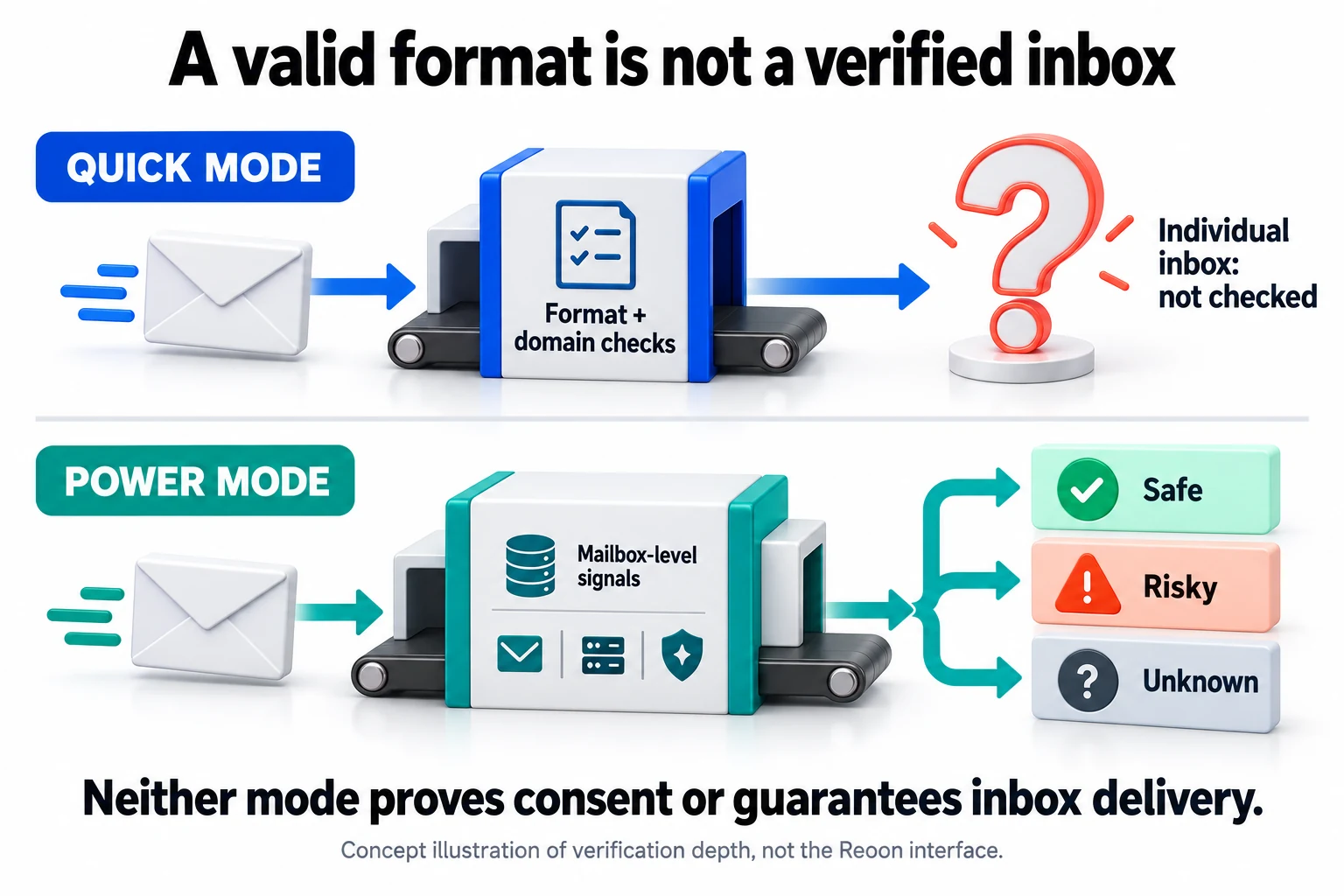
Quick Mode is designed for fast entry-point checks and does not inspect individual inbox status. Power Mode performs deeper verification, and the documentation says dashboard single and bulk checks use that deeper level internally. This distinction is easy to miss when a marketing page talks broadly about live verification. A fast valid response from the quick path is not evidence that the same address passed the mailbox-level checks of the deeper path. Choose the mode according to the decision you are trying to make.

At a signup form, responsiveness matters. A visitor should not be left staring at a spinner while a remote mail system decides how cooperative it feels. A quick check can help identify obvious problems, while a later process handles deeper verification if the application needs it. That is an architectural option to test, not a claim that every plugin implements it automatically. The confirmation email and the person's completion of the subscription process remain distinct evidence from a technical verification response.

For maintenance of an existing list, depth is generally more relevant than an instant answer at a form. Plan the job ahead of the campaign rather than starting it when the scheduled send is already overdue. Keep result timestamps and distinguish the mode used. Without that metadata, two records marked valid can appear comparable even though one received a quick check and the other a deeper check. The illustration highlights precisely this difference rather than implying that one path can promise delivery.

Test failure behavior as carefully as the successful response. What happens if the service is slow, the credit balance is exhausted or the response cannot be interpreted? Decide whether the application allows a pending signup, asks the user to retry or holds a downstream action for review. Do not silently convert a network error into a positive result. Conversely, avoid permanently rejecting a real customer solely because an external check timed out. A useful integration has a humane uncertain state, not just green and red lights.

Sources: Quick Mode versus Power Mode

Quick checks leave individual inbox status untested while deeper verification produces safe risky or unknown outcomes
Conceptual comparison, not the Reoon interface. Quick Mode does not establish individual inbox status; deeper checks still do not prove consent or guarantee delivery.

Daily credits are capacity, instant credits are inventory

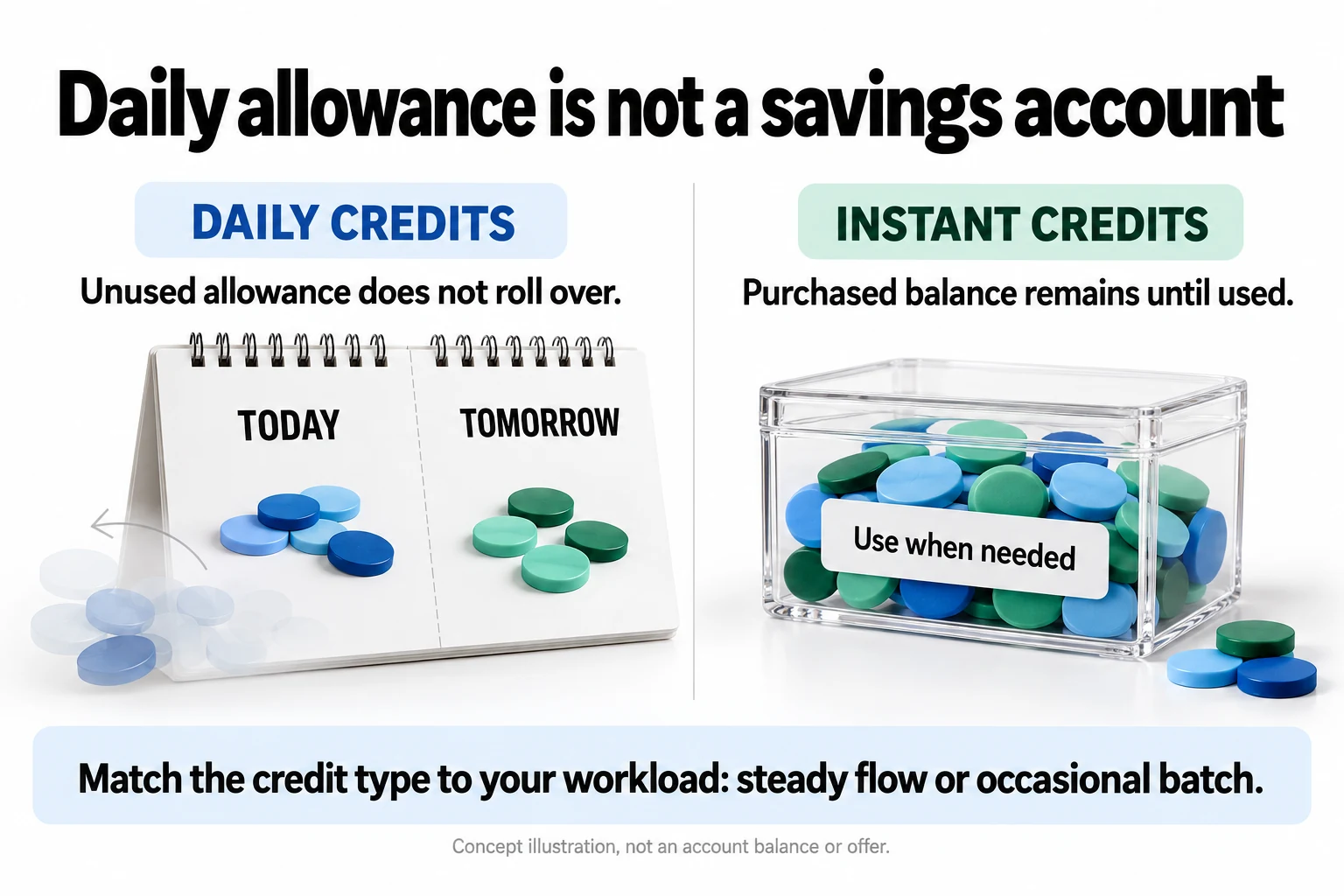
Reoon separates renewing daily credits from instant credits that remain until used. Unused daily capacity does not accumulate, and daily credits are consumed first when both types are available. The dashboard guide places the daily reset at 12:05 AM GMT. This is a practical distinction for buyers in the United States: the reset follows the service's stated clock, not necessarily the end of your local working day. Check the actual account balance before starting a job near the boundary.

Imagine an operation that needs five hundred checks spread evenly through each working day. A daily allowance may fit that pattern. Now imagine another operation that needs ten thousand checks on one Monday and nothing for several weeks. The same theoretical monthly capacity may be a poor fit because unused days do not build a reserve for that Monday. The second buyer should evaluate immediately available credits rather than multiplying a daily number by thirty and assuming the entire result can be spent at once.

Bulk processing also requires enough available credits for the submitted list. Do not upload a large job assuming tomorrow's renewal will gradually fund it. Prepare the batch against the balance you actually have, and confirm current behavior in the account before planning an operational deadline. Unknown results are described as automatically refunded, but that does not remove the need to fund the initial job. A refund policy for inconclusive checks and the capacity needed to begin processing are separate questions.

Track how much of a renewing allowance you genuinely use. A large daily quota can look economical when divided by its maximum theoretical volume, while most of that volume expires unused. For a small team, a smaller recurring plan or a one-time balance may be more sensible than the largest discount. The illustration uses a calendar and a stored balance because the mental model matters: daily capacity is a recurring opportunity to process work, not a savings account that gets richer while you ignore it.

Sources: Verification service and credit options; Bulk upload, column selection and result downloads; Re-verification workflows and credit behavior

A daily calendar allowance renews without rollover beside a separate stored balance of instant credits
Illustration of credit behavior, not an account balance. Daily capacity resets; instant credits remain available until used under the applicable service terms.

Current prices and the archived deal are separate references

The direct product page currently advertises twenty free checks per day plus one hundred signup credits, instant packages starting at $11.90 for ten thousand checks, and daily plans starting at nine dollars monthly for five hundred daily credits. Confirm the account and checkout terms before purchasing; the free page also describes renewal on login. These figures are the checked public offer, not a promise that an older account has the same entitlement or that a displayed package will remain unchanged.

This SoftScout record remains archived, preserving its existing URL and historical deal context. That does not mean Reoon has stopped operating. On the review date, the external offer page displayed a $79 purchase option with five hundred daily credits and a one-hundred-thousand-credit bonus. Its displayed percentage differed from the saved historical badge. Use current checkout terms rather than the archived percentage when deciding whether to buy. An archive is useful context, but it should not masquerade as a live quotation.

Compare purchase routes by the workload you can reasonably expect, not only by the word lifetime. A bonus balance can be useful for a large initial cleanup; a daily renewal can be useful for ongoing intake. If neither workload exists, a larger package is not automatically a saving. Check redemption requirements, the meaning of lifetime access and which account receives the entitlement. Keep the receipt and the applicable terms so an account question can be resolved without relying on a remembered screenshot of a promotion.

Refund conditions also depend on the purchase route. Reoon's direct terms describe a conditional policy that takes use and circumstances into account, while an external deal can state its own window. Do not call the purchase risk-free or assume cancellation automatically requests a refund. The low-cost way to reduce uncertainty is to test the service first with data you are authorized to process, inspect the output and then buy the amount of capacity you need. That is less exciting than a giant discount badge, but considerably more useful when the invoice arrives.

Sources: Reoon product checks and current direct pricing; External offer terms checked alongside the archived listing; Direct-service purchase and refund conditions

Prepare a narrow CSV and verify the intended column

The bulk guide supports plain-text address lists and CSV files, retaining original columns while appending verification details. Its important warning is that a file with several email columns can have the first one selected by default. Avoid ambiguity by preparing a dedicated verification file with one intended address column and a stable internal identifier. There is little benefit in uploading a sprawling CRM export if the job needs only an address and a way to match the result back to the correct record.

Remove unnecessary names, notes, order values and other personal or commercially sensitive fields from the processing copy. Keep the source dataset separately under your normal controls. A narrow file is easier to inspect and reduces the amount of information sent to another service. It also makes accidental column selection easier to notice. Before a large run, check a few records whose primary and secondary addresses differ so the test can reveal whether the intended field was actually processed.

Deduplicate carefully. Two identical rows may be redundant, while two records sharing an address can represent separate customer relationships or subscriptions. Do not collapse business records merely to save verification credits. A useful design verifies a unique address once for the relevant period and maps the result back to the appropriate records, preserving their separate permission and purpose information. That mapping belongs in your controlled workflow; it should not be guessed from names after the results arrive.

Keep a small reconciliation note with the job: input count, unique-address count, submitted count and the identifier used for matching. Review these numbers before importing the output. If the counts differ, understand why rather than assuming the vendor has cleaned everything correctly. A file can process successfully while still representing the wrong segment or wrong column. The best early check is not a progress bar reaching one hundred percent; it is confirming that a few known records have the expected address and the expected associated result.

Sources: Bulk upload, column selection and result downloads

Bring results back without losing the reason for exclusion

A categorized export is only useful if the destination system preserves its meaning. Keep separate fields for verification status, verification time, verification mode and the decision made by your own process. Do not overwrite the subscription state with the technical result. A record can be technically suitable for delivery while remaining excluded because the person opted out. Another record can belong to an active customer while needing an address correction. Flattening those situations into one active flag is an avoidable source of mistakes.

Before importing into a mailing platform, build a preview of the proposed changes. Count how many records would become eligible, remain held or be excluded, and inspect examples from each group. Pay particular attention to any operation that would add people back to a campaign audience. The result file should enrich the technical assessment, not silently undo a previous suppression. A small test import into a non-sending segment can reveal field-mapping errors without turning a data-maintenance task into an accidental campaign.

Use stable identifiers and an explicit update policy. If the source address changed after the verification export was created, do not attach the old result to the replacement address merely because the customer ID matches. Check that the address being updated is the address that was actually verified. Similarly, keep newer results from being overwritten by older batches. These are ordinary reconciliation rules, but they matter more than the convenience of importing a file in one click.

After the import, compare the destination counts with the approved preview and inspect a few boundary cases again. Retain enough of the job record to explain why a contact was held back without keeping unnecessary personal data indefinitely. Assign a person to handle correction requests and unresolved records. The point of verification is to improve a continuing process, not to create a one-time clean file that becomes stale immediately while the original database continues collecting the same errors.

Sources: Meaning of verification result categories; Re-verification workflows and credit behavior

Verification never replaces subscriber choice

Google's sender guidance recommends sending subscription messages to people who want them, confirming addresses and making it easy to unsubscribe. It also treats authentication and sender behavior as separate delivery responsibilities. Reoon cannot supply those missing parts by assigning an address a favorable technical result. For a newsletter, keep the original subscription record and the current suppression state as independent evidence. A mailbox existing somewhere on the internet is not an invitation to add it to your audience.

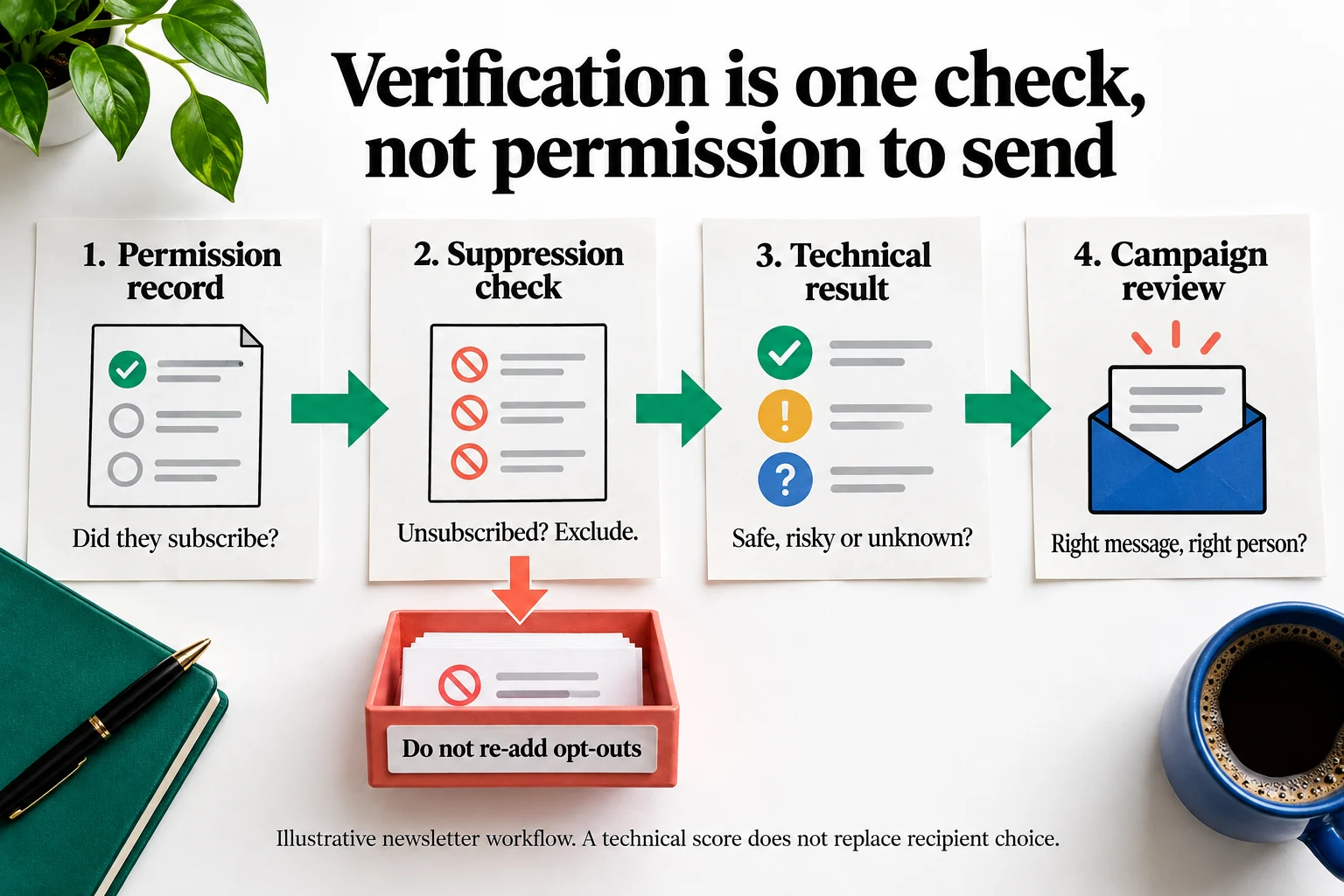
Our suggested workflow begins with permission and suppression checks, then applies technical verification and a final campaign review. This order avoids spending effort on contacts who should not be included in the first place. It also makes responsibility visible: the verification service answers a technical question, while your organization decides whether the proposed message fits the relationship. The diagram is a process recommendation, not a claim that Reoon enforces every step or that it determines legal compliance for your business.

Be especially careful with old exports. A historical list can omit recent opt-outs or contain people whose relationship with the business has changed. Reconcile it with the current source of truth before using it. Do not upload a cleaned version and label every row newly subscribed. If a team cannot establish why a person should receive a newsletter, technical verification does not solve that gap. A smaller audience that expects the message is more useful than a larger audience that wonders how the sender found them.

This distinction also protects the interpretation of results. Poor replies or complaints after a campaign do not necessarily indicate that the verifier failed. It may have correctly identified reachable mailboxes while the message was unwanted or irrelevant. Evaluate address quality separately from audience fit and content quality. Buying more verification credits is not a substitute for improving those other parts. The product can help you avoid some technical mistakes; it cannot make an unappealing offer welcome merely by confirming where to send it.

Sources: Google's sender and subscription guidelines

Newsletter workflow checks permission and suppressions before technical verification and a final campaign review
Suggested newsletter process. Rechecking an address must not re-subscribe someone who opted out; verification is only one part of the decision to send.

An API integration needs limits, retries and a pending state

The API documentation separates single-address verification from bulk jobs and warns against using the single endpoint for bulk processing, including a five-thread continuous concurrency limit. It also defaults to Quick Mode if the mode is omitted. These are implementation details worth checking before connecting the service to an application. An integration can return plausible-looking results while using a shallower verification path than its developer intended. Make the mode explicit and test the returned fields rather than assuming the default is the deepest option.

Keep the API credential on the server side of your application and out of public browser code. The documented request format includes the key in request parameters, so consider how request URLs are recorded by proxies, application logs and error-reporting systems. Redact secrets and unnecessary personal information before logging. Do not paste a real key into a support screenshot or an online example. An inexpensive verification service does not make an exposed account credential inexpensive to clean up.

Define bounded timeouts and retries with clear states. A new signup might be pending verification, verified for the chosen technical checks or awaiting user correction. A service error is not the same as an invalid address. Store enough information to retry a temporary failure without repeatedly charging for or processing the same event unnecessarily. For bulk jobs, retain the returned task reference and reconcile completion before requesting results again. Confirm the current limits for the exact endpoint instead of borrowing a file-upload limit from the dashboard documentation.

Monitor the integration as a business dependency. Track unusual increases in unknown results, failed requests and depleted credits, but do not expose raw addresses in broad operational dashboards. Have a safe fallback that preserves the user's request without automatically approving a downstream campaign. Test the fallback before a live incident. The useful standard is simple: when Reoon is unavailable or uncertain, your application should remain understandable to both the user and the person who must resolve the issue.

Sources: Single and bulk verification API documentation; Quick Mode versus Power Mode

Privacy: upload less and retain deliberately

Reoon's privacy policy describes encrypted uploaded data, a default fifteen-day retention period for verification files and manual deletion options. It also says limited staff may access data for service-quality purposes and that task statistics can remain after the file data is deleted. These are published vendor statements, not controls we independently audited. Read the applicable policy and obtain any documentation your organization requires before sending customer information, particularly when the data is sensitive or subject to contractual restrictions.

The simplest practical protection is minimizing the processing file. Verification normally does not need a customer's purchase history, private notes or full profile. Use the least information needed to identify the intended address and match the result. Confirm who inside your organization may upload lists, access results and download copies. A small team can still lose control of personal data if several people keep full exports in unrelated download folders after the original task has finished.

Plan retention before running the job. Decide where the necessary result will be stored, how long it is needed and who can access it. The vendor's automatic deletion is not a substitute for retaining the operational evidence you legitimately need, and it does not remove copies your team downloaded elsewhere. Conversely, keeping every raw export forever is not a sensible default. Separate the minimal status record needed for ongoing decisions from a full processing file that may no longer serve a purpose.

For an agency, establish the client's authorization and data-handling expectations before uploading its list. Do not assume that access to a CRM automatically authorizes every new external processor. Keep client datasets separated and avoid using one client's information to test an unrelated workflow. This review does not determine the legal basis or contractual requirements for your situation. It identifies the questions a responsible buyer should answer so a simple list-cleaning tool does not become an undocumented data-sharing process.

Sources: Reoon privacy policy and uploaded-data retention

Test accuracy with a small, meaningful sample

Reoon advertises high accuracy, but a percentage on a product page is not a benchmark of your own data. A useful evaluation needs a representative sample and a clear definition of what counts as correct. Include addresses you control or are authorized to test, known formatting errors and cases where the expected result is genuinely uncertain. Do not send unsolicited messages to questionable addresses merely to create a test dataset. Technical evaluation should not create the very mailing problems the product is meant to reduce.

Separate false reassurance from excessive caution. A tool that calls every address safe may appear productive while missing risk. A tool that labels every difficult case unknown may avoid obvious mistakes while leaving much of the work unresolved. Track both the useful classifications and the unresolved share. Compare equivalent modes and similar checking times if evaluating another service. Otherwise a quick check and a deep check can produce different answers for reasons that say little about which vendor is better.

Use a small reconciliation table for the test: address identifier, known context, mode, returned category, time and your interpretation. Avoid presenting a handful of favorable results as proof of universal accuracy. If the sample contains only addresses at one cooperative provider, it says little about corporate catch-all domains or temporary server behavior. The goal is to learn whether the output improves your process and where you still need caution, not to manufacture a perfect score for a purchasing decision.

Measure usability as well as classification. Can the person responsible understand the categories, select the correct column and import the results without undoing suppressions? How much manual review remains? Does the credit history reconcile with the work performed? A slightly cheaper verification rate can be poor value if the output requires extensive cleanup or creates mistakes during import. Conversely, clear categorized results can justify a tool even when some uncertainty remains, because the team now knows which records need attention instead of treating the whole list alike.

Sources: Reoon product checks and current direct pricing; Why verified addresses can still bounce

Recheck the relevant segment, then investigate delivery separately

A verification result describes a check at a point in time. People change jobs, domains change configuration and mailboxes stop accepting messages. Reoon's maintenance guide recommends matching re-verification to the type and age of the list rather than treating one cleanup as permanent. For a small newsletter, start with the segment you actually intend to use and the new records added since the last check. There is little reason to spend credits repeatedly on an unrelated archive that will not be contacted.

Set a review cadence based on observed change and risk, then adjust it when the evidence changes. A new collection source, a long pause in sending or an unexpected increase in failures can justify an earlier review. Do not assume that checking every record every day is automatically better. It can waste credits and distract from a more basic issue, such as a form that consistently collects misspelled domains or an import that ignores the current suppression list.

When a verified address still produces a failed message, inspect the actual delivery response. A nonexistent mailbox, a temporary refusal and an authentication problem require different responses. Do not automatically delete a customer because a sender-side configuration failed, and do not keep retrying a clearly invalid destination indefinitely. Reoon's bounce guide explicitly distinguishes verification from other delivery factors. Use that distinction to assign the problem to the right part of the process rather than blaming or trusting the verifier indiscriminately.

Keep the business outcome in view. Fewer avoidable failures are useful, but they are not the same as more interested subscribers or more revenue. Review whether the people receiving messages still expect them, whether the content is relevant and whether the sending system is configured appropriately. Verification should be a modest, reliable maintenance step inside that larger process. If it becomes the main explanation for why a campaign will succeed, the business is probably asking an address checker to do the work of a much broader strategy.

Sources: Re-verification workflows and credit behavior; Why verified addresses can still bounce; Google's sender and subscription guidelines

Our verdict: good value when the question is genuinely technical

Reoon is a sensible candidate for a small organization that already manages recipient permission and wants better address-level information at a modest cost. The useful combination is flexible credit purchasing, a deeper bulk workflow and categories that can preserve uncertainty. Its value is strongest when the team knows how those categories will change an existing process. It is much weaker as an impulse purchase made because a large number of lifetime credits seems too cheap to ignore.

The 81-point assessment gives credit for a focused problem, accessible evaluation and practical credit options. It does not certify the advertised accuracy percentage, guarantee delivery or rate the quality of any audience you upload. We have not performed an independent service audit or a production mailing experiment. Buyers with strict data-processing obligations, very high throughput or unusual integration requirements should establish those details directly and test them before relying on the service for a critical workflow.

A reasonable purchase sequence is to prepare a narrow authorized sample, choose the appropriate verification depth, inspect the categories and test the return path into your system. Confirm that opt-outs stay excluded, changed addresses do not inherit stale results and failures remain visible. Then estimate the actual daily and occasional workload and buy capacity that fits it. Keep a record of the current terms, especially when comparing a direct purchase with a historical or newly displayed external promotion.

Skip or postpone the purchase if the real problem is missing consent, poor targeting, an unresolved sending configuration or a belief that every uncertain address must become usable. Those problems do not improve simply because the checker is inexpensive. Buy when technical screening is the missing piece and the small test proves that Reoon fills it cleanly. A good verifier helps you make a better-informed decision about an address. It should never be mistaken for a decision about whether the person behind that address wants to hear from you.

Sources: Verification service and credit options; Quick Mode versus Power Mode; Direct-service purchase and refund conditions

Frequently asked questions

Does a Safe result mean I can send any message to that person?

No. It is a technical classification, not evidence that the person subscribed or wants the message. Keep permission records and opt-outs separate from verification and apply both before any campaign.

Can Quick Mode confirm that the individual mailbox exists?

No. The documented quick path omits individual inbox-status verification. Use the appropriate deeper workflow when mailbox-level signals matter, and still retain a policy for uncertain results and delivery failures.

Do unused daily credits build up for a large batch?

No. Daily capacity renews rather than accumulating. Instant credits are a separate balance intended for use when needed, so a one-time large cleanup should be budgeted against the balance actually available that day.

Is Catch-All the same as Invalid?

No. Catch-all behavior means the domain accepts addresses broadly, so the particular mailbox cannot be confirmed in the same way. Keep that uncertainty visible rather than automatically treating every such address as either valid or nonexistent.

Why is this page archived if the service is still available?

The archive status applies to SoftScout's saved deal record, not to whether the vendor still operates. Check current direct-service or offer terms separately; the historical price or percentage is not a current checkout promise.

Current alternatives to Reoon Email Verifier

Email & Outreach

SalesBlink

SalesBlink addresses the challenge of time-consuming and often ineffective cold email outreach. It offers an AI-driven workflow to generate personalized emails, automate sending, and enhance deliverability. This platform is suitable for teams and businesses focused on scaling their outbound communication and lead generation efforts.

$79 · checked Nov 9, 2026

Email & Outreach

WarmySender

WarmySender helps teams manage cold email sequences by providing a 200M-contact B2B database, integrated email warmup, and Bounce Shield for deliverability. It streamlines outbound campaigns, fitting teams needing a repeatable email process with clear control. It's best suited when buyers have a defined use case and can validate output quality before broader adoption.

$59 · checked Nov 12, 2026

Email & Outreach

AI Emaily

AI Emaily unifies multiple email accounts into one inbox, using AI to triage messages and draft replies in your specified voice. It aims to streamline communication for busy professionals. The product is designed for teams that need a repeatable email & outreach process and want clearer control over the core task. It fits best when the buyer has a defined use case, realistic input data, and a way to judge output quality before rolling it out across a wider workflow.

$69 · checked Nov 14, 2026

Developer Tools

Context.dev

Context.dev combines web scraping, search, structured extraction and brand profiles behind one API. It makes sense for developers building research assistants, knowledge imports or company-aware onboarding. The catch is familiar: clean output is not automatically correct output. This review explains where the service can save engineering work, which limits matter, and how to evaluate it before committing to a subscription.

Extra 25% off · checked Oct 24, 2026

Deal alerts

Get email & outreach deal alerts by email.

SoftScout will send short buying notes when offers like Reoon Email Verifier look worth checking or worth skipping.

Short buyer verdicts

Useful offers before checkout

Editorial note

Use the free allowance on a small authorized sample and inspect the actual results. Keep opt-outs and uncertain addresses separate, test the correct API mode and confirm current purchase terms. No verifier supplies consent, repairs every delivery problem or guarantees that a message will reach an inbox.

For vendors

Have a better deal for Reoon Email Verifier?

Send current partner terms, coupon limits, refund rules, and the best buyer fit. We review offers before adding them to SoftScout pages or Telegram alerts.

Submit terms