Back to deals
Content & WritingArchived deal

Syllabbles deal archive

Potentially useful for repurposing your own expertise into well-edited guides and audio. The historical lifetime offer is unavailable. Before a new purchase, clarify current commercial terms, plan entitlements and the exact distribution route for any synthetic narration. This page is kept as a historical SoftScout archive entry, so readers can compare past terms, category positioning, and buyer-fit notes.

Product overview

What Syllabbles does

The strongest use case is a creator with valuable source material who wants fewer handoffs between writing, design and audio tools. Generating more formats does not create an audience or replace the editing needed to make a book worth reading.

This is a researched review checked October 24, 2026, not a hands-on export or narration test. We compared public documentation with primary marketplace requirements and identify unresolved questions instead of treating sales-page promises as verified results.

Read the full Syllabbles review

Best for

  • Authors repackaging their own well-understood material into short guides and companion audio
  • Independent creators who can edit, fact-check and validate every final format
  • Existing license holders evaluating what their allowance covers before expanding production

Why we picked it

  • One workspace connects manuscript preparation with visual and audio outputs
  • Chapter-level narration revision can support targeted corrections instead of restarting an entire project
  • Templates and reusable style profiles offer useful starting points when the author supplies the substance

Check before buying

  • This offer is archived and may no longer be available at the original price.
  • Use this page as historical research for content & writing buying context.
  • Check the vendor's current pricing, limits, and refund terms before making any purchase.

Archived offer

This page preserves the deal context for research and SEO, but the original discount may be closed.

Use it for

Compare historical content & writing pricing, positioning, and buyer fit before choosing a current tool.

Next step

Browse active SoftScout deals or check the vendor's current terms before spending money.

This archive page stays live for research. Use active SoftScout listings when you are ready to buy.

Check Source History

Source transparency

Source
Source marketplace
Link type
Source page
Last checked
Oct 24, 2026

Buyer checklist

  • Treat this as a historical deal page, not a live checkout recommendation.
  • Use the notes to compare the old offer against the vendor's current pricing.
  • If the original source still opens, verify all terms before buying.

Syllabbles: the buying decision

Syllabbles combines manuscript preparation, visual presentation and audio repurposing in one workspace. Its most credible benefit is helping an author turn material they understand and are entitled to use into several reader-friendly formats, while retaining a separate editorial and distribution review before publication.

Research-based review, not a hands-on test. Sources checked on 2026-10-24. The assessment below is our editorial judgment, not a customer rating. Editorial assessment: 70/100.

Consider it if

  • You have original or properly licensed material and a specific audience that benefits from the proposed formats.
  • A representative sample exports cleanly, reads well and passes the relevant destination checks after your review.
  • The vendor clarifies your account allowance, commercial-use rights, data handling and any external provider costs in writing.

Skip it if

  • Your plan is to import other people's content, lightly rewrite it and assume the result is automatically yours to sell.
  • Your business depends on guaranteed ACX acceptance of synthetic narration without the required authorization.
  • You require verified team controls, private client-work protections or a custom-domain feature that has not been demonstrated.
Problem fit: 17/20
Creators with existing expertise can benefit from reducing handoffs between manuscript editing, visual presentation and companion audio production.
Capabilities: 17/20
The documented combination covers several useful formats and revision steps, although output quality and destination compatibility still need direct evaluation.
Workflow fit: 15/20
A shared project can simplify repurposing, but meaningful editing, listening, format validation and approval remain separate work rather than automatic outcomes.
Evidence confidence: 9/20
Useful tutorials coexist with placeholder support pages, conflicting sales wording and broad legal clauses that need clarification for commercial client use.
Value: 12/20
The bundle may reduce production overhead for recurring projects, but uncertain entitlements, provider costs and necessary review work weaken an automatic savings claim.

The useful promise is easier production, not an instant publishing business

Syllabbles combines several activities that often live in separate tools: preparing a manuscript, arranging its pages, creating a visual edition and producing audio. That is a reasonable product idea for someone who already has something worthwhile to say. The strongest starting point is a useful workshop, an original guide or a carefully developed body of knowledge, not a blank topic followed by a request for a bestseller before lunch.

The appeal is fewer handoffs. An independent creator may prefer to keep the source, design and companion formats together instead of exporting and reimporting material through several applications. That convenience can matter even when every stage still needs human review. It should not be confused with a guarantee that the resulting book is accurate, distinctive, commercially successful or accepted by a particular retailer.

Our verdict is conditional. Syllabbles may suit a solo creator producing short, well-edited resources from material they understand. We would be more cautious about confidential client manuscripts, a distribution plan dependent on unrestricted synthetic narration or a workflow that needs demonstrated team controls. Public documentation leaves important questions in those areas, and an attractive production bundle does not make them disappear.

This review is based on product pages, help articles and primary marketplace guidance checked October 24, 2026. No account-level export test or narration listening test was performed. The evaluation exercises below are our recommendations. SoftScout's offer remains archived; the review preserves the page as a useful reference without presenting an expired purchase opportunity as something currently available.

Sources: Current direct pricing, export claims and product FAQ; Ebook creation and editing workflow

The archived lifetime price and today's subscription are different offers

The checked lifetime listing is sold out. It historically showed $69, $149, $329 and $599 tiers with fifty, one hundred twenty-five, three hundred and six hundred monthly creations. Its lower tiers restricted Brand Voice, Humanize and model selection to bring-your-own-key use, while the higher tiers included those features. Those details describe that offer, not an entitlement automatically attached to a new subscription.

The direct site currently displays Starter at $24 per month with fifty combined creations and Pro at $38 per month with unlimited creations. Yet a FAQ on that same page still describes lifetime access. The buyer FAQ also omits the fourth tier shown on the source listing. These inconsistencies may reflect older copy, but they make written confirmation more important than guessing which paragraph controls your purchase.

Ask the vendor to identify the exact billing period, renewal behavior, included models, feature access and usage restrictions for the account you would receive. Keep the answer with the checkout terms. If you already hold a license, ask about your particular purchase cohort rather than assuming the newest pricing table replaces it. Similar plan names can conceal different allowances and conditions.

Do not let a countdown substitute for that clarification. The meaningful comparison is between a verified package and the work you expect to do with it. A historical low price can help explain the archive, but it should not create artificial urgency around a different current product. The cheapest plan is not a bargain when the feature you need belongs to another version of the offer.

Sources: Sold-out lifetime offer, historic tier prices and feature allowances; Current direct pricing, export claims and product FAQ; Lifetime buyer FAQ defining creations and monthly resets

Count output actions, not just book titles

The lifetime FAQ defines a creation as an output-generating action, such as an ebook draft, flipbook conversion, audiobook, podcast episode or generated design. Stored projects and drafts are not the same counter. It says monthly allowances reset without rollover and that existing projects remain accessible for editing, previewing and downloading when the creation limit is reached. That is a more useful definition than treating fifty creations as fifty finished commercial packages.

Imagine a modest guide with an ebook edition, a flipbook, an audio version and a separate cover design. That project may touch several output categories before revisions enter the picture. The exact accounting for a regenerated chapter, a failed generation or a partial edit needs confirmation in the account. We would not infer those edge cases from the general creation definition alone.

During evaluation, record the counter before and after a representative sequence. Include the first draft, a change to the source, an audio correction and a repeated export. Keep a separate note of any provider usage when your own key is involved. This exercise is about understanding the real unit of consumption, not pushing the allowance as hard as possible for its own sake.

Choose capacity around accepted work and a sensible revision margin. If the available allowance encourages you to skip proofreading or avoid correcting a mispronounced name, the plan is not sized well for the project. Conversely, a large unused allowance does not make the purchase productive. A publishing workflow needs room for judgment; the counter should inform the schedule without becoming the editor.

Sources: Lifetime buyer FAQ defining creations and monthly resets

Import material you are entitled to use, then rebuild it for the reader

The URL-import guide describes bringing web content into the editor and continuing with manual work or AI regeneration. The technical ability to import is useful, but it is not permission to republish. KDP's content rules place responsibility for rights on the publisher and specifically distinguish publicly accessible copyrighted material from material the rights holder is entitled to provide. A successful import proves that text was retrieved, nothing more.

The strongest source is often your own material: a workshop outline, a series of articles you wrote or notes from experience you can explain accurately. Even then, review permissions around guest contributions, client examples and images. Keep a simple source record stating where each substantial element came from and what use is allowed. This is a practical publishing discipline, not a substitute for professional advice where rights are uncertain.

An imported article also needs adaptation. A web page may assume links, navigation, a publication date or knowledge established elsewhere. A standalone guide needs its own context and order. Remove navigation debris, explain references that no longer make sense and check whether the material still answers the reader's current question. Changing the format without repairing those gaps can produce a book that feels like a website lost its browser.

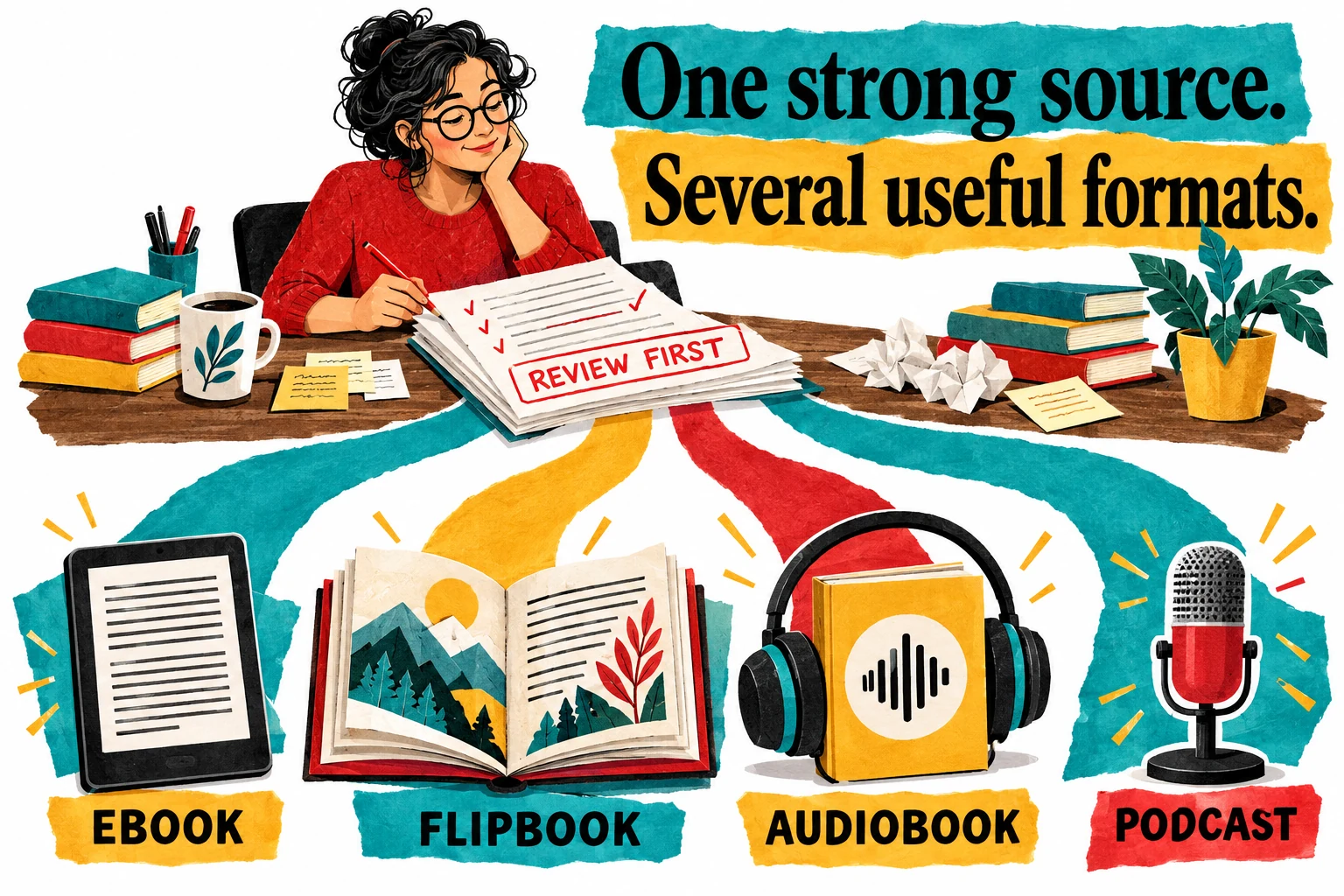
Our first illustration places a reviewed manuscript before the different outputs. That order matters. When a weak source is multiplied into several formats, its mistakes become harder to maintain and correct. Start with a small, coherent resource you would be comfortable putting your name on, then decide which additional format genuinely helps someone use it. Repurposing should increase usefulness, not merely increase the inventory count.

Sources: URL import and subsequent manuscript editing; Amazon KDP content rights, AI disclosure and reader-experience rules

An author checks an original manuscript before four paper paths lead to an ebook flipbook audiobook and podcast
Our suggested production order: establish a useful, reviewed source before multiplying formats. The illustration is conceptual, not a Syllabbles interface or measured result.

Outline the reader's decisions before generating chapters

Syllabbles' AI-writing guide describes both structured input and chat modes, with controls for audience, chapters, tone and intended length. Those inputs are useful when the author has already decided what the book is for. A requested word count alone is not an editorial brief. The better starting question is what the reader should understand or be able to do differently by the end.

For a hypothetical guide to preparing a small business newsletter, the chapters might follow actual decisions: whom to write for, what to include, how to review a draft and how to judge whether the message was useful. Each chapter should resolve a different uncertainty. Five chapters repeating that communication is important would satisfy a table of contents while leaving the reader exactly where they started.

Write a short purpose statement for every chapter and list the evidence, examples or exercises it needs. Identify where your own experience adds something specific. Then inspect the generated outline for repetition, missing prerequisites and unsupported promises before expanding it. This creates an editorial structure that can survive a change of model or template because the logic belongs to the project, not to the first draft.

When drafting, work in sections small enough to review meaningfully. Keep a list of terms and decisions that must remain consistent across chapters. Do not assume that a long generation remembers every qualification from the beginning. The tool can help assemble prose, but the author remains responsible for the argument, the sequence and the useful distinction between a complete explanation and a lengthy one.

Sources: Chapter planning, input mode and chat-based drafting

Brand Voice can guide expression, but it cannot supply expertise

The Brand Voice tutorial supports creating profiles from a link, a file or manually supplied material, then selecting a profile for a project. That can help make repeated output more consistent. The important input is a representative sample of writing you actually want to reproduce in spirit, not every document you happen to have in a folder. Old sales copy and a thoughtful teaching guide may model very different habits.

Select examples that show how you explain difficult ideas, use humor and qualify uncertainty. Remove private information before supplying the sample. A good voice profile should make the output easier for the intended reader to follow, not merely add familiar phrases. Repeating a signature expression in every chapter can turn a personal style into a catchphrase machine with a surprisingly persistent marketing department.

Separate stylistic consistency from factual authority. A paragraph can sound like an experienced professional while containing an unsupported claim. Do not use the feature to imply that an author personally performed a test or worked with a customer when that did not happen. The voice of expertise is not evidence of expertise, and a reader deserves to know which examples are real and which are hypothetical.

Evaluate the profile on a short passage with a clear purpose. Compare it with your own revision and note whether the result preserves your priorities, not just your sentence length. Keep different audience needs distinct: a client handout may need less personality than a public essay. The useful outcome is a recognizable, readable explanation that still allows you to disagree with the draft and edit it substantially.

Sources: Creating and selecting a Brand Voice profile

Humanize is a style operation, not a fact-checking department

The Humanize instructions describe selecting the feature and generating a more natural version of the text. That may improve rhythm or remove stiff phrasing, but it does not establish that a claim is true, original or properly sourced. Treat style review and evidence review as separate activities. A confident, conversational error is still an error; it has simply learned to make better eye contact.

For each important claim, identify what would support it. A quotation needs a real source, a numerical comparison needs a defined basis and a product recommendation needs relevant evidence. Remove invented anecdotes and unsupported certainty. Where the material offers an opinion or illustrative scenario, label it accordingly. Readers can handle nuance; they are less forgiving when a polished passage implies research that never happened.

KDP's stated distinction turns on how the content was created. AI-produced text, images or translations remain AI-generated even after substantial editing, while human-created material merely refined with AI is treated differently. A humanizing pass is therefore not a way to change the origin of a generated manuscript for disclosure purposes. Keep an honest record rather than trying to make the process invisible.

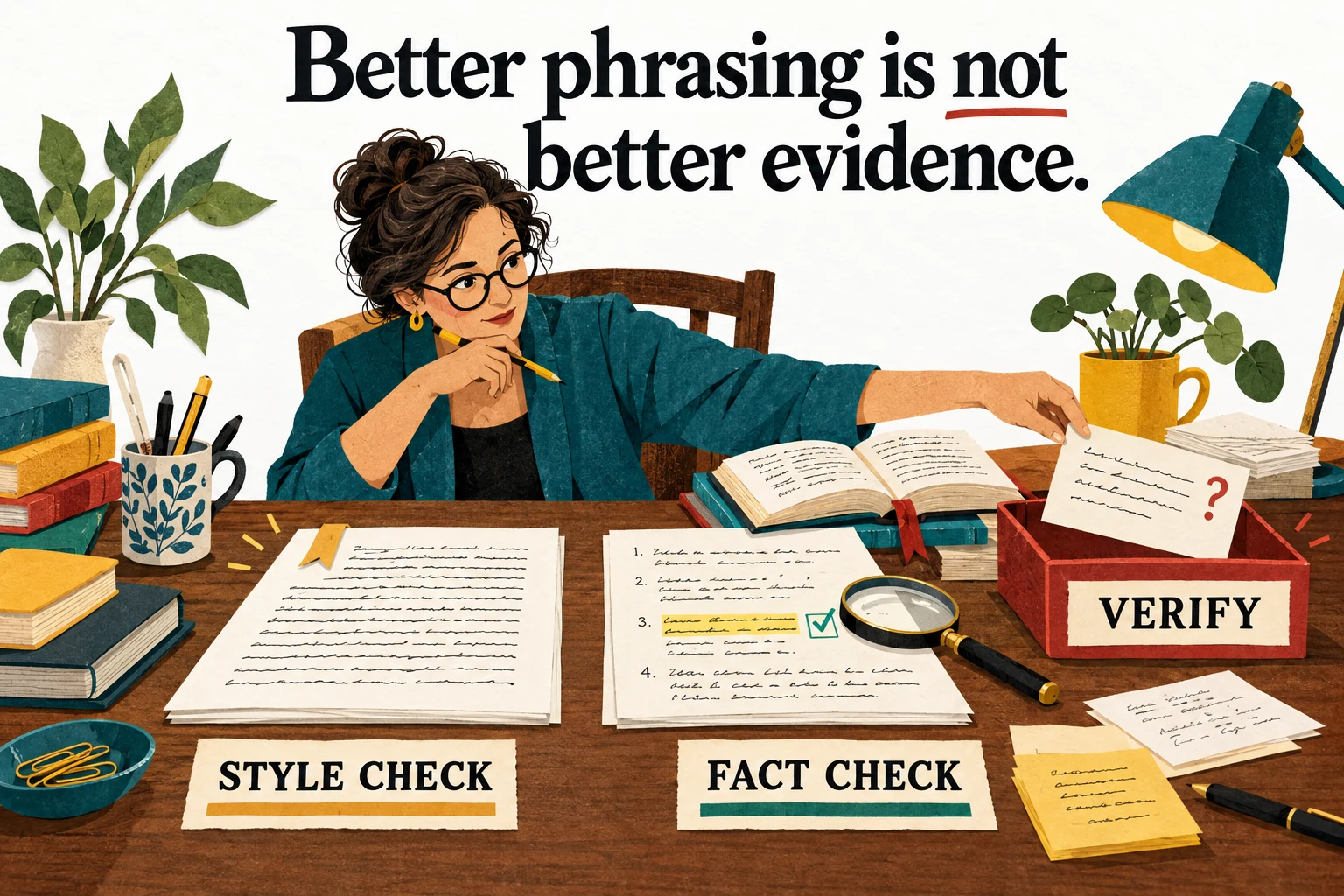
Our second illustration separates the attractive manuscript from the supported claim. That is the review habit worth keeping. Read first for substance, then for clarity, and finally for presentation. If the author cannot explain why a recommendation belongs in the book, another rewrite is unlikely to solve the problem. The remedy may be better research, a narrower scope or deleting the passage altogether.

Sources: Humanize feature instructions; Amazon KDP content rights, AI disclosure and reader-experience rules

An editor separates a polished manuscript from a reference-backed fact check and places an unresolved claim into a verification tray
Style and evidence are separate checks. A smoother sentence can still contain an unsupported claim.

Choose a template for the reading task, not just the cover preview

The template guide describes previewing layouts before applying them, and the ebook workflow allows further text, image and design adjustments in the editor. Use that flexibility to test real content early. A template with a striking opening spread can become awkward when a chapter contains a long heading, a table, a short quotation and an image caption. The attractive sample is only the beginning of the evaluation.

Build one representative chapter before styling an entire book. Include the longest heading you expect, a dense paragraph, a list and any recurring visual element. Inspect where page breaks occur and whether captions remain attached to the relevant image. If the layout needs repeated manual rescue, a simpler design may be the more professional choice. Readers rarely complain that a useful guide contains too few decorative flourishes.

Keep a small visual system: a consistent heading hierarchy, readable body type, restrained emphasis and predictable spacing. Reserve illustrations for things that are easier to understand visually. A screenshot, process diagram or annotated example should help the reader perform the task; an unrelated stock image mainly adds another page to scroll past. Explain any conceptual illustration so it cannot be mistaken for product evidence.

Test the cover at thumbnail size as well as full size. The title should remain understandable without a magnifying glass or prior knowledge of the topic. Check that the promise matches the actual contents. Design can make a strong resource easier to approach, but it should not inflate a modest guide into a claim of expertise or transformation the material does not deliver.

Sources: Previewing and choosing book templates; Ebook creation and editing workflow

Validate the exported ebook outside the editor

Syllabbles advertises PDF and EPUB outputs, but the exported file is what readers and retailers receive. KDP supports EPUB files that meet its publishing specifications and recommends validation in Kindle Previewer. The preview tool supports checks across device types, orientations and font sizes. That is a separate stage from looking at a pleasing layout inside the creation app.

Open the actual export and inspect the beginning, middle and end of every chapter. Check navigation, headings, links, images, punctuation and any special characters. Follow the table of contents rather than assuming it works because the labels appear correct. A link that looks like a chapter entry but does nothing is a small technical defect that becomes a repeated annoyance throughout the book.

Distinguish a fixed page design from a text flow intended to adapt to a reader's settings. A layout that works as a downloadable PDF may not behave the way you expect in an ebook reader. Ask for a representative export if the format is essential to your purchase. We did not inspect a Syllabbles-generated EPUB and cannot certify its structure, accessibility or device compatibility from the marketing description.

Keep the validated final file with a version label and the source used to create it. If you revise the manuscript later, repeat the relevant checks instead of assuming the earlier export proves the new one is sound. Publishing quality is not a badge earned once by the application. It is a property of the particular file, content and delivery route you are about to use.

Sources: Current direct pricing, export claims and product FAQ; KDP supported manuscript formats and EPUB validation recommendation; Kindle Previewer and device, orientation and font-size checks

A flipbook should make browsing easier, not turn reading into a performance

The flipbook guide describes converting a prepared project into a page-turning presentation. That can suit a portfolio, a visual catalog or a short showcase where the page design is part of the experience. It is less obviously valuable when the reader mainly wants to find a specific instruction quickly. Choose the format because it helps the task, not because a page-turn animation proves the software has been switched on.

Evaluate the published version on a small phone. Can the reader comfortably read the text, move to the right page and return to where they were? Does the presentation depend on precise gestures or a wide screen? These are questions to test, not problems established by this review. Keep a straightforward alternative when the visual presentation is less usable for a particular reader or device.

If you intend to place the resource on your own website, verify the actual embedding and hosting arrangement. The custom-domain help article currently contains only a coming-soon placeholder dated September 2025. That is insufficient evidence to confirm the feature's present availability or plan scope. Ask for a current demonstration rather than assuming either that it works or that the old article proves it cannot work.

Consider continuity as well as appearance. Know which links depend on an active account, what can be downloaded and how a revised edition replaces the old one. A beautiful resource becomes less useful when its address breaks or readers encounter two conflicting versions. The right presentation is one you can maintain and deliver reliably, not merely the one with the most convincing digital paper sound.

Sources: Flipbook creation and conversion workflow; Custom-domain help article currently containing only a future-feature placeholder

Narrate the approved manuscript, then listen to the whole result

The audiobook guide describes choosing a language, voice provider, model, emotion and speed, generating chapters and regenerating individual sections when needed. Chapter-level revision is potentially useful because a correction does not always require starting the whole project again. Still, the best time to fix a factual error or confusing sentence is before narration, when the source is easier to change and compare.

Prepare a pronunciation list for names, abbreviations and specialized terms. Decide how tables, links and visual references should be explained to someone who cannot see the page. A sentence that says as shown below may be perfectly understandable in an illustrated guide and useless in an audio edition. Repurposing requires adaptation to the listener's situation, not merely routing every visible word through a voice model.

Listen to an entire representative chapter before committing to a full title. Check pronunciation, pace, transitions, emphasis and whether numbers are spoken clearly. Then listen to the full final work, including credits and chapter boundaries. A pleasant twenty-second sample cannot reveal inconsistent volume, a repeated paragraph or a missing sentence halfway through the book. We did not perform that listening test for Syllabbles in this review.

Keep the approved manuscript version linked to the audio edition. When a text correction is made, identify which chapters need new audio and which distribution files must be replaced. A small change can otherwise leave the ebook and audiobook disagreeing about the same instruction. The benefit of a shared creation workspace is strongest when it supports that discipline, not when it encourages publishing every new rendering without a final listen.

Sources: Narration settings and chapter-level regeneration

An Audible-friendly file is not automatic ACX authorization

Syllabbles' export language references major audio marketplaces. ACX's current requirements, however, state that narration must be human unless otherwise authorized; unauthorized text-to-speech or AI recordings are not permitted. This is a material buying condition for anyone whose plan depends on that route to Audible. A file extension or preset does not establish that the chosen narration method is eligible for submission.

The same ACX page specifies chapter or section files, separate credits, consistent audio and technical requirements including at least 192 kbps constant-bit-rate MP3 at 44.1 kHz. It also defines loudness, peak and noise limits. Those are distinct from permission to use synthetic narration. Passing a technical analysis is not the same as receiving authorization, and authorization would not excuse a file that fails the technical checks.

Confirm the exact distribution route before generating a long book. Different services, programs or authorized arrangements may have different rules, so do not generalize one platform's position to every audio outlet. Ask the destination directly about the method and files you intend to submit. This review is not a claim that all AI narration is prohibited everywhere or that Syllabbles can never produce an acceptable audio product.

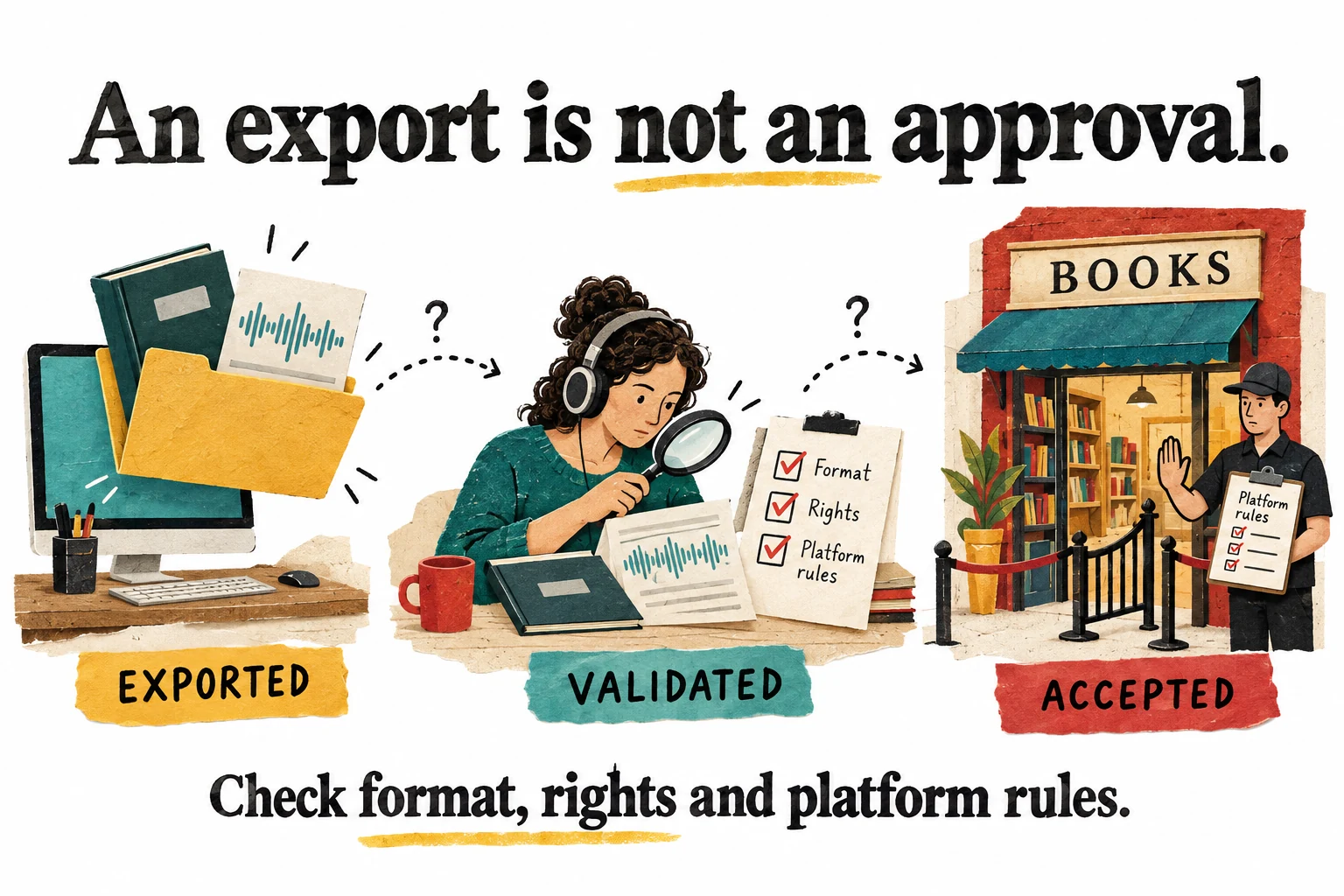
Our third illustration separates export, validation and acceptance. Keep those stages visible in your production plan and customer promises. If you offer a client an audiobook service, do not promise a particular store placement until the relevant eligibility and review conditions are established. The useful software feature is help preparing the material; the distribution decision belongs to the destination platform.

Sources: ACX narration eligibility and technical audio submission requirements; Current direct pricing, export claims and product FAQ

Exported book and audio files pass through an inspection desk before a separate bookstore admission gate checks platform rules
Exported, validated and accepted describe different stages. A compatible file extension does not guarantee distribution approval.

A synthetic podcast conversation should not invent real expertise

The podcast tutorial describes one to four speakers, script generation before audio, selectable voices and a downloadable script. That opens a useful possibility for presenting a topic as a structured discussion. It also creates an editorial responsibility: a natural-sounding exchange can imply that real people had the conversation, performed the research or possess qualifications that were never established.

Use clearly fictional or appropriately disclosed presenter roles when the dialogue is synthetic. Do not invent a named expert's endorsement, experience or interview. A conversational format can explain an idea without pretending that a real professional sat down in a studio and said those words. The script should make the underlying evidence easier to understand, not use a second voice to make an unsupported assertion sound corroborated.

Review the written script before generating audio. Give each speaker a useful role, such as asking the reader's likely question or explaining a concrete example. Remove repetitive agreement and empty transitions. Two voices saying that a topic is fascinating for several minutes do not create analysis; they create a meeting that could have been a paragraph. Keep the listener's question at the center of the episode.

Check the final audio and the distribution setup separately. An episode file is not by itself proof of a functioning feed, correct metadata or successful appearance in a listening app. We did not verify a live Syllabbles podcast feed or automatic distribution. If those steps are essential, require a current demonstration of the complete route and retain the script and audio outside the platform for continuity.

Sources: Podcast script, speakers, voice providers and output

Bring-your-own-key flexibility introduces another meter and another responsibility

Syllabbles supports connecting external AI-provider accounts, and its ElevenLabs help article shows the account-key integration step. The historical lower tiers also tied several advanced features to bring-your-own-key use. This flexibility can be valuable, but it should not be read as a promise of free provider usage or exemption from every platform limit. The account, allowance and service terms need to be understood together.

Before enabling a provider, identify which operation will use it and where its usage is billed. Ask whether the same action also consumes a Syllabbles creation, what happens on a retry and whether the interface makes the active provider obvious. These are unresolved operational questions rather than claims about a hidden charge. They are easiest to answer with a small controlled sample and the corresponding usage records.

Keep credentials out of manuscripts, public templates and support screenshots. Use the provider's available controls to limit exposure and monitor usage, and revoke an integration when it is no longer needed. Confirm how the application stores and uses the key before trusting it with a business-critical account. The convenience of switching voices or models should not turn a powerful credential into an overlooked publishing accessory.

Compare total production cost, including the software, external generation, editing and validation. A cheaper model may require more correction; a preferred voice may cost more but serve the audience better. There is no universal best choice established by a provider list. Select the combination that produces acceptable work at a sustainable cost, and keep enough information to explain why it was chosen.

Sources: Connecting a separate ElevenLabs account through its API key; Sold-out lifetime offer, historic tier prices and feature allowances; Lifetime buyer FAQ defining creations and monthly resets

Clarify the commercial-use wording before handling paid client work

The sales material says users own outputs and can sell them. The published terms, dated November 3, 2025, contain broad restrictions on revenue-generating use and a substantial license over defined Contributions, including commercial reuse, while also saying ownership is retained. That wording needs reconciliation for a product promoted for selling books. Ownership and the license granted to a service are different questions.

We are not concluding that the vendor takes ownership of every private manuscript or that every commercial export is prohibited. The scope of the defined content and the conflicting statements require clarification. Ask whether private manuscripts, imported client files and generated outputs fall within the Contributions license, and request explicit confirmation that your intended commercial service is permitted under the applicable agreement.

For client work, obtain the answer before uploading confidential material. A client may allow you to edit a manuscript without allowing a broad downstream license or publication of examples. Do not assume a marketing FAQ resolves that obligation. Where the stakes justify it, have the relevant agreement reviewed by a qualified professional. This review identifies a practical purchasing uncertainty, not a legal opinion on enforceability.

A clear written answer would materially improve the buying case. Until then, evaluate with non-sensitive material you control and avoid commitments that depend on an interpretation you cannot defend. Strong features and reasonable pricing can coexist with unclear documentation. The appropriate response is to resolve the uncertainty, not ignore it because the product makes the first draft unusually easy to generate.

Sources: Published terms, contribution license and commercial-use wording; Current direct pricing, export claims and product FAQ

Private projects need more than a reassuring label

The published privacy notice describes processing through third-party AI providers and broader service and marketing data uses. It does not establish a project-specific zero-retention arrangement for the manuscripts you might upload. The team-management help page, meanwhile, is a coming-soon placeholder rather than a usable explanation of roles or access. Neither observation proves a security incident; both limit what we can responsibly verify from public information.

For a solo project using public material, the unanswered questions may be manageable. For an agency handling unreleased books or client recordings, they matter more. Ask who can access a project, which providers receive its content, how deletion works and whether separate clients can be isolated appropriately. Require answers relevant to the actual feature rather than accepting a general statement that the platform is secure.

Do not share one login with several collaborators merely because a team feature has not been demonstrated. Establish an approved collaboration route and keep a record of who may edit or publish. If the product cannot support the controls your work requires, use it only for a narrower task or choose another workflow. A convenient editor should not become an accidental shared repository for information nobody agreed to place there.

Keep independent copies of approved manuscripts, cover assets, source records and final exports. Verify that those files open without the service before depending on them as a backup. Account continuity and content continuity are different things: being able to log in today does not guarantee that a future project can be reconstructed from a preview link. A modest export routine is more useful than discovering the difference during a deadline.

Sources: Published privacy notice and AI-provider processing; Team-member help article currently containing only a future-feature placeholder

Sell a useful answer before producing a large catalog

The commercial opportunity is not the number of files the software can create. It is the value of a particular resource to a particular reader. Start with one question you can answer well and one audience you can realistically reach. A guide that helps a customer complete a specific task can be worthwhile even when it is modest in scope and offered as a companion to an existing service.

For a lead magnet, define what happens after the download. Does the reader understand a problem better, prepare useful information or make a more informed purchase? Avoid treating a download count as evidence of revenue. The content should serve the person who requested it, not merely create a reason to collect an address. A smaller resource that is actually used can outperform a grand ebook that remains unopened.

For a paid product, ask representative readers to review a sample and explain what they found useful or missing. Separate polite encouragement from willingness to pay. Do not promise earnings based on production speed or the existence of a marketplace. Distribution, positioning, trust and support remain work even when the file is finished. The software cannot supply an audience simply by adding a second audio voice.

Add formats in response to a real use case. A spoken companion may help someone who listens while commuting; a printable checklist may suit a workshop; a visual flipbook may suit a portfolio. Each version should justify its maintenance cost. The best multi-format strategy is not everything everywhere immediately, but the few versions that make a strong piece of work more accessible and useful.

Sources: Ebook creation and editing workflow; Flipbook creation and conversion workflow; Podcast script, speakers, voice providers and output

Our verdict: useful consolidation, with questions to settle before scaling

Syllabbles receives 70 out of 100 in our editorial assessment: seventeen for problem fit, seventeen for capabilities, fifteen for workflow, nine for evidence and twelve for value, each out of twenty. The score is our reasoned judgment, not a donor review average. We see practical convenience in connecting formats, but the purchasing case is weakened by unclear terms, inconsistent plan copy and the absence of a verified end-to-end export test.

The right evaluation is one complete, representative mini-project. Prepare a chapter from material you control, edit its claims, apply a restrained layout, export it, inspect the reading experience and create a matching audio section if that matters to you. Record the time, corrections, allowance use and unresolved questions. Ask for a sample or demonstration when account access is not available; do not invent confidence from feature descriptions.

A positive result should demonstrate that the combined workflow saves useful effort while preserving your editorial standards. It should also establish the rights, account scope and distribution route required for your intended work. If the appeal rests mainly on a promise to produce many books quickly, we would pause. More output is not automatically more value, and more formats can multiply the work of correcting a weak source.

For existing license holders with appropriate material, Syllabbles may be worth using as a production workspace under a deliberate review process. For new buyers, resolve the commercial and plan questions first and evaluate the exact outputs you need. Keep the archived price in its historical context. A useful book still begins with a useful idea, and the most important publishing feature remains someone willing to read the final thing carefully.
Sources: Ebook creation and editing workflow; Narration settings and chapter-level regeneration; Published terms, contribution license and commercial-use wording; ACX narration eligibility and technical audio submission requirements

Frequently asked questions

Can I still buy the $69 lifetime offer shown in the archive?

The checked source listing is sold out. The archived price documents a historical offer, not a current checkout promise. Compare any new offer with its own written terms and account entitlements.

Does one creation mean one complete book business package?

No. Think in output actions rather than products for sale. A manuscript, conversion and audio edition can involve separate work, and you should confirm how revisions are counted in your account.

Can I upload any generated audiobook to ACX?

No. Check the destination's authorization and technical rules before producing a full title. A format preset does not establish that your chosen narration method is eligible for that particular distribution route.

Does Humanize remove the need to disclose AI-generated content to KDP?

No. Editing the style does not change who or what created the underlying content under KDP's stated distinction. Keep an honest production record and answer the platform's disclosure questions accordingly.

Is a public article or video automatically safe to turn into my own ebook?

Public availability is not the same as permission to republish. Establish the rights needed for the intended use and keep the supporting record rather than treating a successful import as authorization.

Should I create every available format immediately?

Only when each version serves a real reader need. A well-edited short guide can be more useful than several hurried derivatives, and every extra format adds its own review and maintenance work.

Current alternatives to Syllabbles

Content & Writing

Keyshift AI

Keyshift AI addresses the inefficiency of switching between applications and AI tools for text refinement. It allows Windows and Mac users to rewrite, translate, or summarize text directly within any app using keyboard shortcuts or voice input. This streamlines content creation and communication for individuals and teams who frequently work with text across various platforms, enhancing productivity without leaving their current workflow.

$19 · checked Nov 5, 2026

Content & Writing

Aivolut Books

The product addresses the challenge of maintaining consistency and structure when writing long-form content with AI. It provides a guided workflow to turn ideas or source material into structured drafts, covers, and metadata. This tool is suitable for individuals and small teams focused on efficient content creation and publishing, aiming to streamline the book production process.

$59 · checked Nov 11, 2026

Content & Writing

Vocable AI

Vocable AI generates 30 days of multichannel content plans using AI. It streamlines content creation and distribution for various platforms. The product is designed for teams that need a repeatable content & writing process and want clearer control over the core task. It fits best when the buyer has a defined use case, realistic input data, and a way to judge output quality before rolling it out across a wider workflow.

$89 · checked Sep 21, 2026

Content & Writing

AudioHero

A useful candidate for solo video and podcast creators who regularly need music and effects together. Audition it against a real brief, confirm the license and account terms, and keep evidence with each project. Royalty-free does not mean claim-proof.

$105 · checked Oct 28, 2026

Deal alerts

Get content & writing deal alerts by email.

SoftScout will send short buying notes when offers like Syllabbles look worth checking or worth skipping.

Short buyer verdicts

Useful offers before checkout

Editorial note

Our 70/100 score recognizes the production convenience while deducting for unresolved commercial wording, inconsistent plan messaging and unverified export quality. Treat marketplace presets as preparation, not acceptance, and resolve rights and account scope before using confidential client manuscripts.

For vendors

Have a better deal for Syllabbles?

Send current partner terms, coupon limits, refund rules, and the best buyer fit. We review offers before adding them to SoftScout pages or Telegram alerts.

Submit terms